

On this page
If someone in your family has ever said that a childless couple's "problem" must be the wife's, the science says otherwise. NCERT, ICMR and the WHO all describe infertility as something that can start in either partner's body.
Is infertility only a problem in women?
No. The WHO defines infertility as "a disease of the male or female reproductive system defined by the failure to achieve a pregnancy after 12 months or more of regular unprotected sexual intercourse" (WHO infertility fact sheet). The same fact sheet estimates that about one in six people of reproductive age worldwide experience infertility in their lifetime.
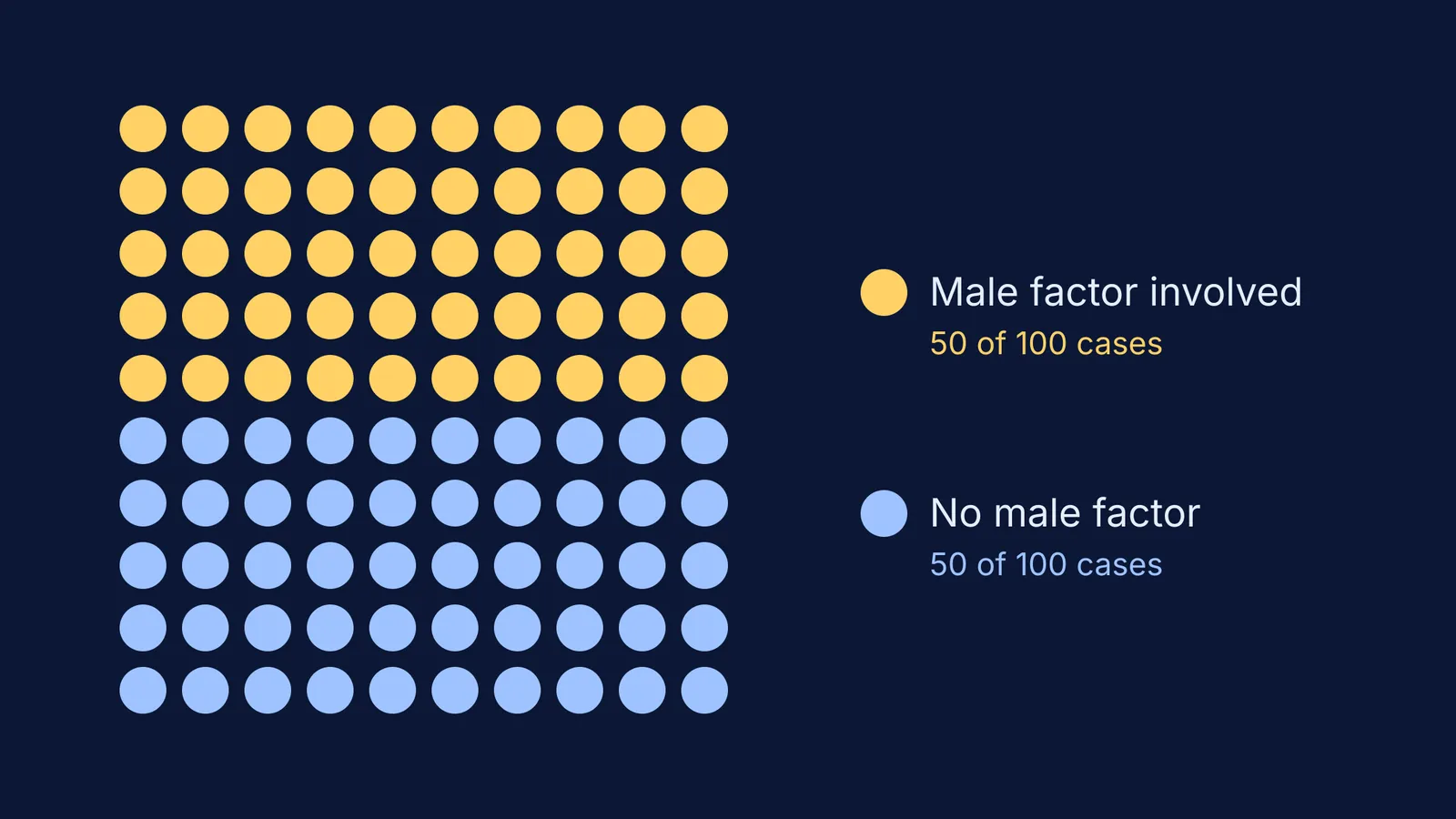
The ICMR Standard Treatment Workflow for male infertility, issued in October 2019 with the Department of Health Research, puts the incidence of infertility at 10-15% and says a male factor is contributory in 50% of cases. "Contributory" means the man's side is part of the picture, sometimes alongside a female factor; it does not mean the other half are all the woman's.
What does NCERT say about infertility?
Section 3.5 of the Reproductive Health chapter in NCERT Class 12 Biology says the reasons for infertility "could be many–physical, congenital, diseases, drugs, immunological or even psychological." It then says plainly: "In India, often the female is blamed for the couple being childless, but more often than not, the problem lies in the male partner."
The chapter's exercises test this exact myth. Question 11(b) asks you to mark as true or false the claim that infertility "is always due to abnormalities/defects in the female partner." The answer is false, and the sentence above is your explanation.
What causes infertility in men?
The WHO fact sheet and the ICMR male infertility workflow list these causes on the male side:
A blocked reproductive tract that stops semen being ejected
Hormone problems in the hypothalamus, pituitary gland or testes
Testicular failure, including from varicocele (enlarged veins around the testis) or treatments such as chemotherapy that damage sperm-producing cells
No sperm (azoospermia), too few sperm, or sperm with abnormal shape or poor movement
Undescended testes, genital tract infection, and genetic or chromosomal causes
Exposure to chronic heat, tobacco, alcohol, some medicines and chemicals such as pesticides and heavy metals
To see where sperm and semen come from, our explainer on what each male accessory gland adds to semen covers the anatomy NCERT tests.
What causes infertility in women?
The WHO fact sheet lists four groups on the female side:
Tubal disorders: blocked fallopian tubes, often after untreated sexually transmitted infections, unsafe abortion, infection after childbirth, or pelvic surgery
Uterine disorders such as endometriosis, fibroids or a septate uterus
Ovarian disorders such as polycystic ovarian syndrome (PCOS)
Hormone imbalances involving the hypothalamus and pituitary gland
WHO adds that smoking, excessive alcohol, obesity and environmental pollutants can affect fertility, and that toxins can harm both eggs and sperm. NCERT's section on sexually transmitted infections also lists infertility among the complications when infections are not treated in time.
Why should both partners be tested together?
The ICMR workflow says both partners should be examined simultaneously, and warns that male factor "is an under recognised problem." It notes that the man is often evaluated only after the woman, which delays treatment, and the longer infertility lasts, the lower the chance of success. Its first steps for the man, at a primary or community health centre, are a history, a physical examination and a semen analysis.
When treatment is needed, NCERT describes assisted reproductive technologies; our guide to how IVF, ZIFT, GIFT and ICSI differ shows where fertilisation happens in each. NCERT also notes that legal adoption is an option for couples looking for parenthood.
What can you say when someone blames the woman?
A short script for a family gathering:
State the fact briefly: "Actually, our Biology textbook says infertility can come from either partner, and ICMR says the man's side contributes in about half of cases."
Point to the source: "It's in NCERT Class 12, the reproductive health chapter. There's even a true-or-false question on it."
Move to what helps: "Doctors check both partners together, so nobody loses time."
Step back if it turns personal: "It's their health and their decision. Let's leave it to them and their doctor."
If terms like varicocele, azoospermia and ovarian disorder blur together, the Fermi Concept Library covers every concept in biology, each with its own lesson and its place in the map. For the rest of the chapter's vocabulary, see our list of reproductive health Class 12 key terms.
The WHO fact sheet notes that women are often perceived to be infertile whether or not they are, and frequently face stigma and emotional stress. Medical questions belong with a qualified doctor. For emotional strain, Tele MANAS, the government's toll-free mental health helpline, is on 14416 (PIB, Ministry of Health and Family Welfare).


