On this page
Semen is not just sperm. Most of what leaves the body comes from three sets of glands that the sperm only meet near the end of their journey. If you are revising Human Reproduction for your CBSE boards or NEET-UG, you need to know which gland adds what, and the order of the ducts. Both are classic one-mark questions, and both are easy to mix up.
What are the male accessory glands?
The NCERT Class 12 Biology chapter on Human Reproduction lists the male accessory glands as paired seminal vesicles, a single prostate and paired bulbourethral glands. The same chapter says their secretions make up the seminal plasma, which is rich in fructose, calcium and certain enzymes. It also says the bulbourethral secretions help lubricate the penis.
Notice the counting: two seminal vesicles, one prostate, two bulbourethral glands. "The prostate is paired" is a common wrong option.
What does each gland add to semen?
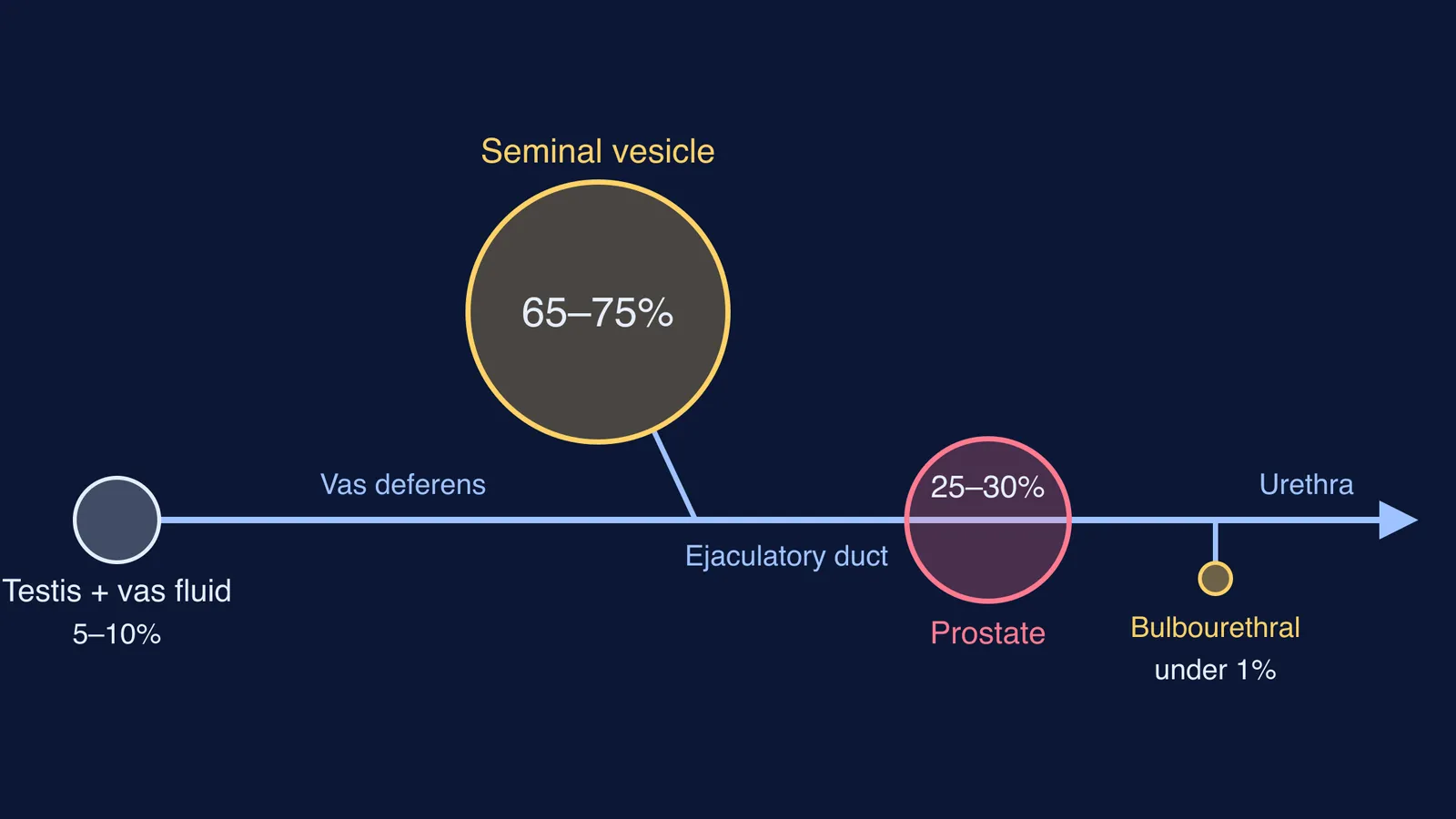
NCERT stops at "fructose, calcium and certain enzymes". For a fuller picture, a 2026 review in the Journal of Reproduction and Development by Njoroge Enoc Wambugu and colleagues at Hiroshima University sets out where human seminal plasma comes from. Its table gives these shares of volume for humans, which the authors describe as widely cited figures:
Seminal vesicles: about 65–75%. The review says this fluid is enriched with fructose, a major energy source for sperm movement, along with prostaglandins and proteins called semenogelins. Semenogelins make semen clot briefly after ejaculation, which helps hold the sperm in place.
Prostate: about 25–30%. The review describes prostatic fluid as high in citrate (around 20 mM) and notes that the prostate holds the highest zinc concentration in the body. The fluid also carries enzymes, including prostate-specific antigen (PSA), that break down the clot so the motile sperm are released.
Fluid from the vas deferens: about 5–10%. This is the stream that carries the sperm themselves.
Bulbourethral glands: less than 1%. A tiny volume, but it is their lubricating role that NCERT highlights.
The same table adds that other measurement methods give a different split, such as about 55–61% from the seminal vesicles and 37–44% from the prostate, so treat all these numbers as approximate. Either way, the bulk of semen is gland fluid, and the seminal vesicles are the biggest contributor. If a question asks for the source of fructose, the answer is the seminal vesicles, not the prostate.
What is the path sperm take from testis to urethra?
NCERT gives the male accessory ducts as the rete testis, vasa efferentia, epididymis and vas deferens, and it describes the route in the same chapter. In order:
Seminiferous tubules in the testis, where sperm are made.
Rete testis, through which the tubules open into the vasa efferentia.
Vasa efferentia, which leave the testis.
Epididymis, along the back surface of each testis.
Vas deferens, which rises into the abdomen and loops over the urinary bladder.
Ejaculatory duct, formed where the vas deferens receives a duct from the seminal vesicle.
Urethra, which starts at the bladder, runs through the penis and opens at the urethral meatus.
The one junction to remember is step 6. The seminal vesicle duct is the only gland duct NCERT names in this route, and it joins before the ejaculatory duct. In NCERT Figure 2.1, the prostate and bulbourethral glands sit further along, around the urethra.
Two look-alike names are easy to swap: vasa efferentia (plural, the small ducts leaving the testis) and vas deferens (one per side, the long tube). The order is efferentia first, deferens later. "E" for exit, "D" for distance.
How do you check you have really learnt it?
Cover the lists above and answer these aloud. If you hesitate on any, go back to that line.
Name the three accessory glands and say which one is unpaired.
Which gland gives the largest share of semen volume, and roughly how much?
Which gland supplies fructose, and why do sperm need it?
What does PSA do?
Which gland's secretion does NCERT link to lubrication?
Put these in order: epididymis, rete testis, vas deferens, vasa efferentia, ejaculatory duct.
Where does the seminal vesicle duct join the pathway?
Then draw it. Sketch the testis on the left and the urethra on the right, and add the glands where they sit along the route. Label each gland with its rough share. If your drawing matches NCERT Figure 2.1, you know the chapter better than a list can tell you.
If one idea keeps slipping, such as the difference between seminal plasma and semen, the Fermi Concept Library gives every biology concept its own lesson and shows where it sits in the map. If you get stuck tracing the ducts, Fermi's AI tutor can draw the figure and check your understanding as it goes.
This post is for exam study. If you have a question about your own health, talk to a doctor.
Next step: do the seven questions above tonight, then again a few days later, without looking.