

On this page
Every monsoon, ponds and flooded fields across India fill with frogs the colour of a highlighter pen. These are male Indian bullfrogs, and the yellow is a breeding colour that lasts only for the short, crowded mating season.
Why does the Indian bullfrog turn yellow in the monsoon?
The Indian bullfrog (*Hoplobatrachus tigerinus*) is a large frog native to the Indian subcontinent, reaching up to 160 mm from snout to vent, according to a Stellenbosch University PhD thesis on the species. For most of the year it is green or brown with dark spots, according to its Wikipedia entry. At the start of the mating season, males turn bright yellow and show vibrant blue vocal sacs, says the Animal Diversity Web species account, which notes that almost all breeding happens around the monsoons.
The timing comes from how the frog breeds. The same thesis describes it as an explosive breeder in short-lived pools in waterlogged fields. At the study site in the Andaman Islands, where the frog was introduced, breeding began on the night of 12 May 2017, after heavy rain. One clutch can hold up to 5,750 eggs, the thesis reports, citing earlier work.
Explosive breeding means many males crowd into a pool for a short window. A 2017 review in the Journal of Evolutionary Biology compiled 178 frog species that change colour temporarily for breeding. The authors note that many are explosive breeders in which males physically compete for females, and name the Asian bullfrog as one example. In tree frogs, their analysis suggests that large breeding crowds evolved first and the colour change followed.
How do hormones turn a frog yellow?
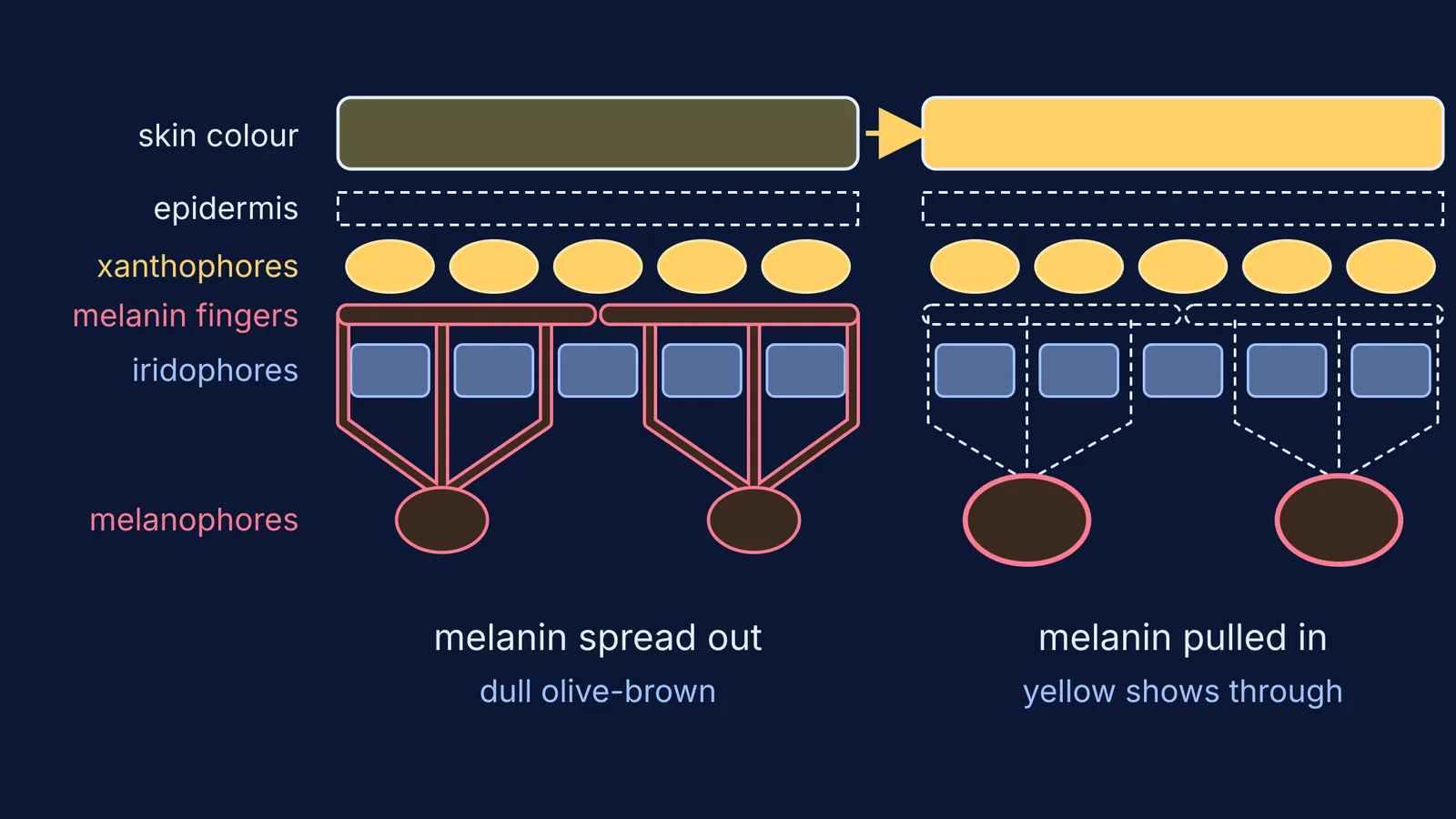
The colour lives in three layers of skin cells. A classic 1968 paper on the dermal chromatophore unit describes yellow xanthophores on top, light-reflecting iridophores below them, and dark melanophores at the bottom. Finger-like branches of the melanophores reach up between the yellow and reflective layers. When melanin moves up into those fingers, it hides the reflective layer and the skin darkens; when the melanin drains back out, the pale colour of the top two layers shows.
Hormones move that melanin. In a 2014 study of Australian stony creek frogs, Christina Kindermann and colleagues found that males turned vivid yellow within 5 minutes of clasping a female and stayed yellow for 3 to 5 hours. Injecting adrenaline (epinephrine) turned brown males yellow within 5 minutes; injecting testosterone caused no rapid change. The authors suggest the yellow comes from xanthophores revealed when melanin gathers in the melanophores. The same paper notes that in another frog, *Buergeria robusta*, testosterone injections increased yellow breeding colour.
So frogs seem to have two controls: sex hormones that build breeding colour over a season, and fast hormones such as adrenaline that flip it in minutes.
How do female bullfrogs choose a mate in a temporary pond?
The Animal Diversity Web account says the males' bright colours play a role in mate selection by females. Males sit close together in shallow water while females gather nearby, and neighbouring males often climb onto a mating pair to break it up, which usually leads to fights. Males also call loudly from the water; our post on why frogs croak so much in the rainy season explains those calls.
Experiments on other explosive breeders suggest bright colour may matter as much to rival males as to females. In moor frogs, males spent more time in contact and in amplexus with a brown model frog than with a blue, male-coloured one. Mated and unmated males did not differ in colour, so the authors judged female choice by colour unlikely. In a Costa Rican yellow toad, unpaired males were more colourful than males already holding a female, and males seem to fade from lemon yellow to dull brown soon after pairing.
That is a different story from the peacock's tail, a classic case of female choice. In a dark, packed pond, yellow may signal "I am a male, don't grab me" as much as "choose me".
How do you write this as an exam answer?
Separate the trigger, the mechanism and the purpose. Here is a five-step plan, worked for the bullfrog:
Trigger: monsoon rain fills temporary pools and breeding begins.
Signal: hormones act on the skin; adrenaline switches colour fast in at least one frog, and sex hormones can build breeding colour.
Cell: melanophores pull their melanin back from the fingers, so the yellow xanthophores show.
Function: in a crowded pond, colour may help males recognise each other and may help females choose males.
Evidence check: say which parts were measured in this species and which come from other frogs.
If the skin-cell layers or the hormone pathway still feel shaky, the Fermi Concept Library gives every biology concept its own lesson and shows where it sits in the map. To test your five-step answer, Fermi's AI tutor decides whether to explain, ask or show, and checks your understanding as it goes.
For a colour switch far faster than any frog's, read how cuttlefish change colour in a fraction of a second.


