

On this page
It is easy to write "internal respiration" when a question wants "cellular respiration", or the other way round. They sit side by side, so they blur, but one is physics (gas diffusing down a gradient) and the other is chemistry (enzymes oxidising food).
What are the five steps of respiration in NCERT?
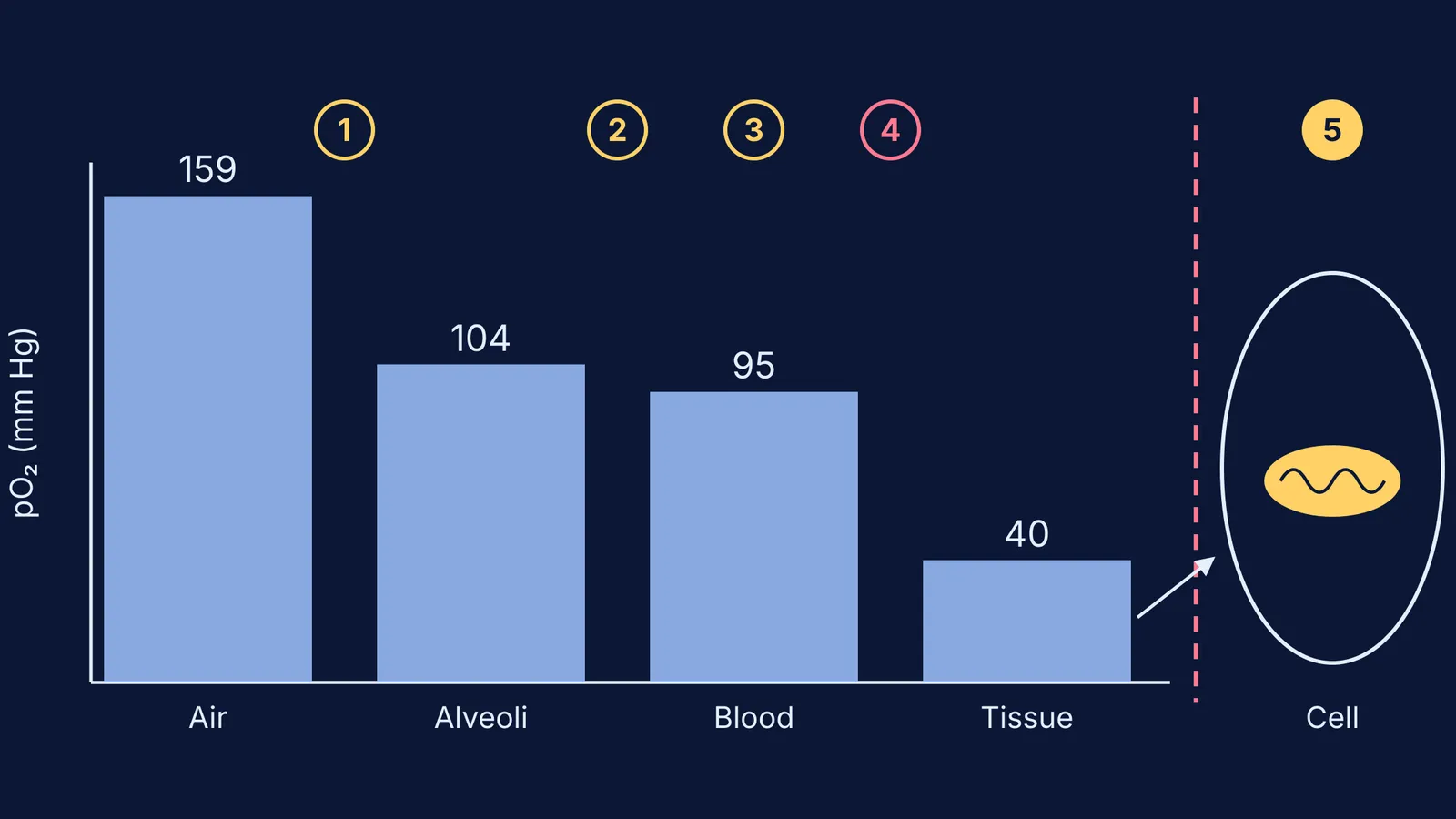
The NCERT Class 11 Biology chapter Breathing and Exchange of Gases (Chapter 14, section 14.1) lists five steps:
Breathing or pulmonary ventilation: atmospheric air is drawn in and CO₂-rich alveolar air is released.
Diffusion of O₂ and CO₂ across the alveolar membrane.
Transport of gases by the blood.
Diffusion of O₂ and CO₂ between blood and tissues.
Utilisation of O₂ by the cells for catabolic reactions and the resulting release of CO₂, which NCERT calls cellular respiration and covers in Chapter 12.
NCERT's list of steps does not use the words "external" and "internal" respiration; those terms are standard in physiology textbooks. OpenStax Anatomy and Physiology defines external respiration as the exchange of gases with the external environment, occurring in the alveoli of the lungs. The same source defines internal respiration as gas exchange that occurs at the level of body tissues. So external respiration is NCERT's step 2, and internal respiration is step 4.
Where does internal respiration end and cellular respiration begin?
The boundary is the moment an oxygen molecule stops moving and starts reacting.
In step 4, no food is broken down and no ATP is made. Oxygen diffuses from blood into tissue because its partial pressure is higher in the blood. NCERT's Table 14.1 gives a pO₂ of 95 mm Hg in oxygenated blood and 40 mm Hg in tissues. The same table gives a pCO₂ of 45 mm Hg in tissues and 40 mm Hg in oxygenated blood, so CO₂ moves the other way. Every value is in our partial pressure table for alveoli, blood and tissues.
Step 5 is chemistry. The NCERT chapter Respiration in Plants describes cellular respiration as the breakdown of food materials within the cell to release energy, which is trapped to make ATP. That chapter says this breakdown takes place in the cytoplasm and the mitochondria. It also says the role of oxygen is limited to the terminal stage of the process, where it acts as the final hydrogen acceptor. Our post on why oxygen is the final electron acceptor walks through that last stage.
They get merged because they are linked. OpenStax explains that tissue pO₂ stays low, about 40 mm Hg, because oxygen is continuously used for cellular respiration. Step 5 keeps step 4's gradient going, but linked is not identical.
How do you tell them apart in one minute?
Ask three questions about any process in the chapter.
Where does it happen? Internal respiration: between capillary blood and the tissues around it. Cellular respiration: inside the cell, in the cytoplasm and mitochondria.
How does it happen? Internal respiration: simple diffusion down a partial pressure gradient. Cellular respiration: a series of enzyme-controlled reactions.
What comes out? Internal respiration: no ATP; O₂ and CO₂ only change place. Cellular respiration: ATP, CO₂ and water.
For a 2-mark answer, this pattern works: "Internal respiration is the exchange of O₂ and CO₂ by diffusion between blood and tissues (step 4). Cellular respiration is the oxidation of food inside cells to release energy as ATP, using O₂ and releasing CO₂ (step 5)." For the wider difference between breathing and the chemistry, read breathing vs cellular respiration.
Can you spot the mistake? A quick quiz
Each statement has one error. Find it before reading the fix.
"Internal respiration produces ATP in the tissues." Fix: step 4 is diffusion only; ATP is made in step 5.
"External respiration is the same as breathing." Fix: breathing (step 1) moves air in and out; external respiration (step 2) is diffusion across the alveolar membrane.
"In internal respiration, O₂ moves from tissues into blood." Fix: it is the reverse. O₂ moves from blood (95 mm Hg) to tissues (40 mm Hg), and CO₂ moves from tissues (45 mm Hg) to blood (40 mm Hg), per NCERT Table 14.1.
"Oxygen is used at every stage of cellular respiration." Fix: NCERT says oxygen's role is limited to the terminal stage, as the final hydrogen acceptor.
"Cellular respiration takes place in the alveoli." Fix: the alveoli are the site of step 2; step 5 happens inside cells, in the cytoplasm and mitochondria.
If you missed two or more, the gap is in the map rather than the facts. The Fermi Concept Library gives every biology concept its own lesson and its place in the map, so you can look up gas exchange and cellular respiration and see where each one sits. When you are ready for exam-style questions, the Fermi Problem Library has worked problems with a step-by-step solver that explains the reasoning rather than printing an answer.
Next step: write the five steps from memory, mark the line between step 4 and step 5, and check yourself against NCERT section 14.1.


