

On this page
Oxygen is the final electron acceptor in the electron transport chain (ETC). It sits at the very end of the line inside your inner mitochondrial membrane, waiting to catch the "spent" electrons that have just powered the pumping of protons. Historically, scientists like J. S. Haldane studied respiration to understand how gases move through the blood to reach these waiting mitochondria, a process that is fundamental to all aerobic life.
When we study cellular respiration, the role of oxygen is often reduced to a single line in a textbook. But understanding why oxygen is uniquely suited for this job explains the entire mechanism of oxidative phosphorylation.
Why is oxygen the final electron acceptor?
The answer comes down to reduction potential and the "pull" of electrons. Oxygen has a powerful "hunger" for electrons, a property known in chemistry as high electronegativity.
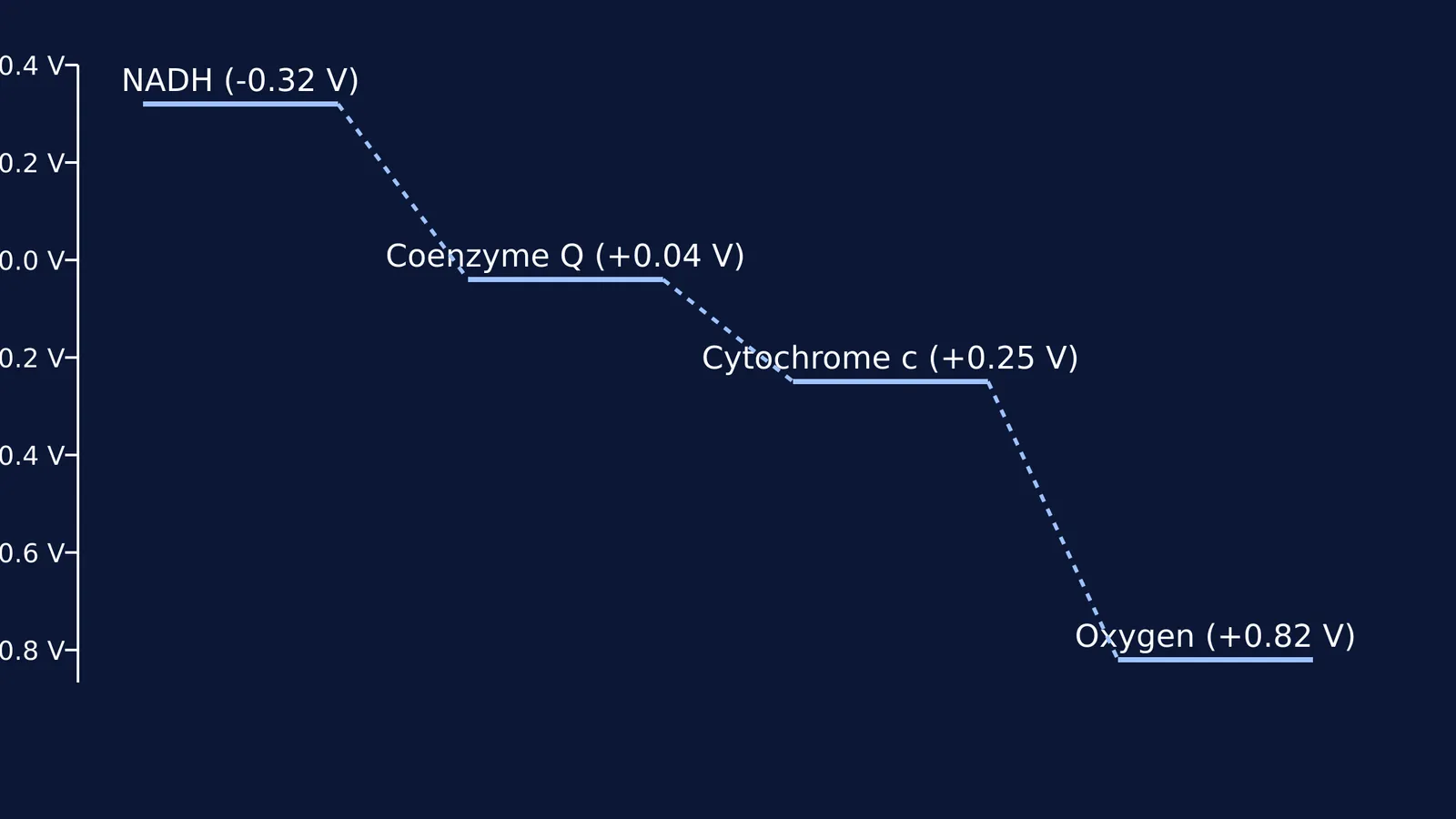
The electron transport chain works much like a staircase. While glucose is the classic starting point in textbooks, respiration acts as an amphibolic pathway where fats and proteins can also enter to produce the electron carrier NADH. Electrons are dropped off at the top of the chain by NADH, which has a low, negative reduction potential, meaning it gives up electrons easily (OpenStax Biology).
As these electrons fall down the stairs through a series of protein complexes—passing from Complex I to Coenzyme Q, then to Cytochrome c, and finally to Complex IV—they lose free energy at each step. Oxygen sits at the very bottom of this staircase. Because it pulls so hard on those electrons (it has a strongly positive reduction potential of +0.82 V), it ensures the electrons keep moving downward in one direction rather than getting stuck in the middle of the chain.
This massive potential difference between NADH at the top and oxygen at the bottom releases the energy that the protein complexes need to actively pump 10 protons (H⁺) per NADH molecule across the inner mitochondrial membrane (StatPearls). This builds the gradient that ultimately drives ATP synthase to produce 2.5 ATP per NADH.
What happens to the electron transport chain without oxygen?
If you hold your breath, or if a cell becomes deprived of oxygen during intense exercise, the entire aerobic energy system comes to a grinding halt.
Without oxygen to act as the final electron sink, the last protein in the chain (Complex IV, or cytochrome c oxidase) has nowhere to hand off its electrons. Because it cannot pass them on, it stays "full" or reduced. This causes a traffic jam that backs up all the way through the preceding complexes. Because the entire chain is backed up, NADH cannot donate its newly arriving electrons to Complex I.
When NADH cannot drop off its electrons, it cannot turn back into its oxidised form, NAD⁺. The cell quickly runs out of NAD⁺. Without a fresh supply of NAD⁺, both the link reaction (pyruvate oxidation) and the Krebs cycle shut down completely. This forces the cell to rely on anaerobic pathways—like lactic acid fermentation in human muscles—to regenerate enough NAD⁺ just to keep glycolysis running, or else face cellular death from a lack of ATP.
How to solve ETC blocker questions?
Exam boards often test this exact concept by asking what happens when a specific toxin blocks a part of the chain, or when a cell becomes hypoxic. For instance, cyanide binds permanently to Complex IV, simulating a lack of oxygen. Instead of memorising the outcome for each individual toxin or scenario, you can use this three-step framework to reason through any ETC blockage:
What builds up? Everything before the block stays reduced (full of electrons). If oxygen is absent, or if Complex IV is blocked by cyanide, the carriers before it cannot unload. Consequently, NADH builds up in the mitochondrial matrix.
What runs out? Everything after the block stays oxidised (empty). The pumping of protons stops, the proton motive force flattens out, and ATP production drops to zero.
What downstream paths stop? Always look for the missing recycled product. If the ETC stops, NAD⁺ runs out. Because the Krebs cycle requires NAD⁺ to function, it immediately grinds to a halt.
If you struggle to piece together what happens when a biological cycle gets interrupted, the Fermi Concept Library maps out these dependencies so you can see how one pathway relies on another. For exam-style practice on respiratory pathways and metabolic blocks, the Fermi Problem Library has worked problems with a step-by-step solver that explains the reasoning rather than printing an answer.


