On this page
If you have ever written "breathing is respiration" and lost a mark, the mix-up is understandable. The NCERT Class 11 chapter Breathing and Exchange of Gases itself says gas exchange is called breathing, "commonly known as respiration". In a biology answer, though, the two words name different processes.
What is the difference between breathing and cellular respiration?
Breathing is a physical process: air moves in and out of the lungs.
NCERT describes breathing, or pulmonary ventilation, as the step by which atmospheric air is drawn in and carbon dioxide-rich alveolar air is released (NCERT Class 11 Biology, Chapter 14). The diaphragm and intercostal muscles change the volume of the chest, so pressure in the lungs falls below or rises above atmospheric pressure and air flows.
Cellular respiration is a chemical process: food is oxidised inside cells to release energy.
The NCERT chapter Respiration in Plants defines respiration as the breaking of C-C bonds of complex compounds through oxidation within cells, releasing a considerable amount of energy. That energy is released in enzyme-controlled steps and stored as ATP, the energy currency of the cell.
Breathing vs respiration: a side-by-side comparison
Each line compares both processes on the same point, which is how a difference answer should be built. The respiration facts come from the two NCERT chapters linked above.
Nature: breathing is a physical movement of air; respiration is a chemical reaction.
Where: breathing happens in the airways and lungs; respiration happens inside living cells, in the cytoplasm (glycolysis) and, in eukaryotic cells, the mitochondria (Krebs cycle and electron transport).
Enzymes: breathing needs none; respiration is a chain of enzyme-controlled steps.
Energy: breathing uses energy, because muscles do the work; respiration releases energy as ATP.
What changes: breathing only swaps gases; respiration turns glucose and oxygen into carbon dioxide, water and energy.
Who does it: breathing is done by animals, through lungs, gills, tracheae or moist skin; respiration happens in plants, animals and microbes alike.
How are breathing and cellular respiration connected?
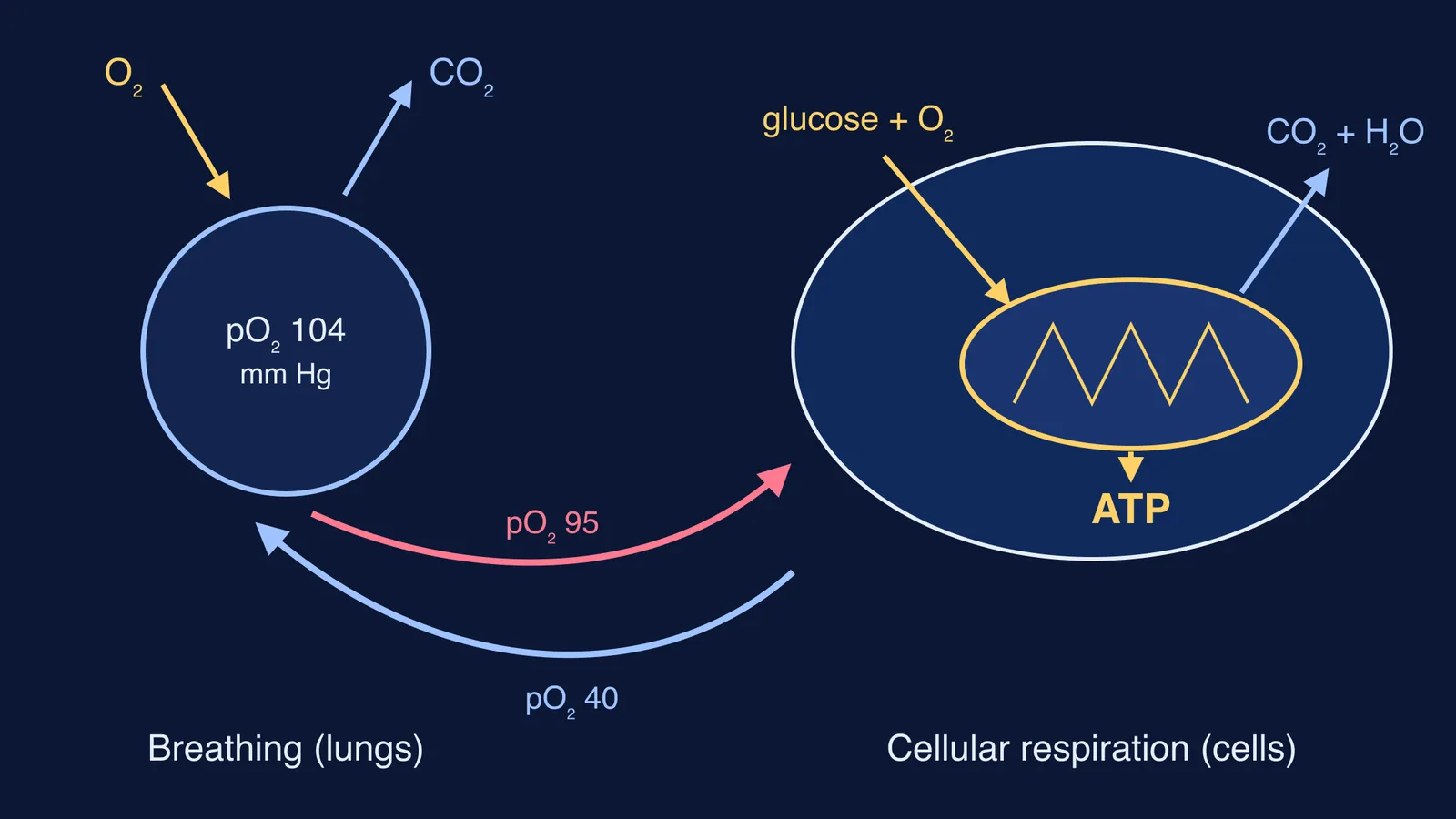
They are two ends of one chain. NCERT Chapter 14 lists five steps of respiration in the broad sense: breathing, diffusion across the alveolar membrane, transport by blood, diffusion between blood and tissues, and finally the use of oxygen by cells. Breathing is step one; cellular respiration is step five.
The same chapter gives the scale of step one: a healthy human breathes 12-16 times a minute, moving about 500 mL of air per normal breath. Oxygen then moves down a pressure gradient, from 104 mm Hg in the alveoli to 40 mm Hg in the tissues. Our explainer on the layers of the alveolar diffusion membrane shows how thin that barrier is.
Inside the cell, the overall reaction is C6H12O6 + 6O2 → 6CO2 + 6H2O + energy (NCERT Chapter 12). NCERT gives a net gain of 38 ATP per glucose in aerobic respiration, but calls the calculation a theoretical exercise; our post on why the aerobic respiration ATP count is 38 explains the assumptions. Fermentation, without oxygen, gives a net gain of only 2 ATP per glucose.
Do plants breathe or respire?
Plants respire but do not breathe the way you do. NCERT Chapter 12 explains that plants use oxygen for respiration and give out carbon dioxide, but have no specialised organs for gas exchange; gases diffuse through stomata and lenticels instead. Quote this if a question asks you to show the processes are different: respiration can happen without breathing.
How do you write the difference in an exam?
A worked answer to "Distinguish between breathing and respiration (3 marks)":
Breathing is a physical process of taking in air and giving out carbon dioxide-rich air; respiration is a chemical process in which food is oxidised to release energy.
Breathing takes place in the lungs; respiration takes place in living cells, in the cytoplasm and mitochondria.
Breathing involves no enzymes; respiration is controlled by enzymes.
Breathing uses energy; respiration releases energy, stored as ATP.
Before you hand it in, check:
Every point compares both processes on the same basis.
You wrote "cells" or "mitochondria" for respiration.
You did not say breathing produces energy.
For more questions in this format, see our guide to answering CBSE biology difference questions.
If glycolysis, the Krebs cycle and ATP still feel disconnected, the Fermi Concept Library gives every biology concept its own lesson and its place in the map. To test yourself, the Fermi Problem Library has worked problems with a step-by-step solver that explains the reasoning rather than printing an answer.