

On this page
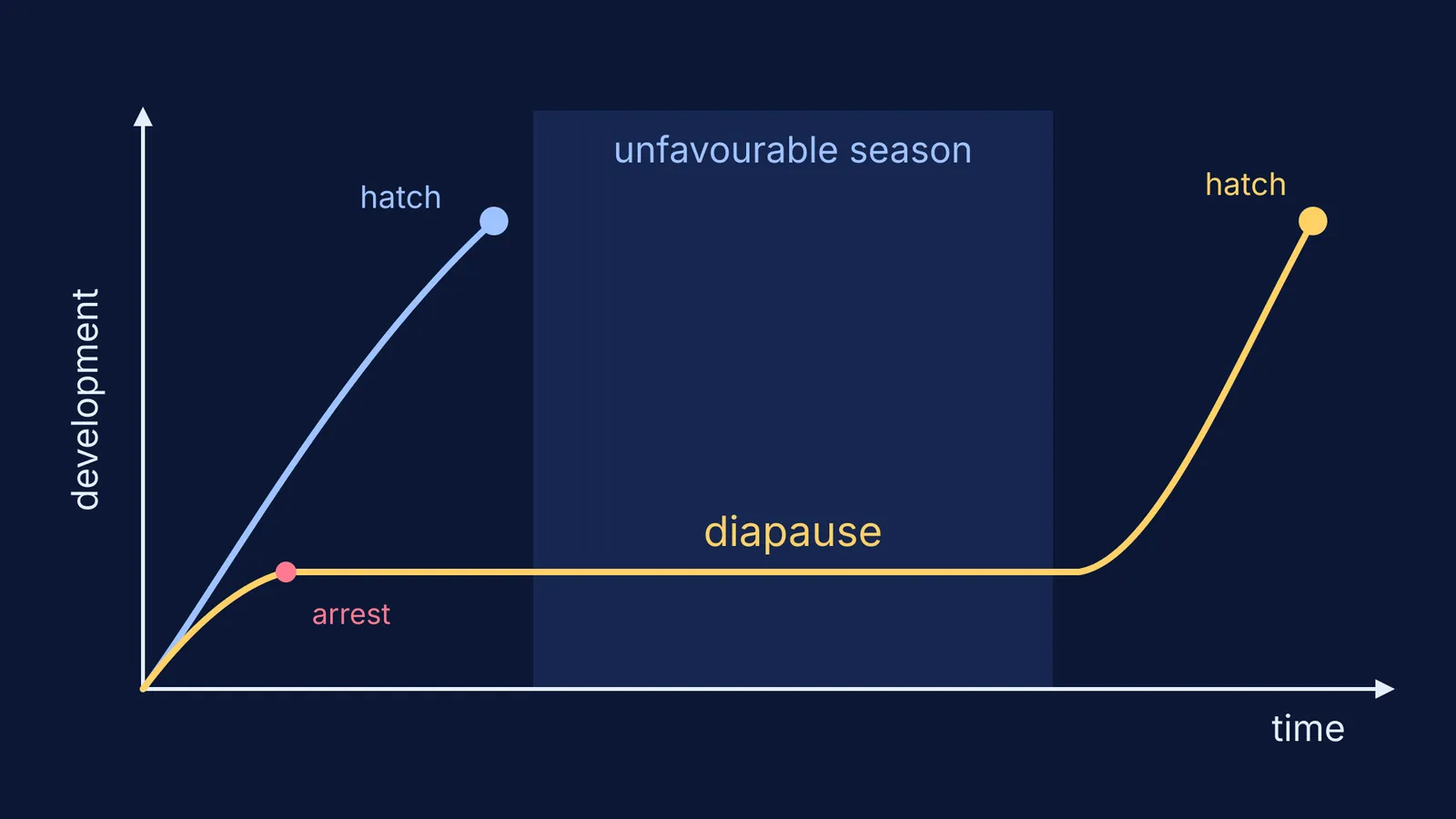
Imagine a silkworm egg that starts developing, forms the beginnings of a head and tail, and then simply stops. It sits through the cold months without growing, and only resumes when conditions change. That pause is diapause.
What is diapause in insects?
Diapause is “a stage-specific, programmed developmental arrest commonly engaged to circumvent an adverse season”, in the words of entomologist David Denlinger's 2023 review in the Journal of Experimental Biology.
Each part of that definition matters:
Stage-specific: a species pauses at one fixed point in its life cycle, such as the egg, larva, pupa or adult.
Programmed: the review notes that diapause “is most frequently programmed far in advance of its actual enactment”, with day length (photoperiod) and temperature commonly acting as the seasonal signals.
Developmental arrest: growth to the next stage stops. Early studies of diapausing cecropia silk moths, the review recalls, measured low metabolic rates.
Denlinger contrasts this with quiescence, which “is entered and exited in direct response to prevailing environmental conditions”. An insect that slows down because today is cold is quiescent. An insect that shuts down because its body read the calendar weeks earlier is in diapause. His earlier review, Regulation of Diapause (2002), adds that many genes switch off during diapause while others are expressed specifically at that time.
Where does diapause appear in NCERT?
Older editions of NCERT Class 12 Biology, in the chapter Organisms and Populations, listed four ways to handle stress: regulate, conform, migrate or suspend (archived copy of the earlier textbook). Under “suspend”, it gave bears going into hibernation as “escape in time”, snails and fish going into aestivation in summer, and this line: “Under unfavourable conditions many zooplankton species in lakes and ponds are known to enter diapause, a stage of suspended development.”
The current 2026-27 reprint of the NCERT chapter begins directly with populations and no longer includes that section. Check your board or exam's current syllabus before deciding how deeply to study it.
How does a silkworm decide to pause?
The domestic silkworm, *Bombyx mori*, is the classic example, and a useful one for Indian students who already know it from sericulture. A 2021 study in Scientific Reports by Takeshi Yokoyama and colleagues sets out the main facts:
The bivoltine strain has two generations per year, and whether its eggs pause depends on conditions such as photoperiod and temperature during the mother's own development.
The pause happens in the embryo: development stops “immediately after forming the cephalic lobe and telson”, the early head and tail regions.
The decision is made a generation early. When eggs of the Kosetsu strain were incubated at 25 °C in continuous darkness, the moths that grew from them laid nearly 100% diapause eggs. Eggs incubated at 15 °C in darkness grew into moths that laid nearly 100% non-diapause eggs.
In Kosetsu, the temperature signal works through a temperature-sensitive channel called TRPA1 and the diapause hormone signalling pathway.
Denlinger's 2023 review notes that diapause hormone itself was discovered in studies of the silk moth. You can read more about the silkworm's economic side in our post on Apis, Bombyx and Laccifer as useful insects.
Zooplankton take the idea to extremes. In a study of copepod eggs buried in lake sediment, Nelson Hairston and colleagues reported that the oldest diapausing egg they hatched was 332 years old.
How is diapause different from hibernation?
Both help an animal get through a bad season, so students often swap them. Our explainer on hibernation vs aestivation covers the other two. The difference with diapause is in what gets paused.
Hibernation slows the metabolism of an animal, often a fully grown one. A review of 214 bird and mammal species by Thomas Ruf and Fritz Geiser found that the mean minimum metabolic rate during torpor was only 6% of basal metabolic rate in hibernators. Diapause pauses development itself, at one fixed life stage, and is set in motion well before the bad season arrives.
A three-question test to classify any example
Use this when an MCQ or case study describes a “resting” organism:
Is development (growth to the next stage) on hold, or just activity and metabolism? If development is frozen, think diapause.
Is it tied to one fixed life stage, such as a silkworm egg? If yes, think diapause.
Is it a winter sleep of a mammal like a bear (hibernation), or a summer shutdown of snails or fish against heat and drying (aestivation)?
Worked example: “Copepod eggs lie in pond mud through a dry season and hatch when the rains return.” Development is on hold, at the egg stage, waiting out bad conditions. Answer: diapause.
If the terms around this chapter still blur together, the Fermi Concept Library covers every concept in biology, each with its own lesson and its place in the map. For practice, the Fermi Problem Library has worked problems with a step-by-step solver that explains the reasoning rather than printing an answer.
Next, revise the chapter's vocabulary with our Organisms and Populations Class 12 key terms.


