On this page
Organisms and Populations is Chapter 11 of the NCERT Class 12 Biology textbook (reprint 2026-27), and the CBSE Biology curriculum for 2026-27 lists it under Unit X with two themes: population attributes and population interactions. Each term below gets a short definition in our words, a chapter example and, where students slip, a "Don't confuse with" note. For answer writing, pair it with our Organisms and populations Class 12 board exam guide.
The 2026-27 chapter starts directly with section 11.1 Populations, so all terms below come from it.
What are the attributes of a population?
Ecology: the study of how organisms interact with each other and with their non-living (abiotic) surroundings.
Population: individuals of one species in a defined area that share or compete for resources and can interbreed (groups formed by asexual reproduction also count). Example: lotus plants in one pond, or bacteria on one culture plate.
Birth rate: births per existing member over a period, not the raw count. Example: NCERT's lotus pond goes from 20 plants to 28, so the birth rate is 8/20 = 0.4 offspring per lotus per year. Don't confuse with: natality, which is the number of births.
Death rate: deaths per existing member over a period. Example: 4 deaths in a lab population of 40 fruit flies in a week gives 0.1 per fly per week.
Sex ratio: the share of females and males in a population. Only a population, never an individual, has one.
Age pyramid: a graph of the per cent of individuals in each age group; its shape shows whether a population is growing, stable or declining.
Population density (N): population size, usually a count, though per cent cover or biomass suits cases like one huge banyan among 200 carrot grass plants. Don't confuse with: relative density, such as fish caught per trap.
What makes a population grow or shrink?
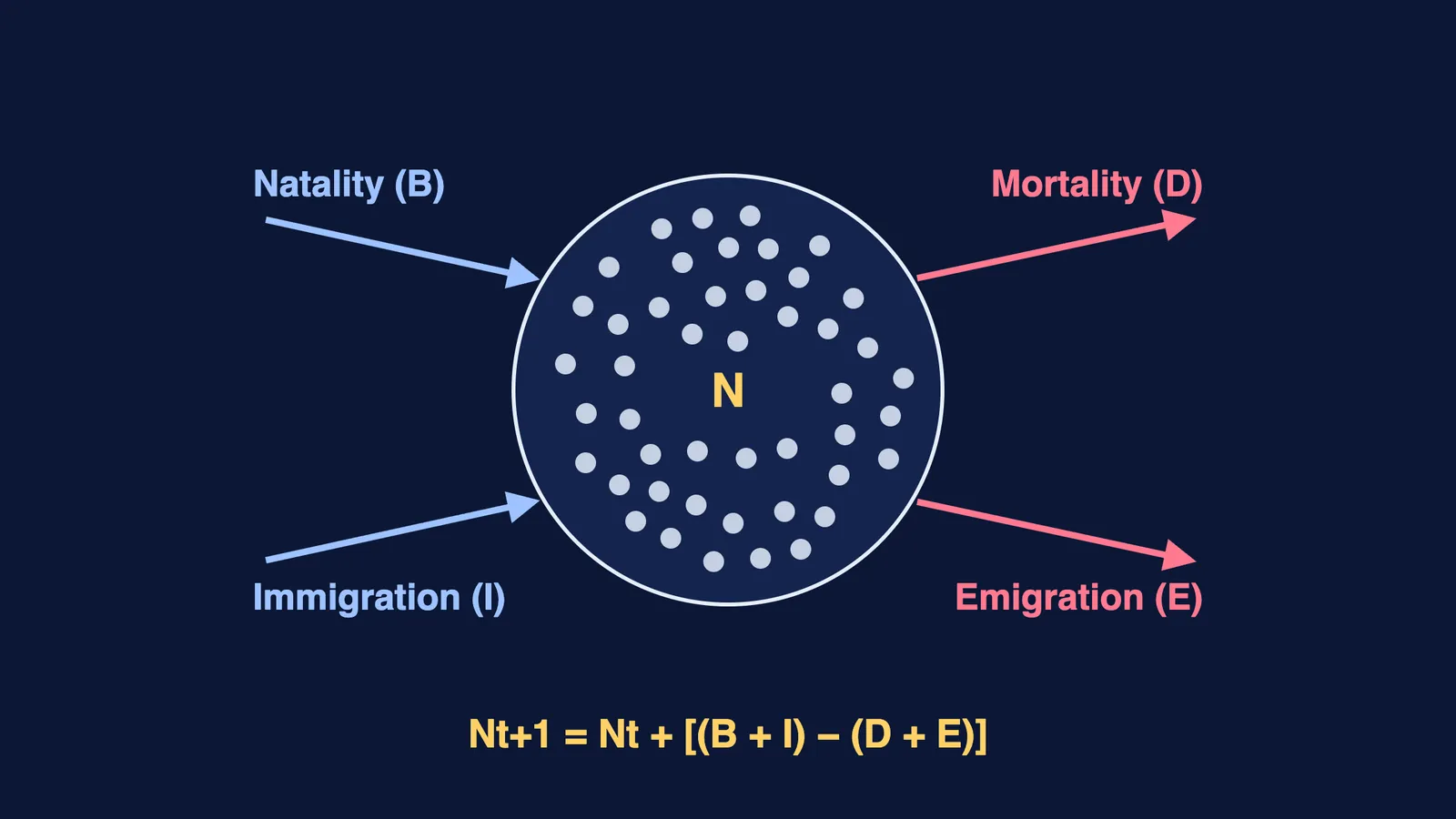
Natality: births added to the population in a given period.
Mortality: how many members die over a set period.
Immigration: same-species individuals arriving from elsewhere; it matters most when a new habitat is being colonised.
Emigration: individuals leaving the habitat. Don't confuse with: mortality; an emigrant is lost to this population but still alive.
Together: Nt+1 = Nt + [(B + I) - (D + E)], so density rises only when B + I exceeds D + E.
Exponential vs logistic growth: what is the difference?
Exponential growth: growth with unlimited food and space: dN/dt = rN. Plotting N against time gives a J-shaped curve.
Intrinsic rate of natural increase (r): per capita birth rate minus per capita death rate (r = b - d), a population's built-in potential to grow. Example: NCERT gives r = 0.015 for the Norway rat and 0.12 for the flour beetle.
Carrying capacity (K): the largest population a habitat's resources can support for that species.
Logistic growth: growth with limited resources: dN/dt = rN[(K - N)/K]. Lag, acceleration, deceleration and an asymptote at K give a sigmoid (S-shaped) curve (Verhulst-Pearl logistic growth), the more realistic model.
Darwinian fitness: reproductive fitness, shown by a high r value; populations evolve breeding strategies that maximise it in their habitat. Example: bamboo breeds once in a lifetime; most birds and mammals breed many times.
Which population interactions have which signs?
NCERT marks each species in an interaction + (benefit), - (harm) or 0 (no effect).
Mutualism (+/+): both species gain. Example: lichens (fungus with algae or cyanobacteria); mycorrhizae (fungus with plant roots).
Competition (-/-): both lose; one species' r falls when the other is present. Example: visiting flamingoes and resident fish competing for zooplankton in some shallow South American lakes (unrelated species).
Predation (+/-): one species eats the other. A sparrow eating seeds counts too.
Parasitism (+/-): one species lives on or in a host and feeds on it, usually harming it. Don't confuse with: predation; both are +/-, but a parasite lives on its host and feeds from it, while a predator eats its prey.
Commensalism (+/0): one gains, the other is unaffected. Example: an orchid growing on a mango branch; cattle egrets feeding near grazing cattle.
Amensalism (-/0): one is harmed, the other is unaffected. Don't confuse with: commensalism (+/0).
What do the special terms inside each interaction mean?
Camouflage (cryptic colouring): prey colouring that hides it from predators, as in some insects and frogs.
Biological control: using a pest's natural predator to control it. Example: a cactus-feeding moth that controlled prickly pear in Australia.
Competitive exclusion principle (Gause): when two closely related species depend on the same resources, they cannot live together forever, and the weaker competitor eventually dies out. NCERT notes this holds when resources are limiting, not otherwise.
Interference competition: one species lowers another's feeding efficiency just by being there, even when food is plentiful.
Competitive release: a species spreads into a wider range once a stronger competitor is removed. Example: on Scottish rocky coasts, Connell found the larger barnacle Balanus excludes the smaller Chthamalus from the intertidal zone.
Resource partitioning: competitors coexist by feeding at different times or in different ways. Example: MacArthur's five warbler species on one tree.
Ectoparasite / endoparasite: ectoparasites feed from outside (lice, ticks, Cuscuta); endoparasites live inside (liver, lungs, red blood cells).
Brood parasitism: a bird lays eggs in another species' nest for the host to incubate. Example: the koel and the crow.
Co-evolution: two species evolve in step. Example: a fig and its partner wasp; the orchid Ophrys, whose petal mimics a female bee, so males pollinate it while 'pseudocopulating'.
Test these against tricky statements with our assertion-reason questions on ecology and populations.
How to learn these terms
Pair the four growth terms (natality-mortality, immigration-emigration), then write the Nt+1 equation from memory.
Draw the J and S curves on one set of axes, mark K, and label the S curve's four phases.
Write the six sign pairs from memory with one chapter example each.
Quiz yourself on look-alike pairs: predation vs parasitism, commensalism vs amensalism, ectoparasite vs endoparasite.
If a term still feels shaky, the Fermi Concept Library gives every biology concept its own lesson and its place in the map. For NEET-style practice, see ecology questions for NEET.