

On this page
If you are revising the Animal Kingdom chapter for school exams or NEET-UG, one short line in the Arthropoda section is easy to mix up with the list printed right under it: the economically important insects.
What does NCERT say about Apis, Bombyx and Laccifer?
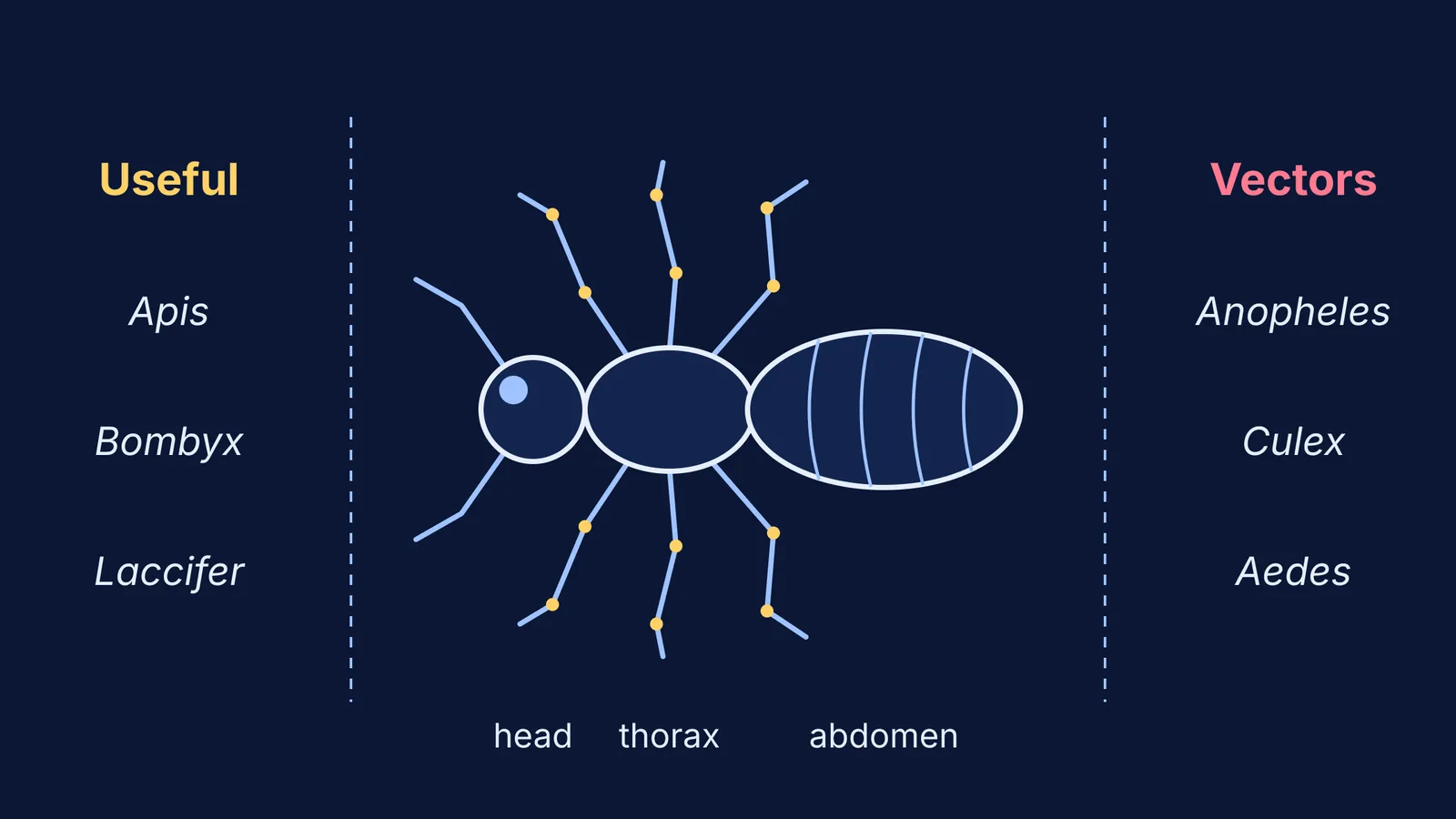
In section 4.2.7 of the NCERT Class 11 Biology chapter on the Animal Kingdom, the examples of Arthropoda are given in four groups. Economically important insects: *Apis* (honey bee), *Bombyx* (silkworm) and *Laccifer* (lac insect). Vectors: *Anopheles*, *Culex* and *Aedes* (mosquitoes). Gregarious pest: *Locusta* (locust). Living fossil: *Limulus* (king crab).
The same page calls Arthropoda the largest phylum of Animalia and says over two-thirds of all named species on earth are arthropods (NCERT). We cover why the phylum is so big in our explainer on Arthropoda, the largest phylum.
One naming note: newer research papers call the lac insect *Kerria lacca*, and the US National Agricultural Library thesaurus lists *Laccifer lacca* as a synonym of it (NAL Thesaurus). In the exam, write what NCERT writes: *Laccifer*.
What does each useful insect give us?
Start with *Apis*, the honeybee. Honey is made by honey bees mainly from flower nectar, and beeswax, which bees use to build combs, is produced by the glands of young worker bees aged 12 to 18 days, according to a 2025 review in *Foods* (Anjos and Miguel, 2025).
The bigger gift may be pollination. The Food and Agriculture Organization says three-quarters of the world's most productive crop plants depend, at least in part, on pollinators, and that over 25,000 species of bees act as pollinators (FAO).
*Bombyx* is the silkworm. Silk is made of proteins secreted in a fluid state by a caterpillar, the silkworm, according to the Central Silk Board's research institute (CMER&TI). Mulberry silk comes from *Bombyx mori*, which feeds only on mulberry leaves. India also produces tasar, eri and muga silk from other silkworm species. Follow the egg-to-cocoon story in our silkworm life cycle post.
*Laccifer* is the lac insect. Lac insects are scale insects that cover their bodies with a hard, resin-like secretion, and they yield three commercial products: resin, dye and wax (Ahmad et al., 2014, Journal of Insect Science). A 2022 study found that adult females secrete most of the lac, and noted its uses in cosmetics, food, textiles, medicines, surface coatings and electrical goods (Bashir et al., 2022, Insects). How farmers raise the insect on host trees is covered in our lac insect and shellac post.
Why are the honeybee, silkworm and lac insect arthropods?
Check each one against the NCERT features of Arthropoda (NCERT, section 4.2.7):
Jointed appendages. The name means exactly this: arthros (joint) and poda (appendages).
Chitinous exoskeleton. The body is covered by chitin.
Head, thorax and abdomen. The body is in these three parts.
Open circulatory system and excretion through Malpighian tubules.
Sense organs such as antennae and compound and simple eyes.
The honeybee shows the outer features plainly: jointed legs, antennae, compound eyes and three body parts. The silkworm is a caterpillar, the larval stage of a moth, and still an insect. The lac insect is the tricky one: its body sits hidden under the resin it makes, so it barely looks like an animal. It is still a true insect, placed in the order Hemiptera (Ahmad et al., 2014).
Useful insect or vector? A sorting quiz
Vectors are living organisms that can transmit infectious pathogens between humans, or from animals to humans (WHO). Sort each genus into useful, vector, or neither before you read the answers.
*Culex*
*Bombyx*
*Aedes*
*Locusta*
*Laccifer*
*Anopheles*
*Limulus*
*Apis*
Answers, with diseases from the WHO fact sheet:
Vector: Japanese encephalitis and lymphatic filariasis.
Useful: silk.
Vector: dengue, chikungunya and Zika, among others.
Neither. NCERT calls it a gregarious pest.
Useful: lac.
Vector: malaria, and also lymphatic filariasis.
Neither. NCERT's living fossil, the king crab, and not an insect at all.
Useful: honey and beeswax.
How do you make the list stick before the exam?
Try this three-step routine, about ten minutes in total:
Cover the NCERT page and write the four groups from memory: useful, vector, pest, living fossil.
Next to each useful insect, write its product. Next to each mosquito, write one disease.
Two days later, redo the sorting quiz above without looking, and mark only what you got wrong.
If the arthropod features still feel like loose words rather than a picture, the Fermi Concept Library has every concept in biology, each with its own lesson and its place in the map. When you move on to practice questions, the Fermi Problem Library has worked problems with a step-by-step solver that explains the reasoning rather than printing an answer.


