

On this page
A single germ almost never makes you sick. For most infections you have to swallow, breathe in or otherwise take in a certain number of microbes before disease follows. That number is the infectious dose, and for food- and water-borne bacteria it ranges from a handful of cells to hundreds of millions.
What is an infectious dose?
The infectious dose is the quantity of a pathogen needed to establish infection in a host. Scientists often report it as the ID50 — the dose that infects half the people who swallow it. It is not fixed by the microbe alone: it depends on the route of entry, the person's defences, and whether the germs ride in on food that shields them.
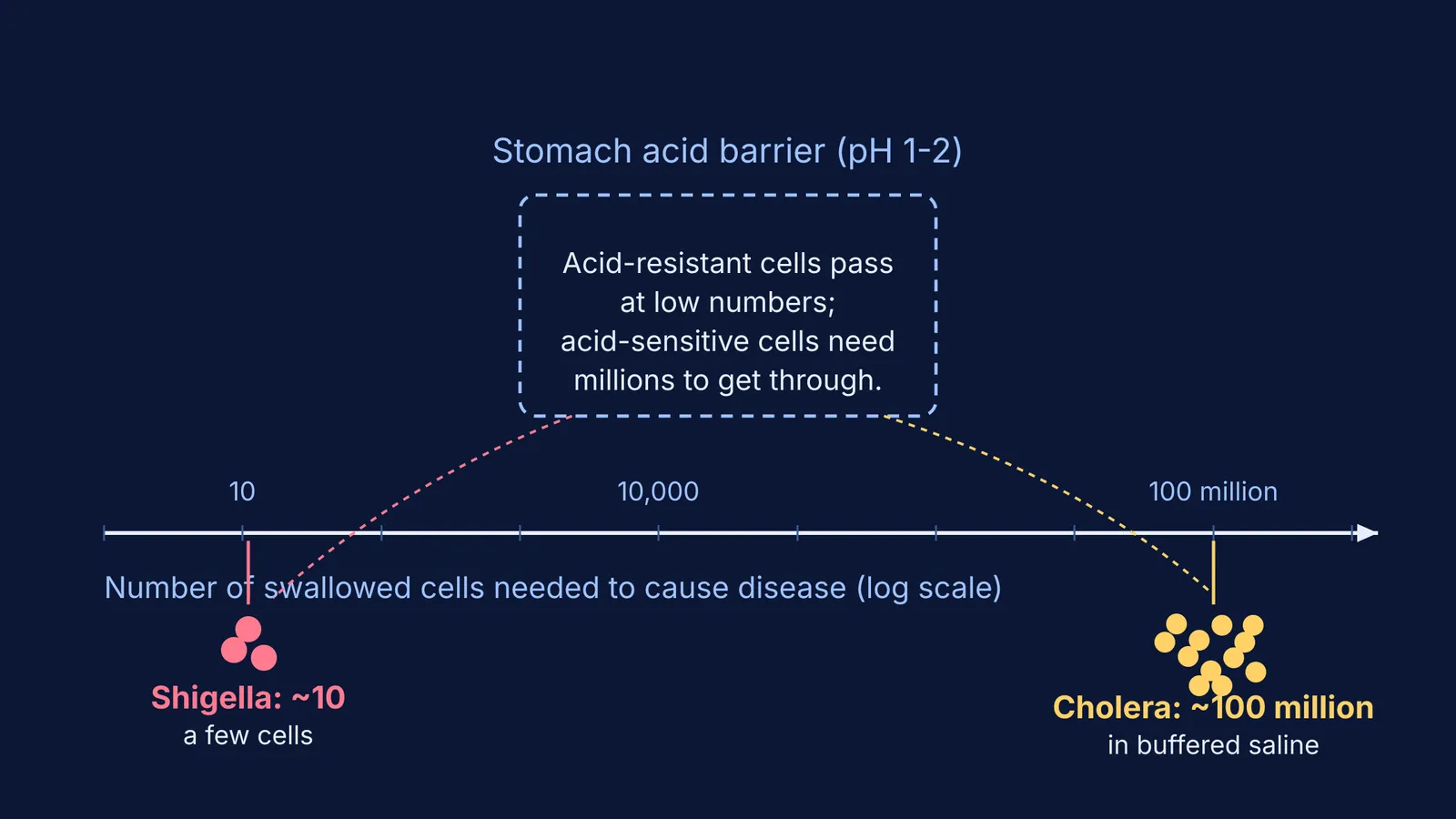
Two controlled, if ethically dated, volunteer studies anchor the numbers. In a 1974 study at the University of Maryland, an oral dose of about 100 million (10 to the 8th) *Vibrio cholerae* in buffered saline was required to induce the diarrhoea of cholera (Cash et al., *Journal of Infectious Diseases*). At the low end, public-health agencies put *Shigella* at as few as 10 to 100 organisms (CDC Health Advisory, 2023). That is a difference of roughly a million-fold between two bacteria that both cause diarrhoeal disease.
Why does Shigella need only a few cells but cholera needs millions?
The single biggest factor is surviving the stomach. The same cholera volunteers tell the story: when the live organisms were given together with sodium bicarbonate, which neutralises stomach acid, the infecting dose fell from 100 million to about 10,000 cells — a 10,000-fold drop (Cash et al., 1974). The germs did not get stronger; the acid barrier was simply removed.
*Shigella* starts with an advantage: it is unusually good at surviving acid. When researchers held bacteria at pH 2.5 for two hours, most *Shigella* and *E. coli* isolates survived, whereas none of the *Salmonella* did (Gorden and Small, *Infection and Immunity*, 1993). A microbe that can walk through the stomach alive needs only a few cells to reach the gut lining; one that gets wiped out needs to flood the system so that a few survivors slip through.
How does stomach acid set the threshold?
A healthy fasting stomach sits at pH 1 to 2, acidic enough to kill many swallowed pathogens (Smith, *Journal of Food Protection*, 2003). That review notes a practical consequence: neutralising gastric acid with antacids, or suppressing it with ulcer drugs, can raise the risk of food- and water-borne illness, because the chemical barrier that normally thins the dose is weakened.
Acid is not the only gate. The gut's resident bacteria crowd out newcomers — an effect called colonization resistance, which is why a course of antibiotics can leave you more vulnerable to gut infections (Buffie and Pamer, *Nature Reviews Immunology*, 2013). Mucus, bile and the immune system add further hurdles. Each barrier a microbe can cross lowers the dose it needs.
You can see how barriers stack up in our explainer on whether boiling water kills all germs, and how the same microbes spread in direct versus indirect disease transmission.
How to use infectious dose in NEET and board answers
Examiners reward the reasoning, not just the number. Use this chain:
State the dose with a unit: *Shigella* ~10 to 100 cells (CDC, 2023); cholera ~100 million cells in buffered saline (Cash et al., 1974).
Name the barrier: stomach acid at pH 1-2 (Smith, 2003) is the main filter.
Link cause to effect: acid-resistant microbes need fewer cells; acid-sensitive ones need a large inoculum so a few survive.
Add a modifier: food buffers acid, antacids remove it, antibiotics weaken colonization resistance — each lowers the effective dose.
Worked example: "Why is *Shigella* so contagious?" A strong answer says it survives gastric acid (Gorden and Small, 1993), so as few as 10 cells can reach and invade the colon — making person-to-person, faecal-oral spread easy. That one sentence carries the dose, the barrier and the consequence.
If the cause-and-effect still feels fuzzy, map it out before you memorise it. The Fermi Concept Library lays out ideas like gastric pH, acid tolerance and colonization resistance with their place in the wider map, and the Fermi Problem Library walks through reasoning questions step by step rather than printing an answer. You can also drill the chapter with NEET practice questions on human health and disease.
The takeaway: ask not how nasty a germ is, but how many of it your stomach lets through.


