On this page
Every definition below is written in our own words and checked against the NCERT Class 12 Biology chapter Reproductive Health (2026-27 reprint). Topics match the CBSE Biology curriculum for 2026-27. For answer-writing, see our Reproductive health Class 12 board exam guide.
What does reproductive health mean?
Reproductive health: the WHO idea, used by NCERT, that reproductive well-being covers body, mind, behaviour and social life, not just normally working organs.
Family planning: India's national programmes, started in 1951, to reach reproductive health as a social goal.
RCH programmes (Reproductive and Child Health Care): the wider, current programmes that followed family planning. They build awareness and provide care for pregnancy, contraception, STIs and infertility.
MMR and IMR: maternal mortality rate and infant mortality rate. Falling MMR and IMR signal better reproductive health.
Amniocentesis: taking a little amniotic fluid around the developing foetus to study fetal cells and dissolved substances, for example to detect Down syndrome. Using it for sex determination is banned in India to check female foeticide.
Which birth control methods are in the chapter?
NCERT groups contraceptives as natural, barrier, IUDs, pills, injectables, implants and surgical.
Ideal contraceptive: one that is simple to use and to obtain, works well, can be reversed, and causes little or no harm.
Periodic abstinence: avoiding coitus from day 10 to 17 of the menstrual cycle, the fertile period when ovulation is expected.
Coitus interruptus (withdrawal): the male withdraws before ejaculation. Natural methods have few side effects but fail often.
Lactational amenorrhea: no menstruation, and no ovulation, during intense breastfeeding after childbirth. It works only up to about six months after parturition.
Barrier methods: physical barriers that keep sperm and ovum apart. Example: male and female condoms, which also protect against STIs.
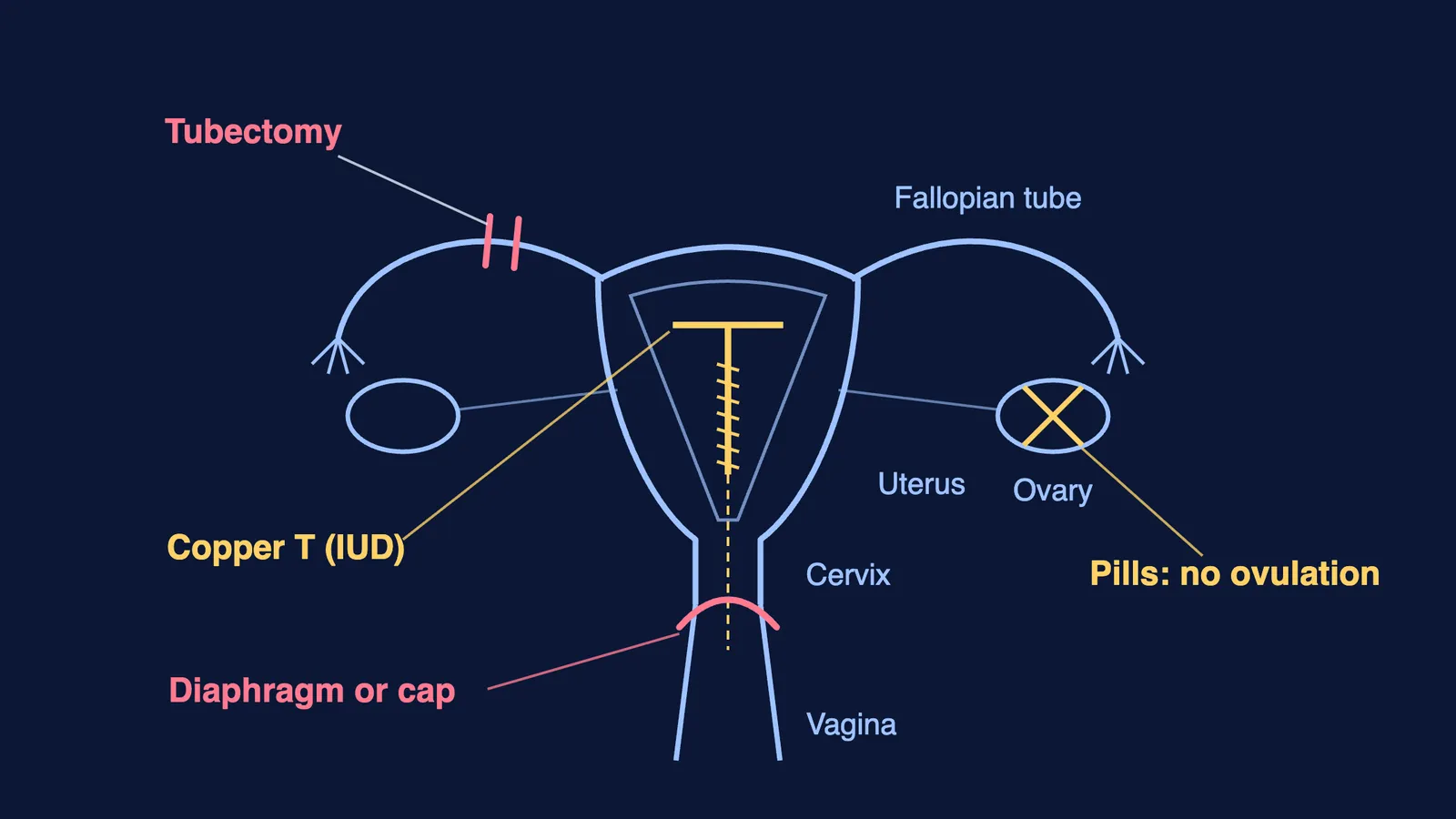
Diaphragm, cervical cap and vault: reusable rubber barriers that cover the cervix. Spermicidal creams, jellies or foams are used with them.
IUDs (intra uterine devices): devices placed in the uterus by a doctor or trained nurse. Examples: non-medicated (Lippes loop), copper-releasing (CuT, Cu7, Multiload 375) and hormone-releasing (Progestasert, LNG-20). All IUDs increase phagocytosis of sperm inside the uterus.
Copper ions: released by copper IUDs, they lower sperm motility and fertilising capacity. Don't confuse with: hormone-releasing IUDs, which also make the uterus unsuitable for implantation and the cervix hostile to sperm.
Oral pills: small doses of progestogens alone or with estrogen, taken daily for 21 days, then a 7-day gap. They inhibit ovulation and implantation and thicken cervical mucus.
Saheli: a once-a-week, non-steroidal oral pill developed at CDRI, Lucknow.
Injectables and implants: the same hormones given as injections or placed under the skin; they act like pills but last longer.
Emergency contraception: hormones or an IUD used within 72 hours of unprotected coitus to avoid a possible pregnancy.
Vasectomy: sterilisation in the male; a small part of the vas deferens is removed or tied through a cut in the scrotum.
Tubectomy: sterilisation in the female; a small part of the fallopian tube is removed or tied. Don't confuse with: vasectomy. Both block gamete transport; neither stops gamete formation, and reversal is poor.
What is MTP?
MTP (medical termination of pregnancy) or induced abortion: deliberately ending a pregnancy before full term. India legalised it in 1971 with strict conditions, per the NCERT chapter. Don't confuse with: spontaneous abortion (miscarriage), which is not intentional.
First trimester: the first 12 weeks of pregnancy, when MTP is considered relatively safe; second-trimester abortions are much riskier.
What are STIs, and which ones are not curable?
STIs, VD or RTI: three names for infections passed on through sexual intercourse, per the NCERT chapter. Examples: gonorrhoea, syphilis, genital herpes, chlamydiasis, genital warts, trichomoniasis, hepatitis-B and HIV.
Not completely curable: hepatitis-B, genital herpes and HIV. The rest can be cured if found early and treated fully.
Asymptomatic: showing no clear symptoms; infected females often are, so infections go undetected.
PID (pelvic inflammatory disease): a later complication of untreated STIs, along with stillbirth and infertility.
Ectopic pregnancy: a pregnancy that implants outside the uterus, usually in the fallopian tube.
What do IVF, ZIFT, GIFT and ICSI mean?
The curriculum marks infertility and ART as an "elementary idea for general awareness" (CBSE 2026-27). The definitions follow the NCERT chapter.
Infertility: a couple cannot conceive even after 2 years of unprotected cohabitation. The cause often lies with the male partner.
ART (assisted reproductive technologies): techniques that help such couples have children.
IVF-ET (test tube baby): ova and sperm are joined in a lab to form a zygote, and the embryo is then transferred into the female.
ZIFT: a zygote or early embryo with up to 8 blastomeres is transferred into the fallopian tube.
IUT: an embryo with more than 8 blastomeres is transferred into the uterus. Don't confuse with: ZIFT, where the destination is the fallopian tube.
GIFT: an ovum from a donor is transferred into the fallopian tube of a female who cannot produce ova but can support fertilisation. Don't confuse with: ZIFT; in GIFT a gamete moves, not a zygote.
ICSI: a single sperm is injected directly into the ovum in the lab.
AI and IUI: semen from the husband or a healthy donor is placed artificially into the vagina, or into the uterus in IUI. Used when the male partner cannot inseminate the female or has very low sperm counts.
How to learn these terms
Sort by where the method mainly acts: on the ovary (pills, which stop ovulation), the tube (tubectomy, ZIFT, GIFT), the uterus (IUDs, IUT, IUI) or the cervix (diaphragm, cap).
Learn ART as "what moves, and where to": zygote to tube, embryo to uterus, ovum to tube, sperm into ovum.
Practise the NCERT "correct the statement" exercises; they test pairs like sterilisation versus gamete formation.
Revise the menstrual cycle and gametes first with our Human Reproduction Class 12 board guide, since fertile period, ovulation and implantation come from there.
If you also write NEET, see reproductive health for NEET: key facts and question types.
If a term such as implantation or blastomere is still fuzzy, the Fermi Concept Library gives each concept in biology its own lesson and its place in the map.