

On this page
If you are classifying an animal, the first split you make is usually between vertebrates and invertebrates. The divide rests on a few core traits: the backbone, the skeleton, and the layout of the nervous system.
While we often think of animals as cats, dogs and fish, those are the exceptions. The vast majority of animal species are invertebrates; one estimate puts the figure at 97% (Wikipedia). Vertebrates still only make up less than five percent of all described animal species (Wikipedia).
When you are mapping out animal taxonomy, the Fermi Concept Library groups these traits side by side so you can see the evolutionary jumps clearly.
What is the main difference between vertebrates and invertebrates?
The primary difference lies in the backbone.
Vertebrates develop a notochord during their embryonic stage. In most cases, this stiff rod gets replaced by the vertebral column, a spine made of interlocking bone or cartilage. This spine runs down the centre of the back, protecting the main nerve trunk and holding the body upright.
Invertebrates do not have a backbone or a vertebral column. Their bodies are held together by different structural methods, which profoundly limits how large they can grow on land.
How does an internal skeleton compare to an exoskeleton?
The presence of a backbone gives vertebrates an internal framework.
Vertebrates have an endoskeleton. Because their bones are inside the body, the skeleton grows as the animal grows. This internal structure supports heavy muscles, allowing vertebrates to achieve immense sizes (like the blue whale or the elephant). To see how these bones are organised in humans, check out our guide to counting the axial and appendicular bones.
Invertebrates use exoskeletons or hydrostatic skeletons. Insects and crustaceans have an exoskeleton, a hard outer shell made of chitin. Because a shell does not grow, the animal must moult and shed it to get bigger, which is energetically costly. Soft-bodied invertebrates, like earthworms, use a hydrostatic skeleton—a fluid-filled cavity kept rigid by muscle pressure.
Where is the nerve cord positioned in each group?
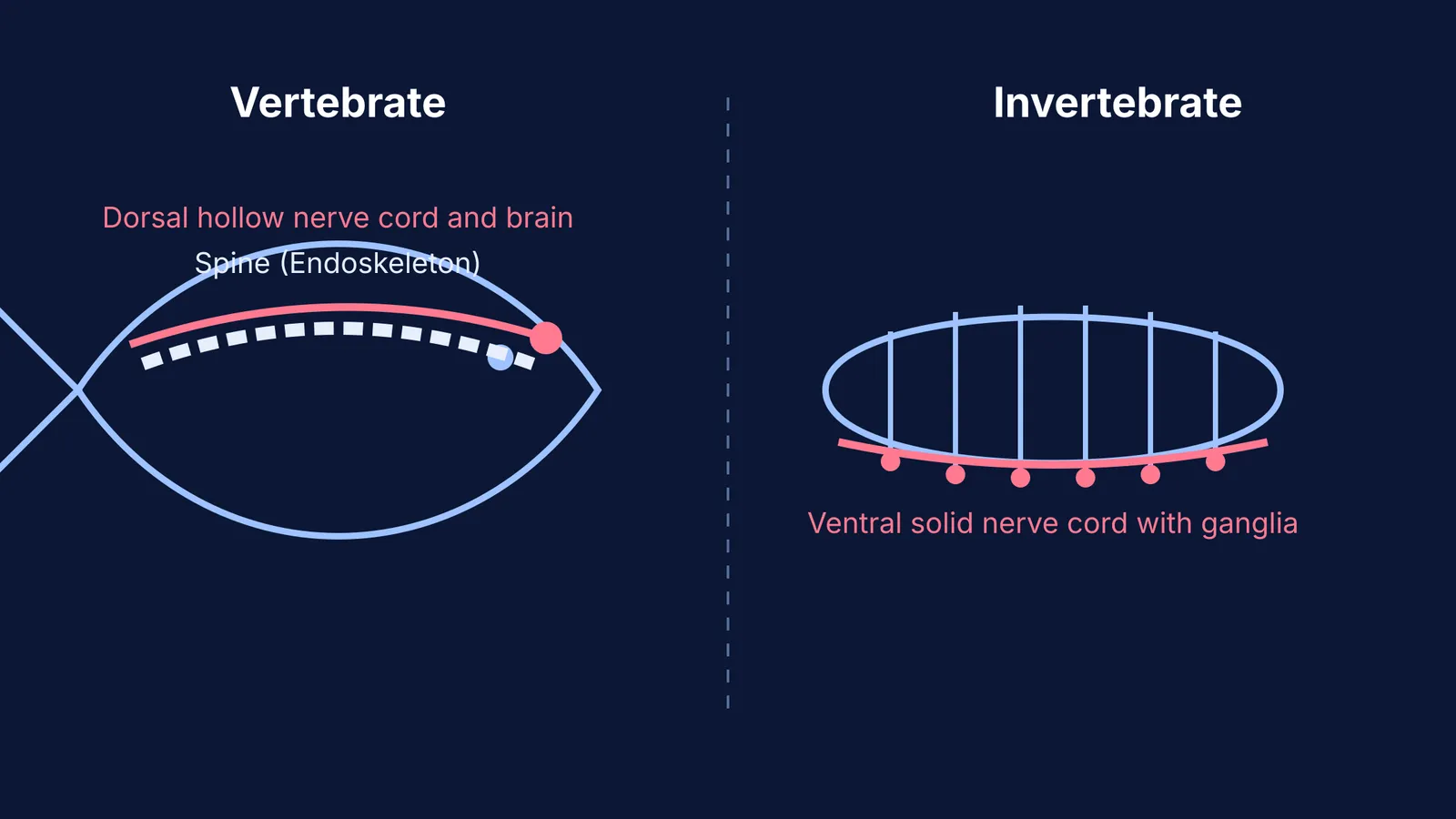
If you flip a vertebrate and an invertebrate over, you will notice their nervous systems are essentially upside down compared to one another.
All chordates (the group that includes vertebrates) possess a hollow dorsal nerve cord, also known as the neural tube, which develops into the spinal cord (Wikipedia). "Dorsal" means it runs along the back. This nerve cord is a single, hollow tube that swells at the front end to form the parts of the human brain.
In contrast, invertebrates have a ventral nerve cord. "Ventral" means it runs along the belly side, below the digestive tract. Furthermore, the invertebrate nerve cord is usually solid and double (forming a pair of parallel cords). Instead of a single centralised spinal cord, their nervous system often features ganglia—clusters of nerve cell bodies—distributed in segments along the cord.
Animal classification checklist
If you are faced with a new animal in biology class, ask these three questions to classify it instantly:
Does it have a backbone? Yes = Vertebrate, No = Invertebrate.
Is its skeleton on the inside or outside? Inside = Endoskeleton (Vertebrate), Outside or none = Exoskeleton or Hydrostatic (Invertebrate).
Where is its nerve cord? Along the back (Dorsal) = Vertebrate, Along the belly (Ventral) = Invertebrate.
What are some examples of vertebrates and invertebrates?
Because they are structurally so different, the two groups dominate different habitats and ecological niches.
Examples of vertebrates:
Mammals: Humans, dogs, whales, bats.
Birds: Eagles, penguins, ostriches.
Reptiles: Snakes, lizards, crocodiles.
Amphibians: Frogs, salamanders, toads.
Fish: Sharks (cartilaginous), salmon (bony).
Examples of invertebrates:
Arthropods: Insects (bees, ants), arachnids (spiders, scorpions), crustaceans (crabs, lobsters).
Molluscs: Snails, octopuses, colossal squids.
Annelids: Earthworms, leeches.
Cnidarians: Jellyfish, sea anemones, corals.
Echinoderms: Starfish, sea urchins.
To map out more animal groups and their traits, search the Fermi Concept Library.


