

On this page
Common names in animal biology frequently confuse students preparing for examinations. Organisms like jellyfish, silverfish, cuttlefish, and starfish carry names that imply kinship with aquatic vertebrates. In competitive exams, questions on animal common names that mislead students appear often because everyday vocabulary masks phylogenetic reality. To avoid this error, zoologists prefer the term "sea star."
Why is a starfish not classified as a true fish?
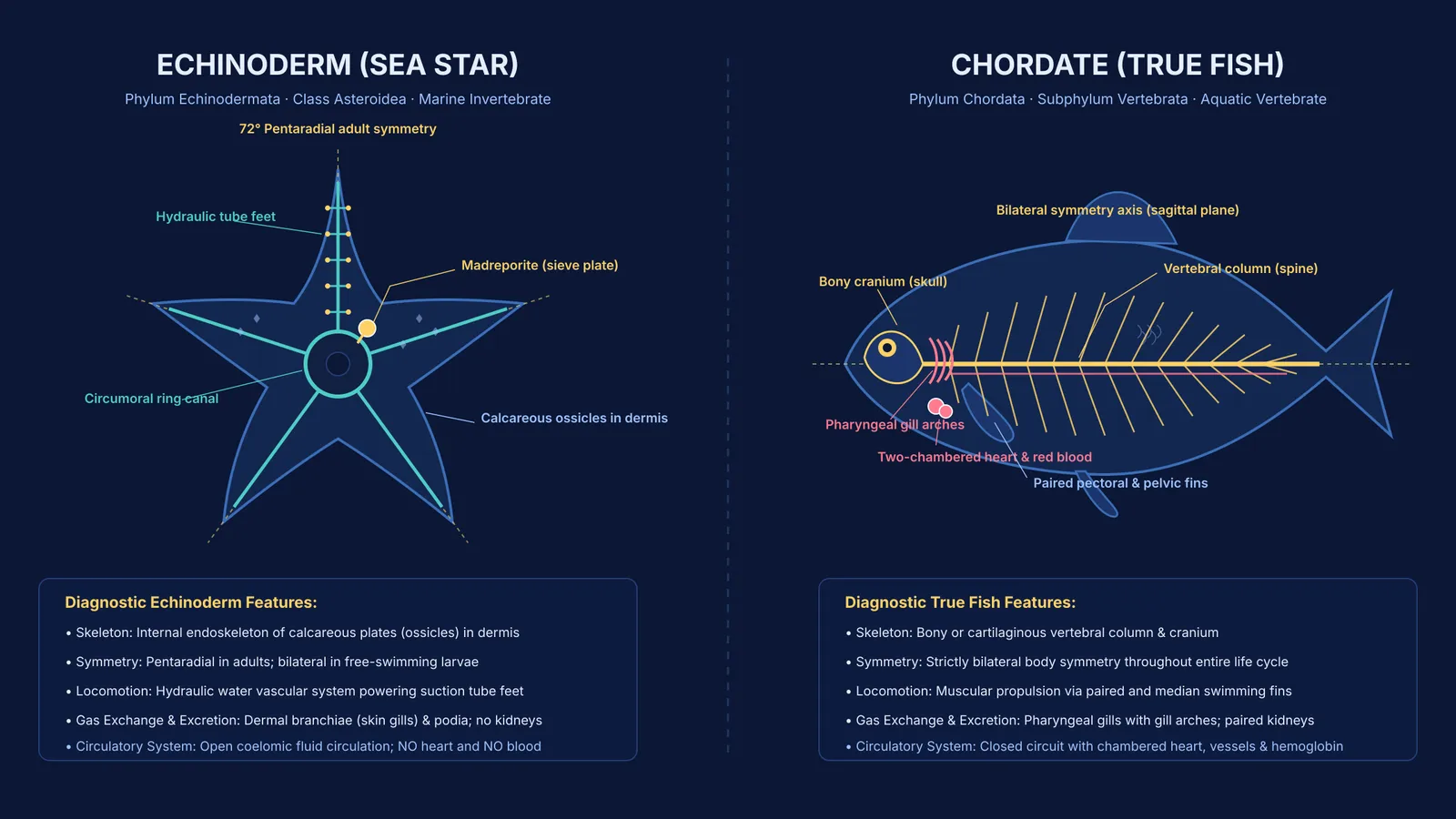
According to the NOAA National Ocean Service, a starfish lacks all defining traits of a true fish. True fishes belong to the phylum Chordata and subphylum Vertebrata. They possess a bony or cartilaginous vertebral column, pharyngeal gills for respiration, paired fins for propulsion, dermal scales, and a closed circulatory system with a chambered heart and blood.
A starfish displays none of these characteristics:
It lacks a vertebral column and cranium, classifying it as an invertebrate.
It has no gills or lungs, respiring through skin gills and tube feet.
It lacks swimming fins, moving via thousands of tiny hydraulic projections.
It lacks scales, protected instead by calcareous plates in its skin.
It has no blood or heart, circulating filtered seawater through internal canals.
Without a backbone, gills, or bilateral vertebrate anatomy, a starfish cannot be a fish.
What core anatomical features define an echinoderm?
Starfish belong to the phylum Echinodermata (from the Greek *echinos*, spiny, and *derma*, skin) and class Asteroidea. According to the World Asteroidea Database, the class contains over 1,800 living species distributed across marine habitats from intertidal shores down to trenches 6,000 metres deep. All echinoderms are exclusively marine; no freshwater species exists.
Echinoderms share five foundational features:
Spiny endoskeleton: Calcareous plates called ossicles form a protective skeleton inside the dermis.
Water vascular system: A hydraulic canal network derived from the coelom. Seawater enters through a sieve plate called the madreporite on the upper surface, flows through a ring canal, and branches into five radial canals.
Tube feet: Muscular ampullae squeeze fluid into external suction-tipped podia, generating the force needed to crawl and pry open bivalves.
Oral-aboral body axis: The mouth sits on the lower surface, while the anus is on the upper surface.
Absence of an excretory system: Echinoderms lack kidneys; nitrogenous waste diffuses directly across thin tissues, a classic diagnostic marker highlighted in animal classification exceptions.
How does a bilateral larva transform into a pentaradial adult?
A central puzzle in zoology is why adult echinoderms display five-part radial symmetry while their closest relatives are bilateral animals.
Starfish larvae, including bipinnaria, are free-swimming and strictly bilaterally symmetrical, as outlined in our overview of animal symmetry types. During metamorphosis, the left side of the larva develops into a five-rayed juvenile, producing pentaradial adult symmetry around a central disc.
A 2023 genetic study published in Nature by Laurent Formery and colleagues (PubMed: 37914929) revealed the molecular mechanism behind this body plan. By analyzing gene expression in *Patiria miniata*, researchers discovered that sea stars completely lack the genetic patterning program that builds the trunk in other bilateral animals. Instead, head-patterning genes radiate along each arm, meaning an adult sea star is essentially a five-armed crawling head.
How can you classify ambiguous marine animals in biology exams?
Use this five-step diagnostic framework to classify marine animals in biology exams:
Skeletal structure: An internal bony or cartilaginous backbone marks a vertebrate fish; calcareous ossicles embedded in the skin indicate an echinoderm.
Symmetry across life stages: Bilateral symmetry from egg to adult marks a vertebrate; a bilateral larva transforming into a pentaradial adult indicates an echinoderm.
Locomotor mechanism: Muscular fins indicate a fish; hundreds of hydraulic tube feet powered by seawater indicate an echinoderm.
Gas exchange: Pharyngeal gills indicate a fish; dermal branchiae and podia indicate an echinoderm.
Salinity tolerance: Any wild specimen from freshwater is never an echinoderm, as the phylum is strictly marine.
How to master animal classification without rote memorisation?
Mastering animal taxonomy requires understanding evolutionary transitions rather than memorising isolated exceptions. Focus on body symmetry, coelom development, and organ-system organization to see how animal phyla connect.
When you encounter complex classification hierarchies, the Fermi Concept Library covers every concept in physics, chemistry, biology, mathematics and computing, each with its own lesson and its place in the map. If you struggle to distinguish larval traits from adult features in practice problems, Fermi's AI tutor works out what you already know, notices where you are stuck, and explains the biological reasoning step by step.


