

On this page
When studying animal diversity for national examinations administered by the National Testing Agency, broad diagnostic rules organize species into phyla. You learn that mammals give live birth, reptiles have three-chambered hearts, and bilateral organisms keep their symmetry from embryo to adult. Competitive papers, however, rarely test broad generalities. Instead, question setters target evolutionary outliers: egg-laying mammals or reptiles with complete ventricular division.
According to the official NCERT Class 11 Biology curriculum, these taxonomic exceptions mark evolutionary milestones where distinct selective pressures shaped anatomical variations. Mastering them requires understanding the functional reasons behind each divergence.
Why do crocodiles have a four-chambered heart?
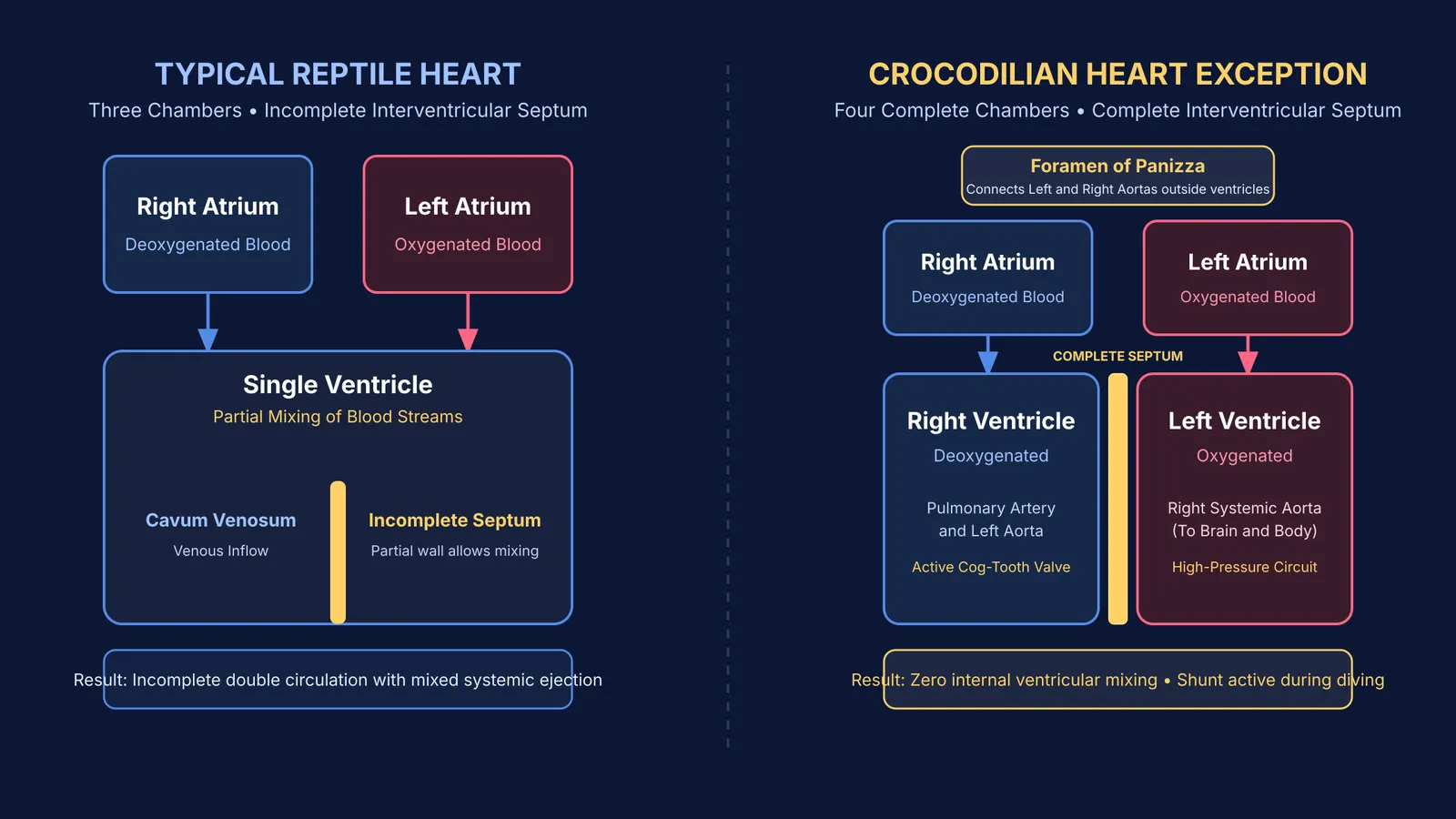
A standard rule in vertebrate anatomy is that reptiles possess a three-chambered heart with two atria and a single, partially divided ventricle. In lizards, turtles, and snakes, ventricular blood undergoes partial mixing before entering the arterial arches. Crocodilians (*Crocodilus*, alligators, and gharials) break this rule with four distinct chambers and a completely closed muscular interventricular septum, as detailed in the NCERT Class 11 Biology textbook.
The hemodynamics of this system were illuminated by Craig E. Franklin and Michael Axelsson in their 2000 Nature study on crocodilian cardiac valves. Franklin and Axelsson demonstrated that crocodilians possess an active muscular cog-tooth valve in the pulmonary outflow tract and an aperture called the Foramen of Panizza connecting the left and right systemic aortas. On land, the heart acts as a four-chambered double pump, sending oxygenated blood to tissues. When diving, constriction of the pulmonary outflow raises right-ventricular pressure, creating a right-to-left shunt that diverts blood from the lungs into the systemic circulation. This mechanism connects taxonomy directly with comparative vertebrate circulation and cardiac cycles.
Which mammals lay eggs instead of giving live birth?
Class Mammalia is defined by hair, mammary glands, and viviparity. Yet the order Monotremata breaks this pattern: the duck-billed platypus (*Ornithorhynchus*) and spiny anteater (*Tachyglossus*) lay shelled eggs rather than giving birth to live young, according to the NCERT Class 11 Biology syllabus.
This evolutionary bridge was characterized in a 2008 Nature platypus genome study led by Wesley C. Warren. His team revealed that the platypus genome retains ancestral vitellogenin genes for egg yolk nutrition alongside mammalian casein genes encoding milk proteins. Monotremes also lack nipples; milk exudes from modified cutaneous glands onto abdominal fur tufts for hatchlings to lap up. Remembering this genetic mosaic prevents confusing egg-laying prototherians with viviparous therians.
Why do echinoderms switch from bilateral to radial symmetry?
Phylum Echinodermata presents another frequent MCQ dilemma: developmental symmetry reversal. While classified within Bilateria alongside chordates, adult echinoderms such as starfish (*Asterias*) and sea urchins display pentamerous radial symmetry, whereas their free-swimming larvae are bilaterally symmetrical, as documented in the NCERT Class 11 Biology textbook.
In a 2007 Proceedings of the Royal Society B study on echinoderm symmetry, Valerie B. Morris demonstrated that adult radial symmetry develops from coelomic hydrocoeles aligned along an ancestral bilateral plane. For slow-moving benthic adults feeding from all directions, radial organization provides functional balance. Our guide to placing any phylum with six core questions explains how larval symmetry reveals these phylogenetic affinities.
How can you systematically master animal kingdom exceptions?
Instead of treating exceptions as disconnected trivia, evaluate unfamiliar specimens using a four-step diagnostic filter grounded in the NCERT Class 11 Biology syllabus:
Check developmental symmetry: Does adult symmetry match larval symmetry, or does the organism switch from bilateral larvae to radial adults as in echinoderms?
Examine cardiac partitioning: Is the ventricle unpartitioned (amphibians), partially partitioned (typical reptiles), or fully separated (crocodilians, birds, and mammals)? Reviewing how metabolic waste excretion differs across phyla also clarifies how circulatory and metabolic adaptations align.
Verify buoyancy adaptations: In aquatic vertebrates, is an air bladder present to maintain buoyancy (Osteichthyes), or must the fish swim continuously to avoid sinking (Chondrichthyes)?
Confirm reproductive specialization: Does the vertebrate produce shelled eggs, nourish embryos internally through a placenta, or lay eggs while lactating like monotremes?
Here is how this filter resolves a classic exam problem:
Problem: "An adult marine organism has pentaradial symmetry, a water vascular system, and no specialized excretory organs. Its swimming larva is bilateral. Identify the phylum and genus."
Step 1: Symmetry shift. The transition from a bilateral larva to a pentaradial adult identifies Phylum Echinodermata.
Step 2: Locomotion. The water vascular system with tube feet confirms echinoderm structure and excludes coelenterates.
Step 3: Excretion. Lacking excretory organs, echinoderms eliminate metabolic waste through diffusion across podia membranes.
Solution: The specimen is *Asterias* (starfish) within Phylum Echinodermata.
When multi-layered classification problems combine morphological exceptions with assertion-reason formats, the Fermi Concept Library covers every concept in biology, each with its own lesson and its place in the map, so you can inspect phylogenetic branch points without ambiguity. For targeted practice on tricky classification items, the Fermi Problem Library provides worked problems with a step-by-step solver that explains the reasoning rather than printing an answer. If you are unsure where classification gaps remain across different phyla, Fermi's AI tutor can work out what you already know and build a plan for the session, so you sit down to a clear next step.


