

On this page
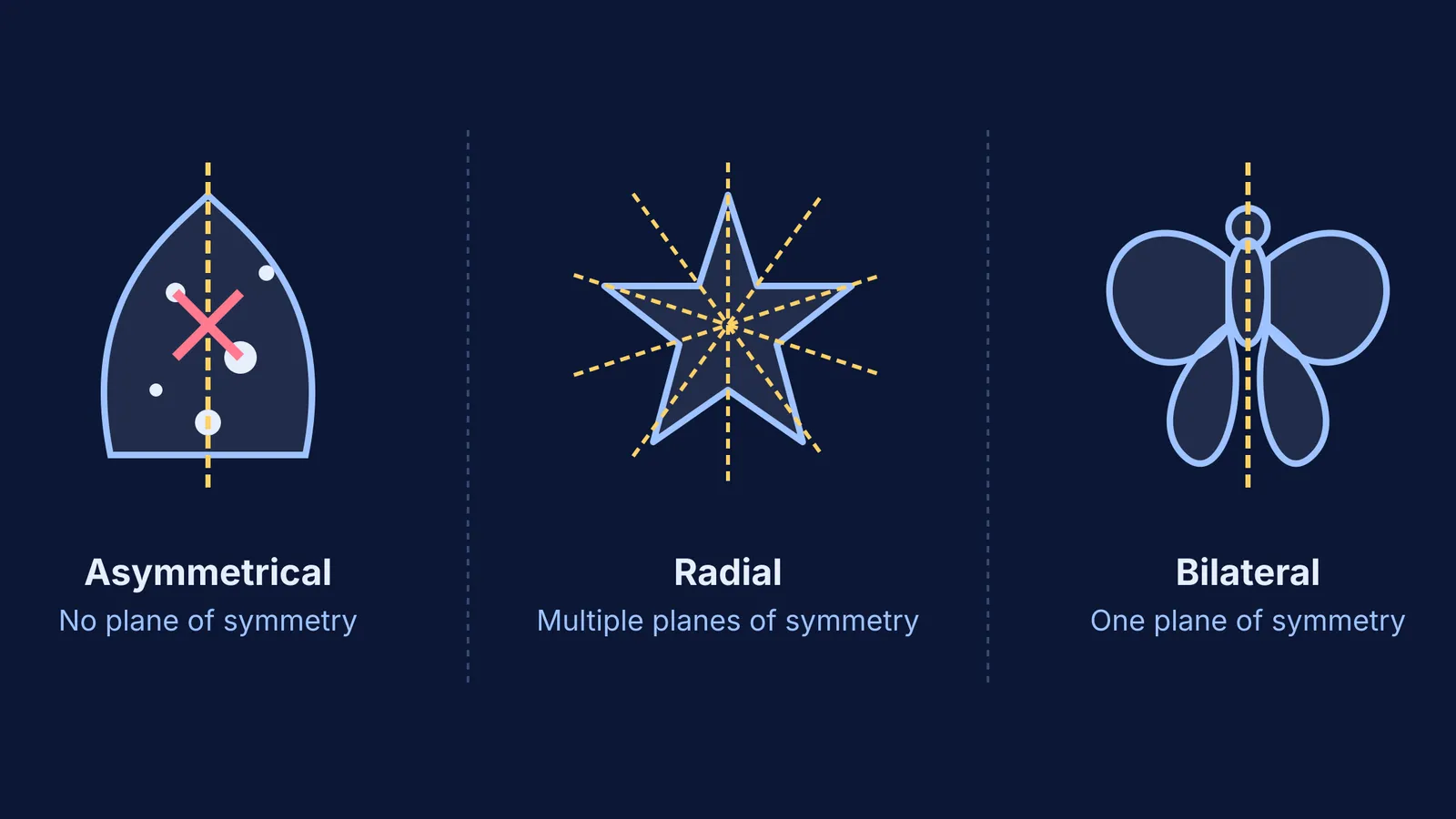
Symmetry is one of the first features biologists use to classify the animal kingdom. While a few primitive organisms grow in irregular shapes, the vast majority of animals follow strict geometric body plans. The National Council of Educational Research and Training (NCERT) categorises animals into three basic types: asymmetrical, radial and bilateral.
These anatomical blueprints determine more than just an animal's appearance. They dictate how it moves, how it feeds, and where its nervous system develops.
What are asymmetrical animals?
An animal is asymmetrical if any plane passing through its centre fails to divide it into two equal halves.
Sponges (phylum Porifera) are the most common example of asymmetrical animals. They grow as irregular, tube-like or branching structures on the sea floor. Because they are sessile—meaning they remain attached to one spot—and filter water for food, they do not need a streamlined shape or a central nervous system. Their irregular growth pattern simply allows them to adapt to the shape of the rocks or coral reefs they attach to.
Without symmetry, these organisms lack true tissues and organs. A sponge's body is essentially a loose aggregation of cells that work together, but they are not organised into complex structures like muscles or nerves. This simple, asymmetrical plan is perfectly suited to their stationary, filter-feeding lifestyle.
Which animals have radial symmetry?
Radial symmetry occurs when any plane passing through the central axis of the body divides the organism into two identical halves. These animals have a distinct top (often where the mouth is located) and bottom, but they do not have left or right sides, nor do they have a defined front or back.
According to the NCERT, this body plan is found in three main groups:
Coelenterates (Cnidarians), such as jellyfish, sea anemones, and *Hydra*
Ctenophores, commonly known as comb jellies
Adult echinoderms, such as starfish, sea urchins, and sea lilies
Radial symmetry is an evolutionary advantage for organisms that either float freely in the water column or remain firmly fixed in one place. A jellyfish floating in the ocean can sense environmental changes, detect danger, or capture prey arriving from any direction equally well. Their nerve net is distributed evenly throughout their body, allowing for a 360-degree response to the world around them.
If you are revising these phylum characteristics for exams, the Fermi Concept Library covers every concept in biology, each with its own lesson and its place in the map.
What is bilateral symmetry?
An animal exhibits bilateral symmetry when its body can be divided into identical left and right halves in only one specific plane. This is known as the sagittal plane, which runs vertically from the head to the tail.
Bilateral symmetry is the most successful and widespread body plan on Earth, shared by over 99% of all animal species (Wikipedia). This diverse group includes:
Platyhelminthes (flatworms) and Aschelminthes (roundworms)
Annelids (earthworms and leeches)
Arthropods (insects, spiders, and crabs)
Molluscs (snails, squids, and octopuses)
All Chordates (fish, amphibians, reptiles, birds, and mammals)
This symmetry allows animals to move forwards efficiently in a straight line, reducing drag in water and air.
Directional movement led to a massive evolutionary leap known as cephalisation—the clustering of sense organs, mouth parts, and a central nervous system at the front of the body. An animal moving forward through its environment needs to see, smell, and taste what is ahead of it before its body gets there. Because of bilateral symmetry, these animals evolved distinct, highly complex heads and brains.
How does symmetry help us understand animal evolution?
Recognising an organism's symmetry is the first step in learning animal physiology and tracing evolutionary lineages. As organisms evolved from simple asymmetrical sponges to radial jellyfish, and finally to bilateral predators, their internal organ systems became exponentially more complex.
Symmetry dictates the layout of the nervous system, the efficiency of muscles, and the placement of the digestive tract. Just as learning about ammonotelic, ureotelic and uricotelic animals helps you understand how evolution shaped the kidneys to conserve water, and studying the six enzyme classes reveals the universal mechanics of metabolism, understanding symmetry explains the fundamental origin of the brain and nervous system.
It is also a key structural marker used to separate true animals from simpler organisms that challenge traditional definitions, much like how viruses, viroids and lichens sit at the very edges of the five-kingdom classification system. Whenever you struggle to picture these physical and evolutionary leaps, the Fermi Simulation Lab provides interactive simulations for the ideas that are easier to see than to read.


