

On this page
The retort-shaped grass nests hanging from palms and thorny trees near Indian fields in the monsoon are built by male baya weavers (Ploceus philippinus). He works in stages, is judged halfway through, and, if his African relatives are a guide, gets better with practice.
How does a baya weaver build its nest, step by step?
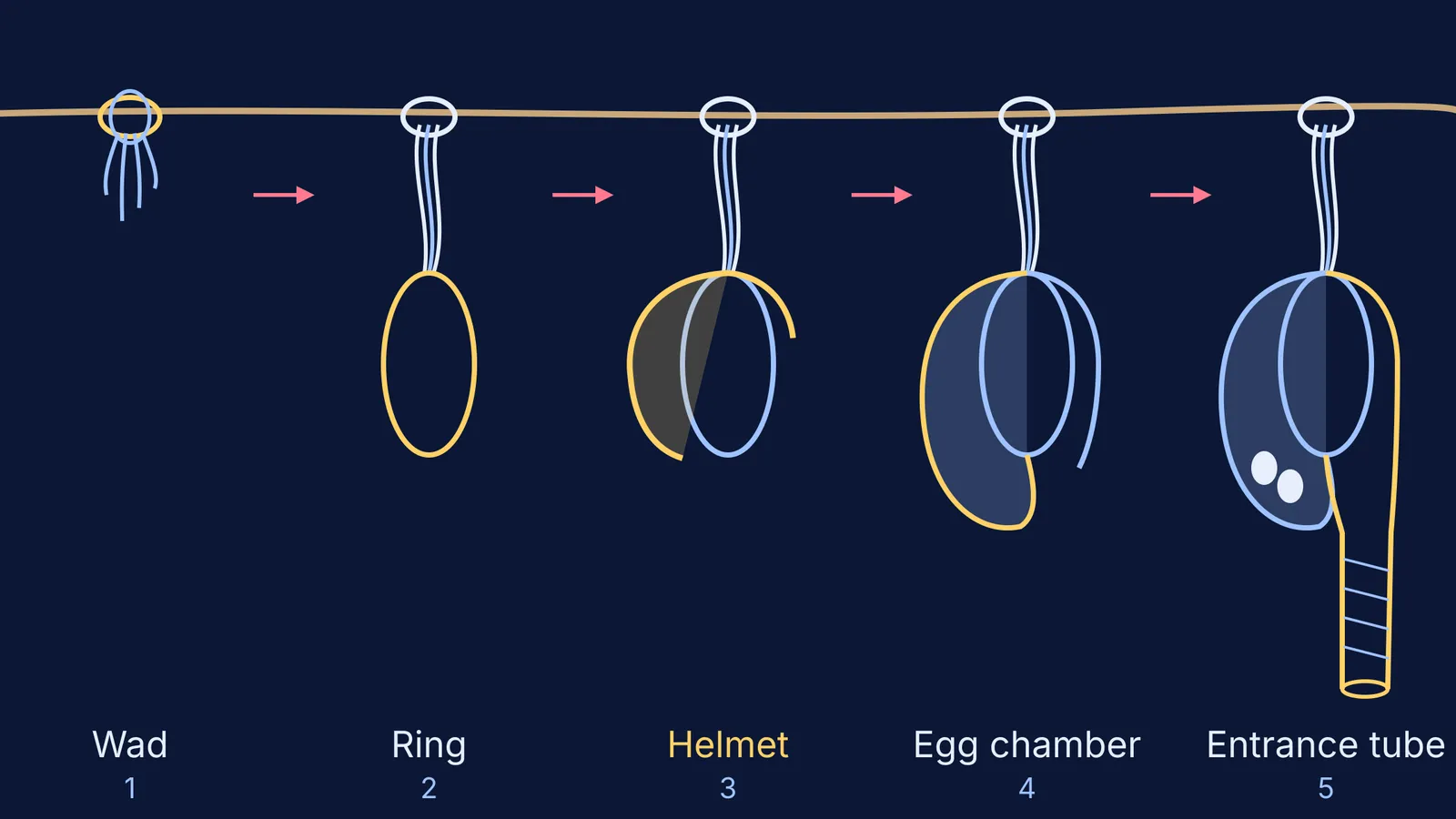
A field study in the Nagapattinam and Tiruvarur districts of Tamil Nadu found that only the male built the nests, taking 18 days to finish one (Asokan, Ali and Nagarajan, Journal of Environmental Biology, 2008). The same study named the stages wad, ring and helmet, and the helmet stage took a maximum of eight days.
The five stages in the diagram above, in order:
Wad: he cuts strips from paddy leaves, rough grasses or palm fronds and knots them onto a bare branch. The Wikipedia summary of baya weaver nesting gives strip lengths of 20 to 60 cm.
Ring: below the wad he weaves a hanging loop.
Helmet: he builds the loop out into a partial, hood-like nest, perches on it and displays to passing females.
Egg chamber: once a female accepts, he finishes the floor of the brood chamber.
Entrance tube: last, he extends the opening into a vertical tube, so the way in is from below.
Suhel Quader's 2006 study in The Auk describes the same sequence: build a helmet, display on it, finish after a female accepts, then add the entrance tube. In 34 completed nests measured in Selangor, Malaysia, the entrance tube averaged 17.8 cm and the whole nest 65.2 cm from top to bottom (Thiruvenggadam and colleagues, Animals, 2022).
Why do female baya weavers inspect half-built nests?
Because the helmet already shows where the nest hangs. When Quader swapped the nests of highly visited males with those of poorly visited males, female visits stayed highest at the original male and location, not with the moved nest (Quader, Ethology, 2005). He found no link between female choice and male display, and nest location predicted choice better than nest architecture.
His follow-up at ICRISAT in Patancheru, near Hyderabad, asked whether that preference pays off (Quader, The Auk, 2006). Nests in thorny trees and nests woven with fine fibre were more likely to succeed, and success rose with nest height and with the thickness of the supporting branch. Location was a slightly better predictor of success than architecture, which fits the finding that females weigh location more.
Is nest building instinct or learned?
Both. A 2015 review notes that nest building was long assumed to be independent of experience, and that experiments have given that view relatively little support (Hall, Meddle and Healy, Journal of Ornithology, 2015). It summarises classic captive experiments by Elsie and Nicholas Collias on village weavers, an African relative of the baya: experience with nest material during development had a significant effect on the birds' later material choices and weaving ability.
Field data point the same way. Patrick Walsh and colleagues filmed male Southern Masked weavers in Botswana as each built a series of nests (Behavioural Processes, 2011). Most building behaviours were not repeatable within a male, which is not what a fixed genetic template would produce, and males dropped grass less often as they built more nests, which the authors put down to increasing dexterity. A 2016 review adds that juvenile weavers with access to nest material became more proficient builders (Breen, Guillette and Healy, Comparative Cognition and Behavior Reviews, 2016).
A fair way to split it for a biology answer:
What looks inborn: the drive to build a nest of the species' type. None of these studies describes a male being taught the design.
What practice adds: weaving skill and fewer dropped strips.
What females judge: mostly where the nest hangs.
Songbirds show a similar split: how young birds learn to sing from tutors and practice.
What can a student learn from the baya weaver?
Try the helmet check on your next big answer or chapter:
Build the wad: one anchoring idea or definition you can say in a sentence.
Build the helmet: a rough half-version, such as an outline or a first try at five problems.
Get it inspected: show it to a teacher, parent or study partner and ask, am I answering the right question? Then finish.
Build again: the weavers improved across nests, so plan a second attempt days later.
Worked example: a 5-mark answer on innate versus learned behaviour. Wad: a one-line definition of each. Helmet: three bullets (nest stages, Quader's nest swap, weavers dropping less grass). Inspection: a friend checks they match the question.
If the anchoring idea is shaky, the Fermi Concept Library has every concept in biology with its own lesson and its place in the map. Fermi's AI tutor works out what you already know and checks understanding as it goes, so the inspection happens before you build the rest.
Next time you pass baya nests, look for hoods without tubes: helmets still awaiting a verdict. For another bird skill mixing instinct and experience, read how migratory birds find their way.


