On this page
Look closely at a peacock pansy, a butterfly found in India, Sri Lanka and Southeast Asia, and you will see round spots on its wings that look like eyes. The usual explanation is that they scare predators. Biologists have tested that claim, and the real answer is more interesting: there are two separate ideas, and each has its own experiments.
What are the two explanations for eyespots?
A 2013 study led by Ullasa Kodandaramaiah of IISER Thiruvananthapuram sets out the two ideas clearly (Ecology and Evolution, 2013).
Intimidation: eyespots scare off a predator before it attacks.
Deflection: eyespots draw the attack away from vital body parts, so the insect escapes with a torn wing instead of losing its life.
The team compared eyespots across butterflies of the genus *Junonia*, which includes the peacock pansy. Larger eyespots tended to sit alone, which fits intimidation, while smaller eyespots sat closer to the wing margin, which fits deflection (Kodandaramaiah and colleagues, 2013).
Do eyespots really scare birds away?
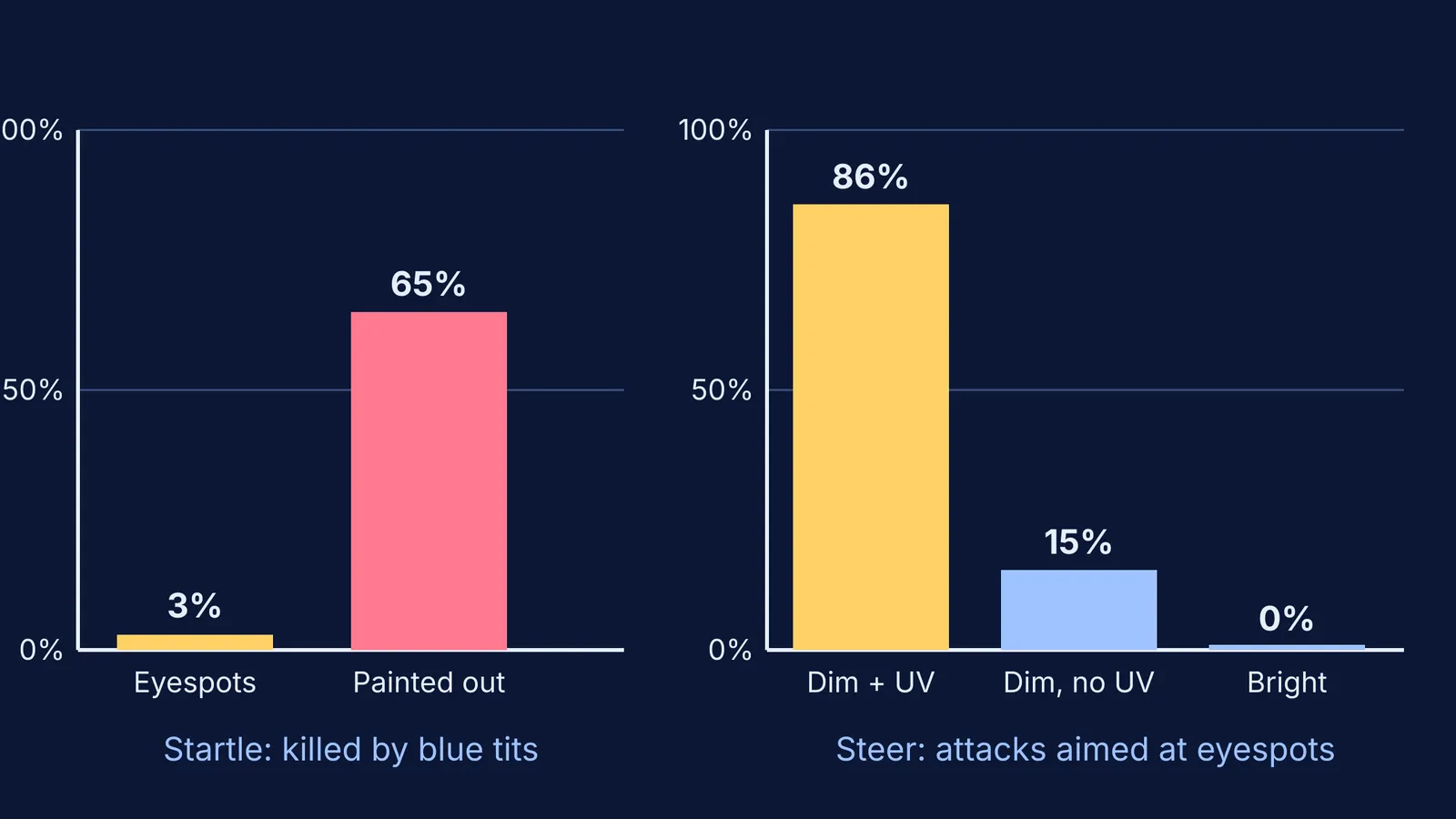
The cleanest test came from Sweden. Adrian Vallin and colleagues put peacock butterflies in with wild-caught blue tits for trials of up to 30 minutes (Vallin et al., Proc. R. Soc. B, 2005). In one group they blacked out the four eyespots with a marker pen; control butterflies got the same ink nearer the body, leaving the eyespots intact.
Blue tits killed 1 of 34 butterflies with intact eyespots and 13 of 20 butterflies whose eyespots were painted over (Vallin et al., 2005). Peacock butterflies also hiss as they flick their wings open, so the team silenced some by trimming part of the forewing. Eyespots still protected the butterflies when the sound was removed.
But do the spots work because they look like eyes? A field study with artificial prey says probably not. Martin Stevens and colleagues found that larger and more numerous spots protected prey from wild birds, but circles did no better than other conspicuous shapes such as bars (Behavioral Ecology, 2008). Being bold seems to matter more than looking like an eye.
Do eyespots steer pecks away from the body?
Martin Olofsson and colleagues tested the woodland brown, a butterfly with small marginal eyespots, against blue tits under three kinds of light (PLOS ONE, 2010).
Dim light with UV: 12 of 14 birds aimed their attacks at the eyespots.
Dim light without UV: 2 of 13 birds did.
Bright light: 0 of 13 birds did; all went for the head.
So deflection is real, but conditional. In this test, birds were steered towards the spots mainly in dim light that contained UV wavelengths (Olofsson et al., 2010).
Eyespots work against more than birds. Kathleen Prudic and colleagues showed that praying mantids attacked the large eyespots of wet-season *Bicyclus anynana* butterflies, and those butterflies survived and laid eggs more often than dry-season ones with small, dull spots (Proc. R. Soc. B, 2015). Pasting large eyespots onto the hindwings raised survival in either form.
Which Indian butterflies and moths have eyespots?
You do not need a Swedish forest to see this. Three to look for:
**Peacock pansy (*Junonia almana*):** found in India; the wet-season form has more prominent eyespots on the underside, while the dry-season form has fainter, more variable markings (Wikipedia summary).
**Other pansies (*Junonia*):** the genus studied by the IISER team, with both large single eyespots and rows of small marginal ones (Kodandaramaiah et al., 2013).
**Tasar silkmoth (*Antheraea paphia*, also listed as *A. mylitta*):** a wild silk moth of India, Sri Lanka and neighbouring countries with large eyespots on its wings (Wikipedia summary).
Eyespots are one of several defences; compare them with camouflage in animals, warning colouration and the copycat butterflies in Henry Walter Bates and mimicry.
How can you tell which job an eyespot is doing?
Use this four-question check on any photo or live butterfly:
Size: one large spot per wing points to intimidation; small spots point to deflection.
Position: spots near the wing edge, far from the head and body, point to deflection.
Display: if the insect hides its spots and flashes them when disturbed, that is a startle display.
Damage: a wild butterfly with a piece missing near its spots but an intact body fits what deflection predicts.
If the idea of a trait spreading because of selection still feels abstract, the Fermi Simulation Lab has interactive simulations for ideas that are easier to see than to read. For the definitions behind it, such as polyphenism and natural selection, use the Fermi Concept Library.