

On this page
Animals use camouflage to hide from predators or to ambush prey. It is one of the most widespread evolutionary adaptations in nature. From insects that look exactly like twigs to mammals that change their coats with the seasons, blending in is a matter of life and death for countless species across the globe.
What are the main types of camouflage?
Different species have evolved distinct ways to blend into their surroundings to avoid detection:
Masquerade: Instead of just matching a colour, the animal mimics a specific, uninteresting object. The stick insect is a classic example: its long, thin body and textured exoskeleton perfectly resemble a twig. It even sways gently in the breeze to complete the illusion, mimicking the movement of its surroundings to avoid detection by birds and other visual predators. This behavioural component is just as critical as its physical appearance.
Active camouflage: Some animals can change their appearance to match a new background in seconds. Chameleons use specialised skin cells called chromatophores to shift their colours from vibrant greens to earthy browns. While often used for hiding, this colour change also helps them regulate temperature by absorbing or reflecting heat, and allows them to communicate territorial dominance or mating readiness with other chameleons. This makes their camouflage a highly versatile multi-purpose tool.
Seasonal coloration: Animals in environments with extreme seasonal changes must adapt year-round. The arctic fox grows a thick, pure white coat in winter to blend seamlessly with snow and ice. When summer arrives and the snow melts, it sheds this white fur for a brownish-grey pelt that matches the tundra rocks and vegetation, ensuring it remains hidden across changing environments.
Disruptive coloration: Bold patterns, like the stripes on a zebra or the spots on a leopard, break up the outline of the animal's body. This makes it harder for a predator, such as a lion, to see where the animal begins and ends, especially when it is moving in a herd or hiding in dappled light. The confusing array of moving stripes makes it difficult for a predator to single out one target, creating an optical illusion that severely hampers the attack.
How does camouflage help animals survive?
The primary benefit of camouflage is simple: if a predator cannot see you, it cannot eat you. But how much of a difference does it actually make in the wild?
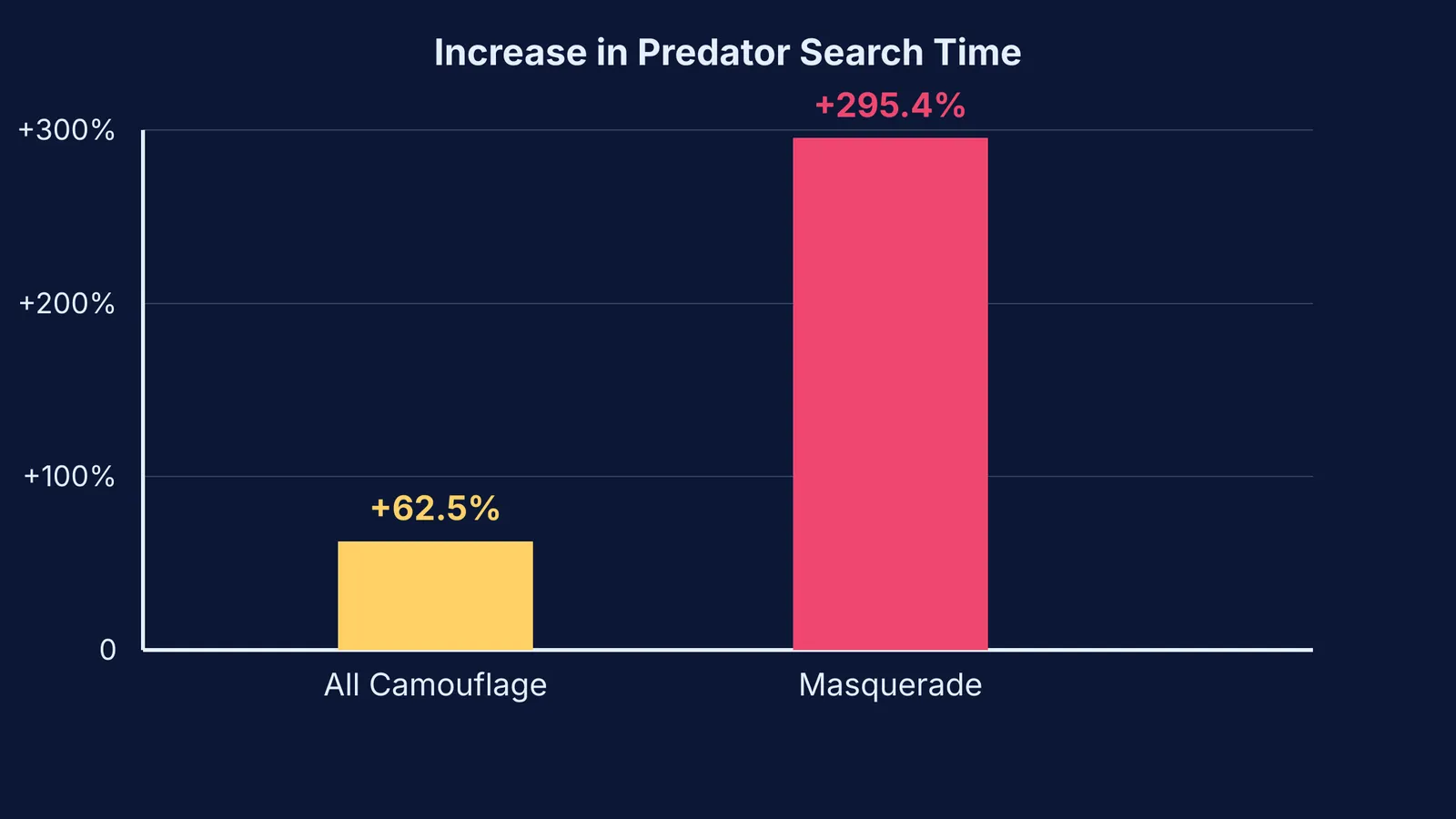
A 2022 meta-analysis of 91 studies published in *Proceedings of the Royal Society B* quantified this advantage. The researchers found that camouflage increases the time a predator spends searching for prey by an average of 62.5%. Furthermore, it decreases the likelihood of a prey animal being attacked by 27.3%.
Not all strategies are equally effective. The same study revealed that masquerade—like the stick insect mimicking a twig—is the most successful strategy overall, increasing a predator's search time by 295.4%. Background matching and disruptive coloration were also found to be highly effective ways to delay capture, though masquerade performed best.
Camouflage as an adaptation
Natural selection drives these incredible traits. Over millions of years, prey animals with better camouflage survived longer and produced more offspring, passing those helpful genes to the next generation. The individuals that stood out were quickly eaten, removing their genetic material from the gene pool. This process of mimicry and selection was famously observed by Henry Walter Bates and the butterflies that copy others in the Amazon rainforest.
This creates a continuous evolutionary arms race. As prey get better at hiding, predators develop sharper senses, improved visual acuity, and learn to "break" the camouflage through cognitive search images. A predator that learns what a hidden stick insect looks like will become much faster at finding the next one. In environments with intense competition, staying hidden is often a safer bet than standing out with bright warning colours, an idea linked to stabilising, directional and disruptive selection.
To understand how animals interact with their changing environments, scientists still rely on the foundational questions set out by Niko Tinbergen and the four questions of animal behaviour.
If you are studying evolution or adaptation for an exam, the Fermi Concept Library has every concept in biology mapped out, with its own lesson and interactive tutor. You can bring a topic like natural selection, and Fermi's AI tutor works out what you already know and builds a plan for the session to help you master the reasoning behind the biology.


