On this page
Microevolution and macroevolution use the same processes. The difference is scale: one population over a few generations, or whole new groups over millions of years. Here is one classic example of each, and a five-line way to write the answer.
What is microevolution?
Microevolution is the change in allele frequencies that occurs over time within a population, driven by mutation, selection, gene flow and genetic drift (Microevolution, Wikipedia).
The textbook case is the peppered moth, *Biston betularia*. During the Industrial Revolution in Britain, a black *carbonaria* form replaced the common pale *typica* form, driven by the interaction between bird predation and coal pollution. In 2016, geneticists found the mutation behind it: a transposable element inserted into a gene called *cortex*, an event they dated to around 1819 (van't Hof and colleagues, Nature, 2016). Their paper calls the moth "the iconic example of microevolutionary change".
The story also ran in reverse. Since 1970 melanism has declined rapidly in Britain as bark became less sooty. In a six-year experiment, Michael Majerus released 4,864 moths; his results, analysed after his death, showed strong bird predation against the dark form, with daily selection against melanics of about 0.1 (Cook and colleagues, Biology Letters, 2012).
Through all of this the moths stayed one species. Only the proportion of one allele changed. For the full story, read our explainer on how industrial melanism in the peppered moth works.
What is macroevolution?
Macroevolution comprises the evolutionary processes and patterns that occur at and above the species level (Macroevolution, Wikipedia).
The origin of whales is a clear example. Skeletons of the fox-sized *Ichthyolestes* and the wolf-sized *Pakicetus*, early Eocene whales, showed that whales are more closely related to artiodactyls (even-toed hoofed mammals) than to mesonychians, once proposed as their ancestors (Thewissen and colleagues, Nature, 2001). Partial skeletons of two protocetid whales from Balochistan, Pakistan, about 47 million years old, have ankle bones with features diagnostic of artiodactyls (Gingerich and colleagues, Science, 2001).
The raoellids, small Eocene artiodactyls from south Asia, turned out to be the sister group of whales. The raoellid *Indohyus* from India resembles whales in its ears, premolars and dense limb bones, and the chemistry of its teeth points to life wading in water (Thewissen and colleagues, Nature, 2007). So aquatic life in this lineage began before whales appeared. For why a whale is a mammal at all, see five clues that make a whale a mammal, not a fish.
What is the difference between microevolution and macroevolution?
Level: microevolution happens within one population or species; macroevolution happens at or above the species level.
Time: generations to centuries, versus millions of years.
Evidence: allele and trait counts in living populations, versus fossils, comparative anatomy and DNA across species.
Example: dark peppered moths becoming common, versus land mammals giving rise to whales.
Mechanism: the same in both. Mutation, selection, gene flow and drift.
How does microevolution add up to macroevolution?
The bridge is speciation. When part of a population is cut off by a river or a sea, its allele frequencies change separately. In time the two groups may no longer interbreed: a new species. Our piece on what a geographic isolation speciation simulation shows walks through that split.
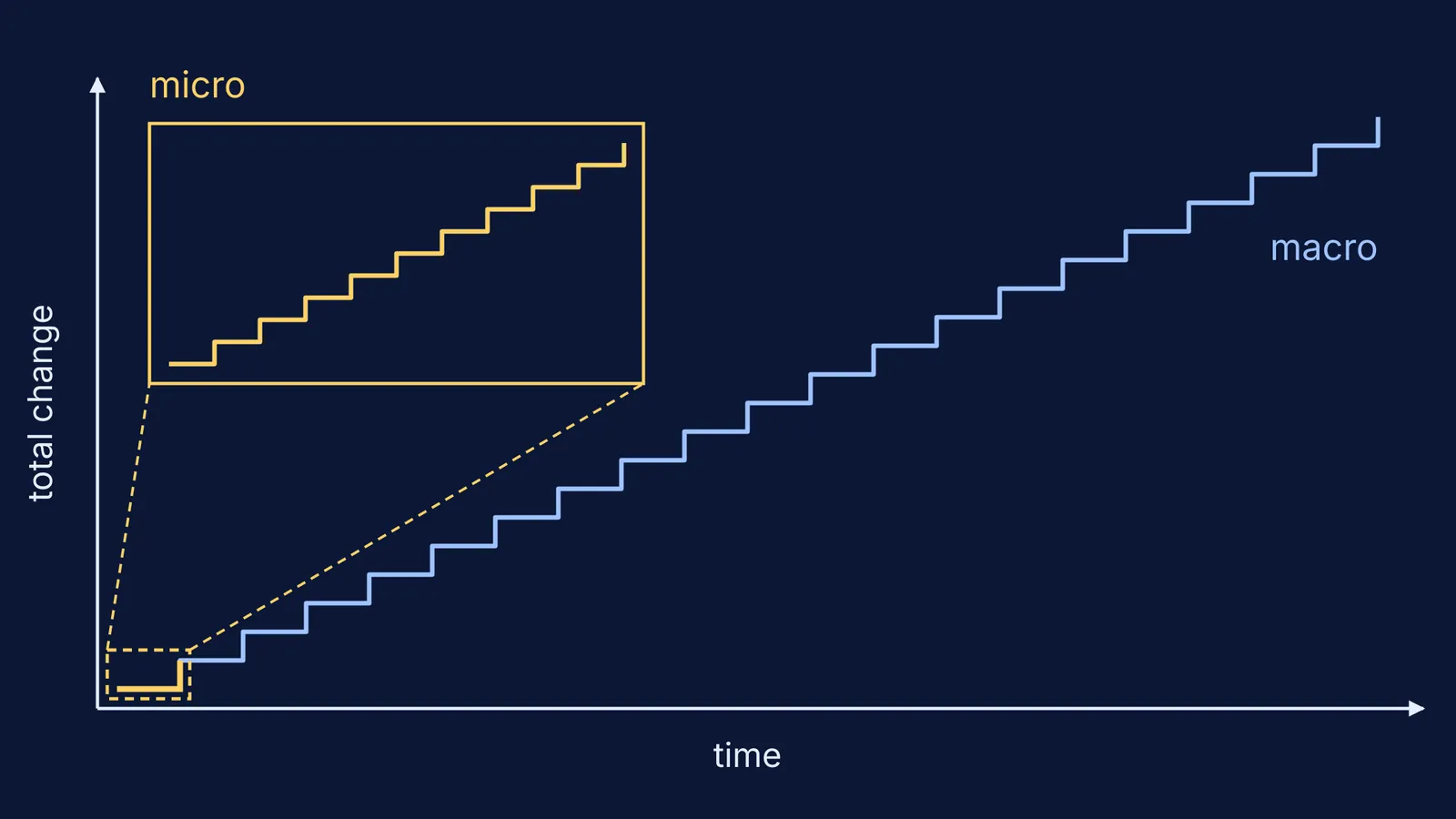
Suppose average snout length grows by 0.01% per generation, too little to notice. 1.0001 raised to the power 10,000 is about 2.7, so after 10,000 generations the snout is nearly three times as long. That is the idea of "added up": tiny steps, long time.
Real evolution is messier than steady compounding. A study of more than 8,000 body-size measurements from short-term studies, the fossil record and comparisons among species found that changes over intervals shorter than about 1 million years are bounded and do not accumulate, while over 1 to 360 million years divergence grows with time. The best-fitting model combined rare but substantial bursts of change with short-term fluctuations (Uyeda and colleagues, PNAS, 2011). The peppered moth is a reminder: dark moths rose and then fell. Macroevolution is microevolution that sticks.
Not sure where to start? Fermi's AI tutor can work out what you already know and build a plan for the session.
How do you write this in an exam answer?
Use this five-line frame for a short answer on micro versus macro:
Define microevolution: change in allele frequencies within a population.
Give the example: peppered moth, dark form favoured by birds on sooty bark.
Define macroevolution: change at or above the species level.
Give the example: whales arising from artiodactyl ancestors, shown by fossils.
Link them: the same processes, acting over long time and through speciation, add up to macroevolution.
If allele frequency or genetic drift feels shaky, the Fermi Concept Library gives every biology concept its own lesson. Then write the five lines from memory.