

On this page
A whale spends its whole life in the sea, has fins and a streamlined body, and never comes onto land. It looks like a fish. Biologists still group it with cows, bats and you, because animals are classified by how their bodies work, not by where they live. The NCERT Class 11 Biology chapter on the Animal Kingdom lists Balaenoptera, the blue whale, among its examples of viviparous mammals.
Why is a whale a mammal and not a fish?
The same NCERT chapter gives the test in one line: the most unique mammalian characteristic is milk-producing mammary glands that nourish the young (NCERT Biology Class 11, Animal Kingdom). It adds hair on the skin, a four-chambered heart, breathing by lungs, warm blood and, with a few exceptions, live birth. A whale has all of these, though its hair is easy to miss.
How does a whale breathe without gills?
Fish breathe with gills. NCERT notes that bony fishes have four pairs of gills, covered by an operculum on each side (NCERT). A whale has no gills. It breathes air with lungs, through blowholes on top of its head.
NOAA explains that a whale's blowholes connect directly to its lungs, so it can take a mouthful of water and breathe at the same time (NOAA Ocean Today: Whale anatomy). Lungs mean every whale must surface to breathe.
Are whales warm-blooded, and do they have hair?
Yes, whales are warm-blooded. NCERT describes mammals as homoiothermous, able to keep a constant body temperature, while fishes, amphibians and reptiles are poikilothermous, or cold-blooded (NCERT). Whales hold that heat in cold seas with blubber, which on a gray whale can be up to 10 inches thick (NOAA Ocean Today).
Hair is the tricky clue. A 2013 study in BMC Evolutionary Biology notes that no living whale keeps body hair after birth, except some snout hairs and hairs around the blowholes that act as sensory bristles in some baleen whales (Chen et al., 2013). On a humpback, each bump on the head, called a tubercle, contains a tiny hair that works as a sensor (NOAA Hawaiian Islands Humpback Whale Sanctuary).
How do whale calves drink milk underwater?
Humpback calves are born after an 11-month gestation, measure about 13 to 16 feet long, and stay near their mothers for up to a year before weaning (NOAA Fisheries: Humpback whale).
Researchers fixed video and motion tags to humpback calves on two US feeding grounds. In a 2020 PeerJ study led by Jennifer Tackaberry, nursing counted only when the calf's snout touched a mammary gland and milk was seen in the water, and the team recorded 11 nursing events averaging 23 seconds each (Tackaberry et al., 2020). A NOAA summary of the study describes the mother lining up with her calf and squirting thick, rich milk into its mouth.
Why does a whale's tail move up and down?
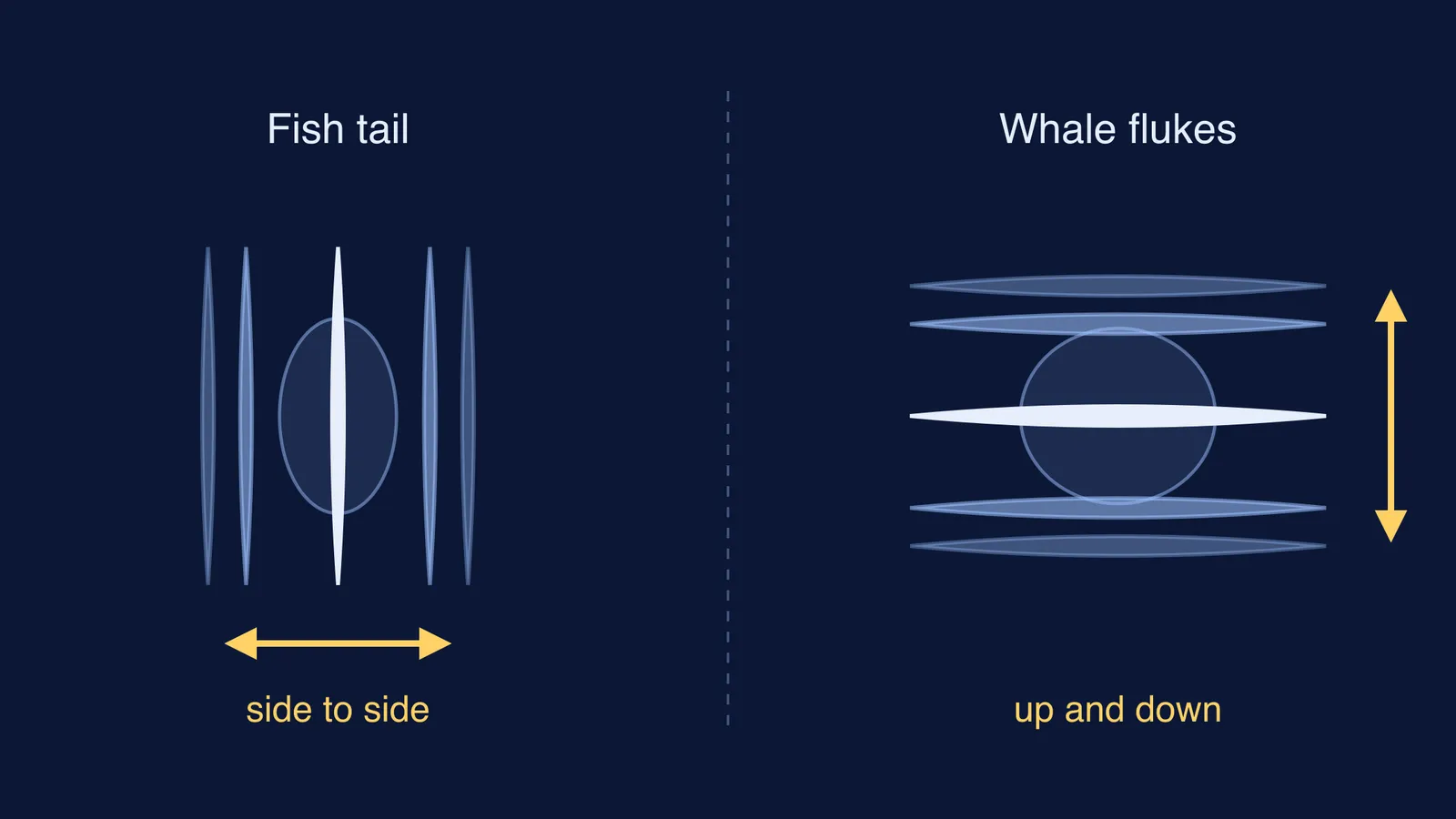
A whale's flukes lie flat, across the body, and beat up and down. Biologist Frank Fish describes whales using their axial (body) muscles to drive vertical oscillations of horizontally oriented flukes (Fish, 1998, in The Emergence of Whales). A 1999 review states the contrast: most fish undulate from side to side, while cetaceans move their body and tail vertically (Videler et al., 1999).
The reason is history. Whales moved into the water from land in the Eocene, and Fish's model links their lift-based swimming to galloping and bounding gaits, which flex the spine (Fish, 1998).
How do you write this in an exam answer?
Use five clues, in this order, to tell a whale from a fish:
Breathing: lungs and blowholes, or gills?
Body temperature: warm-blooded with blubber, or cold-blooded?
Birth: live young? (Careful: sharks too.)
Feeding the young: milk from mammary glands? This is the deciding clue.
Tail: horizontal flukes moving up and down, or a vertical fin moving side to side?
Worked example. Question (3 marks): Why is a whale placed in Class Mammalia although it lives in water?
Model answer: A whale has mammary glands and feeds its young on milk, the most distinctive feature of mammals. It breathes air with lungs through blowholes instead of gills, and it is homoiothermous, unlike cold-blooded fish. It gives birth to live young, and its horizontal tail flukes move up and down, unlike the vertical, side-to-side tail of a fish.
Now test yourself on two harder cases. A shark gives birth to live young but fails clues 1, 2, 4 and 5, so it is a fish. A platypus lays eggs, yet NCERT lists it as a mammal, and it passes clue 4. If the classes of vertebrates start to blur, the Fermi Concept Library covers every concept in biology, each with its own lesson and its place in the map.
Next time someone calls a whale a big fish, ask them one question: where does the calf's first meal come from?


