On this page
Every cell in your body runs on mitochondria, and those mitochondria carry their own small genome. Almost all of it came from your mother. This is not because the father contributes nothing at fertilisation: his sperm does bring mitochondria into the egg. What matters is what the egg does with them next, and how that shows up in a NEET or board pedigree question.
What is mitochondrial DNA?
Mitochondrial DNA (mtDNA) is a separate, circular genome kept inside each mitochondrion. In humans it spans about 16,500 base pairs and carries 37 genes, according to the US National Library of Medicine's MedlinePlus Genetics page. Your nuclear DNA is a 50:50 mix of both parents. mtDNA is not mixed and shuffled like that; it is copied and handed on as a whole.
Why is mitochondrial DNA inherited only from the mother?
Two things work together: numbers and deliberate destruction.
First, numbers. A mature egg contains more than 150,000 copies of mtDNA, while a sperm contains only about 100, according to a 2010 paper in Biology of Reproduction by Wai and colleagues. Even if every paternal copy survived, it would be outnumbered more than a thousand to one.
Second, destruction. The sperm's mitochondria sit in its midpiece, where they power the tail. After the sperm enters the egg, they are not kept. In 1999 Peter Sutovsky, Gerald Schatten and colleagues reported in Nature that sperm mitochondria in cow and monkey embryos carry ubiquitin, a protein tag that marks material for breakdown. Science News reported that the tag is added while sperm mature in the male, and that injecting antibodies that block ubiquitin into fertilised eggs let the paternal mitochondria survive.
Later work showed how the embryo clears them. In roundworm embryos, paternal mitochondria are removed by autophagy, the cell's own recycling system, which is triggered by fertilisation (Sato and Sato, Science, 2011). In mouse embryos, the same kind of clearance, called mitophagy, depends on the proteins PARKIN and MUL1 working as backups for each other (Rojansky, Cha and Chan, eLife, 2016).
If the steps around this moment are hazy, our posts on how sperm find the egg and the acrosome reaction during fertilisation cover what happens just before.
Can a father ever pass on mitochondrial DNA?
Very rarely, and the claims need care. In 2002 Marianne Schwartz and John Vissing described a 28-year-old patient whose muscle carried mtDNA from his father in the New England Journal of Medicine; The Scientist reported that the team also analysed his blood, hair roots and fibroblasts. In 2018 a PNAS paper by Luo and colleagues reported apparent biparental inheritance across three unrelated families.
A larger check followed. Wei and colleagues searched 11,035 parent-child trios and found the same signal in 7 of them, but in all 7 families the father had likely passed on large stretches of mtDNA-like sequence inserted into his nuclear chromosomes, as they reported in Nature Communications in 2020. They concluded there was no evidence of paternal transmission of mtDNA in humans. For school and entrance exams, maternal inheritance is the rule.
How do you trace mitochondrial inheritance in a pedigree?
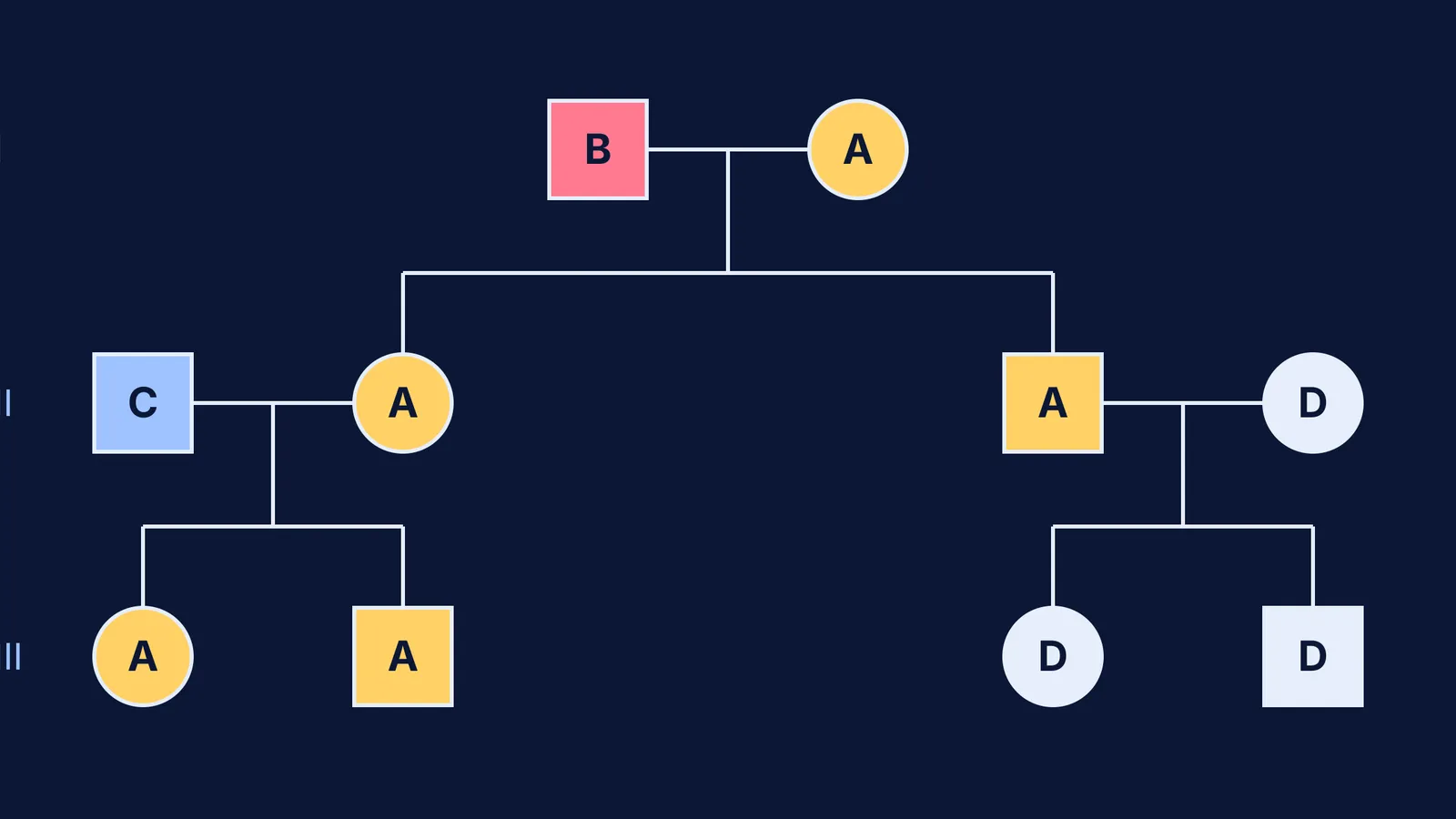
Use the pedigree in the diagram above. Each letter is an mtDNA type.
Generation I: the grandfather has type B and the grandmother has type A.
Generation II: their daughter and son both have type A, from their mother. The grandfather's type B stops here.
The daughter marries a man with type C. Both their children have type A, because it came through her.
The son marries a woman with type D. Both their children have type D. The son's type A ends with him.
Now apply the same three rules to any exam pedigree with a mitochondrial trait:
An affected mother passes the trait to all her children, sons and daughters alike.
An affected father passes it to none of his children.
Only daughters carry it into the next generation.
If you mix this up with Mendelian ratios, the principles of inheritance fill-in-the-blanks for NEET is a good recall drill.
How should you revise this topic?
Learn it as one chain, not as loose facts: egg brings many copies, sperm brings few, sperm mitochondria are tagged, the egg breaks them down, so the line runs through mothers. Then draw two pedigrees from memory, one mitochondrial and one X-linked, and say out loud how the fathers differ.
If a word in that chain is shaky, such as autophagy or ubiquitin, the Fermi Concept Library gives each biology concept its own lesson and shows where it sits in the map. When you get stuck on a pedigree question, the Fermi Problem Library has worked problems with a step-by-step solver that explains the reasoning rather than printing an answer.
Pick up the next pedigree in your question bank and check the fathers first.