On this page
Ask which blood group is most common in India and the honest answer is O, with B very close behind. Two large studies of Indian blood donors agree on that order, and their numbers are good enough to run a real genetics calculation, the kind you meet in Class 12 biology.
Which blood group is most common in India?
The 2014 study its authors describe as the first multicentric one in India, published in the Asian Journal of Transfusion Science, blood-grouped 10,000 healthy donors at blood banks in five regions of the country. O was the most common group at 37.12%, followed by B at 32.26%, A at 22.88% and AB at 7.74%.
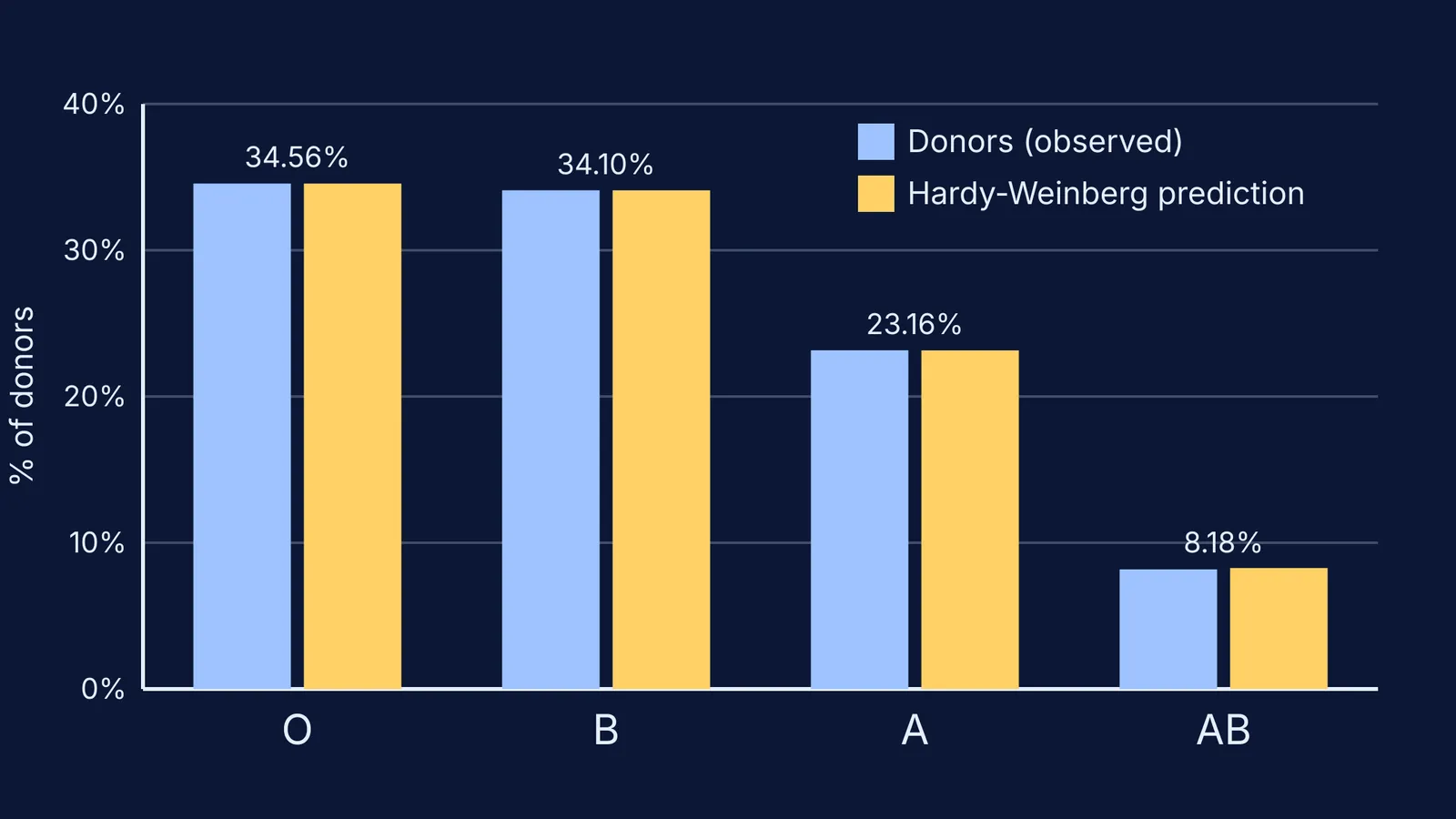
A larger systematic review by Patidar and Dhiman of AIIMS New Delhi pooled 112 studies from 23 states, covering 1,429,996 donors, from a literature search spanning 2001 to 2018. Its national figures were O 34.56%, B 34.10%, A 23.16% and AB 8.18%.
So the order is O, then B, then A, then AB. The gap between O and B is small: under half a percentage point in the review. O is the answer the data supports; B is a close second, and in some regions it leads.
How common is Rh-negative blood in India?
About 94 in every 100 Indian donors are Rh-positive. The 2014 study found 94.61% of donors Rh-positive (PubMed abstract), and the review found 94.13% Rh-positive and 5.87% Rh-negative (Patidar and Dhiman). That makes every Rh-negative group comparatively rare. Why a single gene decides this is covered in our explainer on how the Rh factor is inherited.
Does the most common blood group differ by region?
Yes. In the 2014 multicentric study, O was the most common group in every region except the north, where B led. The 2021 review reported B as common in central India (36.18% of donors) and O in the south (38.95%). Its authors suggest that environment and natural selection, along with genetics, help shape these regional patterns.
How do you calculate allele frequencies from blood group data?
ABO is controlled by one gene with three alleles: IA, IB and i (the O allele), as our post on ABO blood groups and multiple alleles explains. Call their frequencies p, q and r, with p + q + r = 1. Under Hardy-Weinberg equilibrium, O = r², A = p² + 2pr, B = q² + 2qr and AB = 2pq. The review estimated allele frequencies with Hardy-Weinberg; the 2014 study used a maximum likelihood method and tested the result against it.
Here is the calculation with the review's national figures:
O is r², so r = √0.3456 = 0.5879.
O and A together make (p + r)², so p + r = √(0.3456 + 0.2316) = √0.5772 = 0.7597, and p = 0.7597 − 0.5879 = 0.1718.
O and B together make (q + r)², so q + r = √(0.3456 + 0.3410) = √0.6866 = 0.8286, and q = 0.8286 − 0.5879 = 0.2407.
Check: p + q + r = 1.0004, which is 1 within rounding.
The review reports r = 0.5879, p = 0.1719 and q = 0.2402, so this quick method lands within 0.0005 of the published values. Predicted AB = 2pq = 2 × 0.1718 × 0.2407 = 0.0827, or 8.3%, against 8.18% observed. Predicted A comes to 23.2% and B to 34.1%, both matching what donors showed.
B blood is almost as common as O blood, yet the i allele (0.59) is more than twice as common as IB (0.24). Most i alleles are hidden inside people with group A or B, as IAi and IBi genotypes.
Rh works the same way with two alleles. Rh-negative people are dd, so d = √0.0587 = 0.2423 and D = 0.7577, matching the review. Carriers (Dd) are then 2 × 0.7577 × 0.2423 = 0.367: about 37% of donors carry a hidden d allele. For more practice with three alleles, see our step-by-step guide to Hardy-Weinberg for the ABO system.
What should you remember for exams?
Most common group in India: O, with B a close second; AB is the least common (Patidar and Dhiman).
Rh-positive: about 94% of donors.
Always find r first from √O, then p and q from the square roots of O + A and O + B.
Check your answer by predicting AB = 2pq and comparing it with the data.
Population averages never tell you your own group. Only a lab test does, and transfusion matching is done by blood bank staff and doctors.
If the square-root steps keep slipping, the Fermi Problem Library has worked problems with a step-by-step solver that explains the reasoning rather than printing an answer. For the idea behind the formula, the Fermi Concept Library gives each concept in biology and mathematics its own lesson.
Try the calculation once with your own class's blood groups, and Hardy-Weinberg will stop being a formula you memorise.