On this page
Many students can name the first three phyla of the animal kingdom. Then the middle blurs: does Annelida come before Aschelminthes? Here is a mnemonic checked letter by letter against the NCERT textbook, the reason behind the order, and a blank flowchart to fill in from memory.
What is the order of phyla in NCERT's Animal Kingdom chapter?
Chapter 4 of the NCERT Class 11 Biology textbook describes 11 phyla in sections 4.2.1 to 4.2.11, in this order:
Porifera (sponges)
Coelenterata (Cnidaria)
Ctenophora (comb jellies)
Platyhelminthes (flatworms)
Aschelminthes (roundworms)
Annelida
Arthropoda
Mollusca
Echinodermata
Hemichordata
Chordata
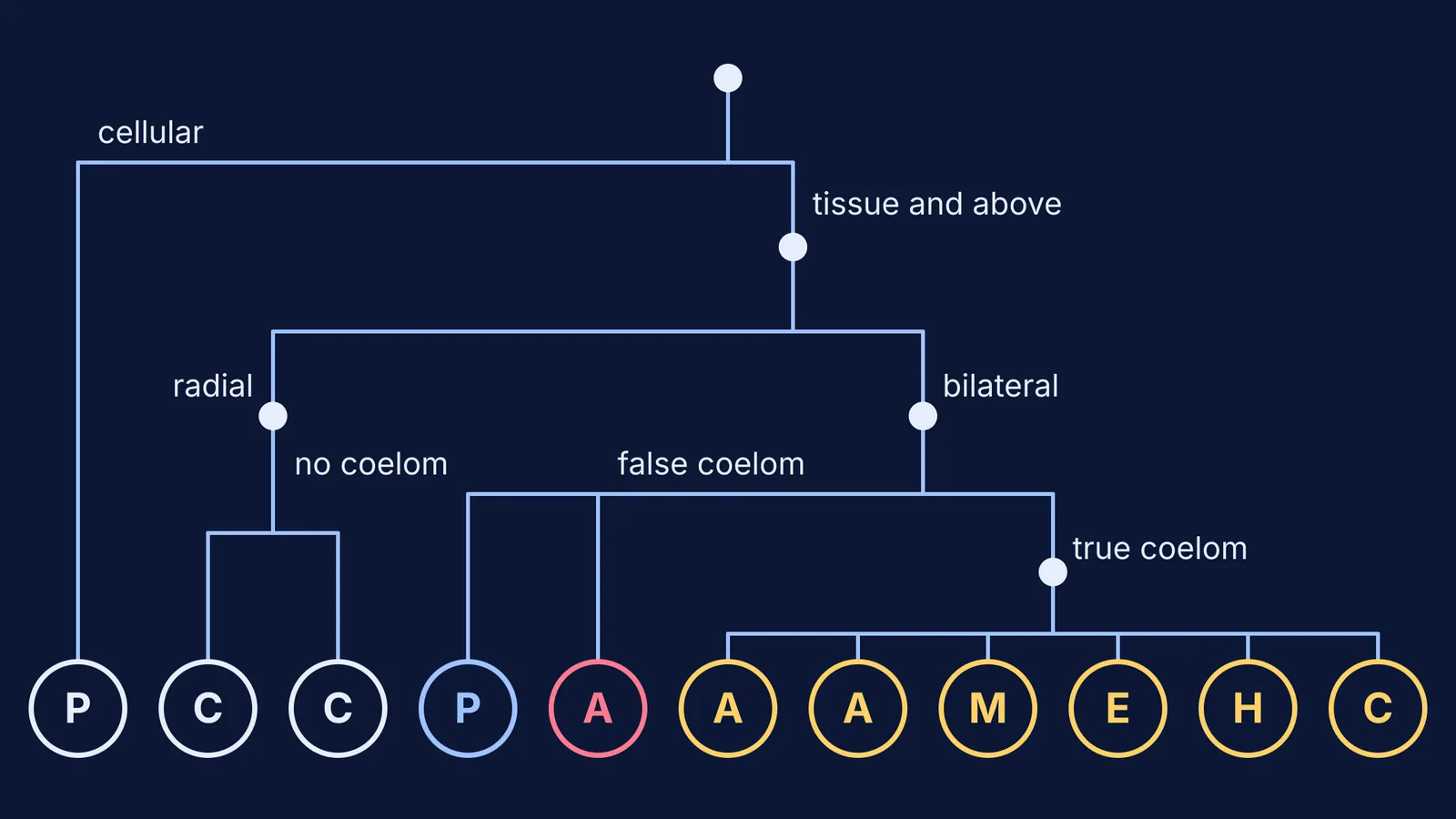
The same order appears as the leaves of the chapter's Figure 4.4, "Broad classification of Kingdom Animalia based on common fundamental features". That figure is the flowchart you will rebuild below.
What is a good mnemonic for the animal kingdom phyla order?
Here is ours: Polite Cows Can't Play; Ask Any Artist: Mostly Eating Hay, Chewing.
A plain first-letter mnemonic (P, C, C, P, A, A, A...) fails exactly where students get stuck, because three phyla start with A and two with C. So most words here match the first two letters of their phylum:
Polite = Porifera, Cows = Coelenterata
Can't = Ctenophora (the only C word with a t in it)
Play = Platyhelminthes
Ask, Any, Artist = Aschelminthes, Annelida, Arthropoda
Mostly = Mollusca, Eating = Echinodermata, Hay = Hemichordata
Chewing = Chordata
Test it the honest way: close this page, write the 11 phyla on paper, and only then check the list above.
Why does the phylum order follow increasing complexity?
Section 4.1 of the NCERT chapter sets out the basis of classification, with subsections on levels of organisation, symmetry, germ layers, coelom, segmentation and notochord. Read the phyla in order and each step adds something:
Porifera: cellular level of organisation, mostly asymmetrical.
Coelenterata and Ctenophora: tissue level, radial symmetry, two germ layers (diploblastic).
Platyhelminthes: organ level, bilateral symmetry, three germ layers, but no body cavity (acoelomate).
Aschelminthes: organ-system level with a false body cavity (pseudocoelom) and a complete gut.
Annelida: a true coelom and metameric segmentation.
Arthropoda: segmented, with jointed appendages; NCERT calls it the largest phylum, with over two-thirds of all named species.
Mollusca: the second largest phylum, coelomate but unsegmented.
Echinodermata: radially symmetrical adults, bilaterally symmetrical larvae, and a water vascular system.
Hemichordata: a stomochord, which NCERT describes as a structure similar to the notochord.
Chordata: a notochord, a dorsal hollow nerve cord and paired pharyngeal gill slits.
The climb is clean up to Annelida. After that, the six coelomate phyla are not a strict staircase: molluscs are unsegmented and adult echinoderms are radial. Read the last stretch as "heading towards the notochord", with Hemichordata as the near miss just before Chordata. Those breaks are where odd-one-out questions come from. If the three body-cavity types still blur, see our acoelomate, pseudocoelomate and coelomate examples.
How do you fill the blank flowchart from memory?
Copy this skeleton onto a blank page, close the book, and fill every blank:
Kingdom Animalia, cellular level of organisation: ____
Tissue level and above, split by symmetry: ____ or ____
Radial, no coelom: ____ and ____
Bilateral, no body cavity: ____
Bilateral, false coelom: ____
Bilateral, true coelom: ____, ____, ____, ____, ____, ____
Beside each phylum, one feature that earns its place (for example, comb plates or flame cells).
Then check against Figure 4.4 and mark every miss.
Why a blank page instead of rereading? In Roediger and Karpicke's 2006 study, students who took free-recall tests on prose passages retained more on final tests 2 days or 1 week later than students who restudied, even though restudying made students more confident. A 2013 review by Dunlosky and colleagues rated practice testing and distributed practice as high utility, and the keyword mnemonic as low utility. The mnemonic gives you the order; recalling the flowchart is what makes it stick.
A simple spacing plan:
Day 1: learn the mnemonic, fill the flowchart, fix the misses.
Day 3: fill it again from a blank page, adding one feature per phylum.
Day 7: fill it a third time, then write one example animal per phylum.
If a blank shows a concept you cannot explain, the Fermi Concept Library gives every biology concept its own lesson and its place in the map. If you are not sure where to start, Fermi's AI tutor can work out what you already know and build a plan for the session. For memory techniques beyond first letters, read about the method of loci and keyword method.
Once the order is solid, practise placing any animal in its phylum with six questions.