On this page
Most of your inheritance chapter is about genes in the nucleus, which you get half from each parent. Mitochondria break that rule, and pedigree questions test whether you notice.
Why is mitochondrial DNA passed only from the mother?
Mitochondria carry their own small genome. Human mitochondrial DNA spans about 16,500 base pairs and contains 37 genes, according to MedlinePlus Genetics. That DNA sits outside the nucleus, so it is not shuffled and halved in meiosis.
An egg is a large cell full of cytoplasm; a sperm is tiny and carries far fewer mitochondria. A 2014 review by Song, Ballard, Yi and Sutovsky in BioMed Research International notes that a single sperm contains about one thousand times fewer mtDNA molecules than an egg. The review also explains that sperm mitochondria which do enter the egg are tagged with ubiquitin, a protein label thought to mark them for breakdown. Sutovsky and colleagues reported this tag in a 1999 Nature paper titled 'Ubiquitin tag for sperm mitochondria'.
So in humans, your mitochondria come from your mother. MedlinePlus puts it plainly: only egg cells contribute mitochondria to the developing embryo, so fathers do not pass these disorders to their daughters or sons.
How do you recognise mitochondrial inheritance in a pedigree?
If the symbols are still shaky, start with our guide to what squares, circles and lines mean in a pedigree chart. Then look for four signs:
An affected mother has affected children of both sexes. Sons and daughters both get her mitochondria.
An affected father has no affected children. The trait stops with him.
The trait travels down the female line. Trace it from grandmother to daughter to grandchildren; it never passes through a man.
Both males and females are affected. MedlinePlus notes these conditions can appear in every generation and affect both sexes.
How is it different from X-linked inheritance?
X-linked traits also pass from mothers to sons, so check the children of both affected men and affected women.
In X-linked inheritance, fathers cannot pass the trait to their sons (MedlinePlus), but every daughter gets his only X. With a dominant trait, all his daughters are affected; with a recessive one, they are carriers, so he can have no affected children.
In mitochondrial inheritance, an affected father has no affected children, and an affected mother has affected sons and daughters, even with an unaffected husband. An X-linked recessive mother would have carrier daughters instead.
For the sex-chromosome side, see how to solve X-linked crosses for colour blindness and haemophilia, and first tell whether a pedigree is dominant or recessive.
Worked example: is this pedigree mitochondrial?
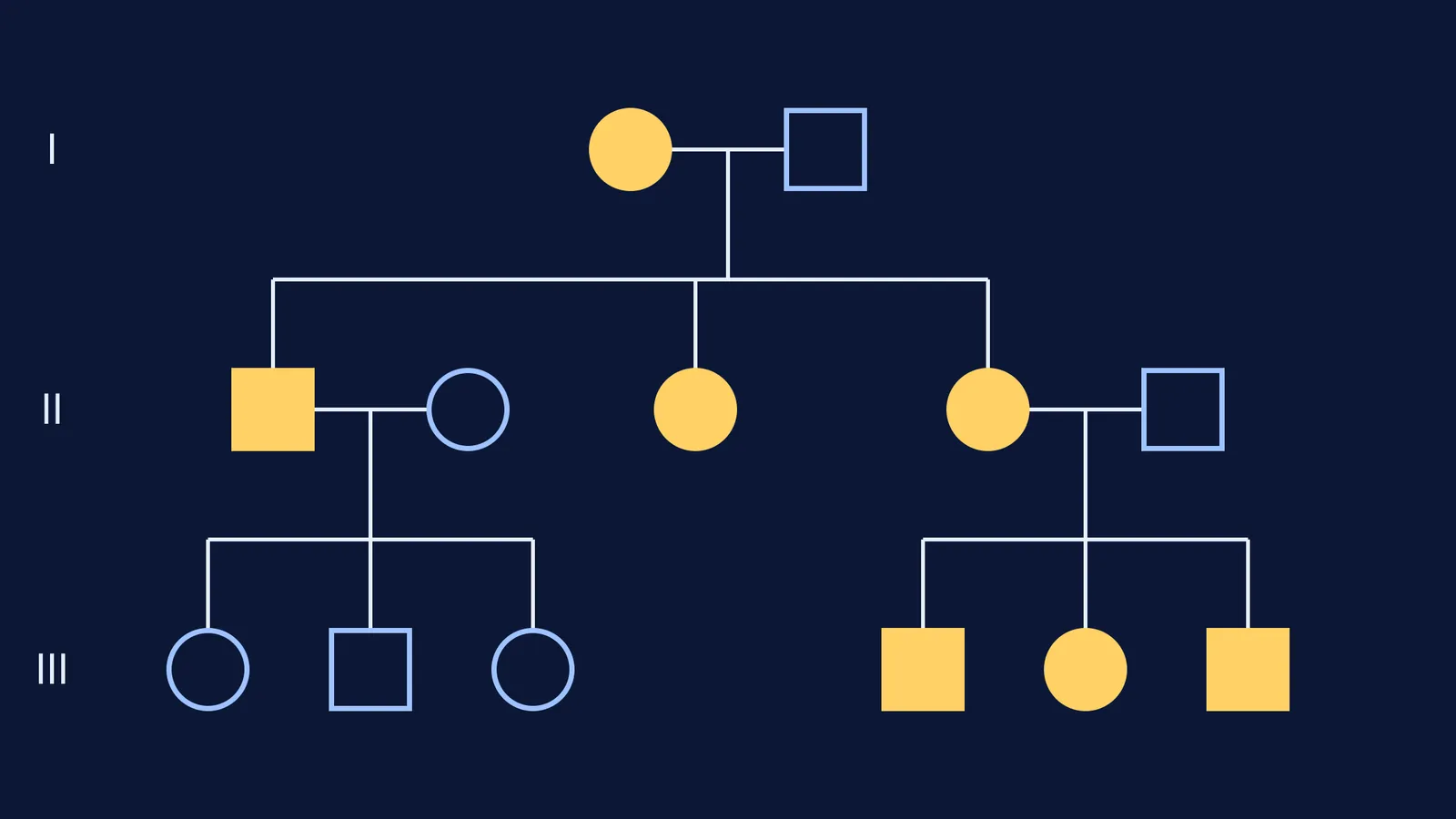
Use the diagram at the top, numbering people left to right in each generation, spouses included. In generation I, an affected woman (I-1) marries an unaffected man (I-2). They have an affected son (II-1) and two affected daughters (II-3, II-4). II-1 and his unaffected wife (II-2) have three unaffected children. II-4 and her unaffected husband (II-5) have three affected children: two sons and a daughter.
I-1 is an affected mother with all children affected. Her affected daughters rule out X-linked recessive and Y-linked.
II-1 is an affected father with no affected children. This rules out X-linked dominant and makes autosomal dominant unlikely.
II-4 is an affected mother whose sons and daughter are all affected. Consistent.
Autosomal recessive would need I-2 and II-5 both to be carriers and all six children to be affected: unlikely.
Verdict: the pattern fits mitochondrial inheritance best. In the exam, give the reason in one line: 'transmitted only through females; affected male II-1 has no affected offspring.'
If the cytoplasm-versus-nucleus idea is still fuzzy, the Fermi Concept Library has a lesson for every concept in biology, each with its place in the map. For practice, the Fermi Problem Library has worked problems with a step-by-step solver that explains the reasoning rather than printing an answer.
Are there exceptions to maternal inheritance?
A person can carry a mix of normal and altered mitochondria, called heteroplasmy, and MedlinePlus notes that the severity of many mitochondrial disorders is thought to track the percentage of altered mitochondria. Penetrance can also be incomplete. For Leber hereditary optic neuropathy, a cause of vision loss, MedlinePlus reports that more than 50 percent of males and more than 85 percent of females with a mutation never experience vision loss. So a mother who carries the change can have children who carry it but never show it; the father's side is the part that holds.
In 2018, Luo and colleagues in PNAS reported three unrelated families in which mtDNA seemed to come from both parents. A 2019 opinion article in Frontiers in Genetics argued that copies of mtDNA inserted into the nuclear genome could explain the result. For board and entrance exam answers, treat mitochondrial inheritance as maternal.