On this page
Every time DNA passes from parent to child, a few letters change. If those changes pile up at a steady pace, the differences between two species work like a stopwatch that started when they split. That stopwatch is the molecular clock.
What is the molecular clock in evolution?
The molecular clock is the idea that the distance between DNA or protein sequences grows roughly linearly with the time since two lineages separated (Yang and Donoghue, 2016).
In 1962, Emile Zuckerkandl and Linus Pauling used it to date the split of the alpha and beta globin genes and of humans and gorillas (Kumar and Hedges, 2016). A clock needs at least one known date, usually from fossils; the slope of distance against time then converts differences into years.
Why would differences tick steadily? Most of them reflect random genetic drift rather than selection. Comparing the chimpanzee and human genomes showed that evolution in protein-coding genes is dominated by the fixation of neutral and slightly harmful variants (Chimpanzee Sequencing and Analysis Consortium, 2005), and changes selection ignores pile up at about the rate they arise. For why shared sequences point to common ancestry, see molecular homology as evidence for evolution.
How do you calculate when two species split from DNA?
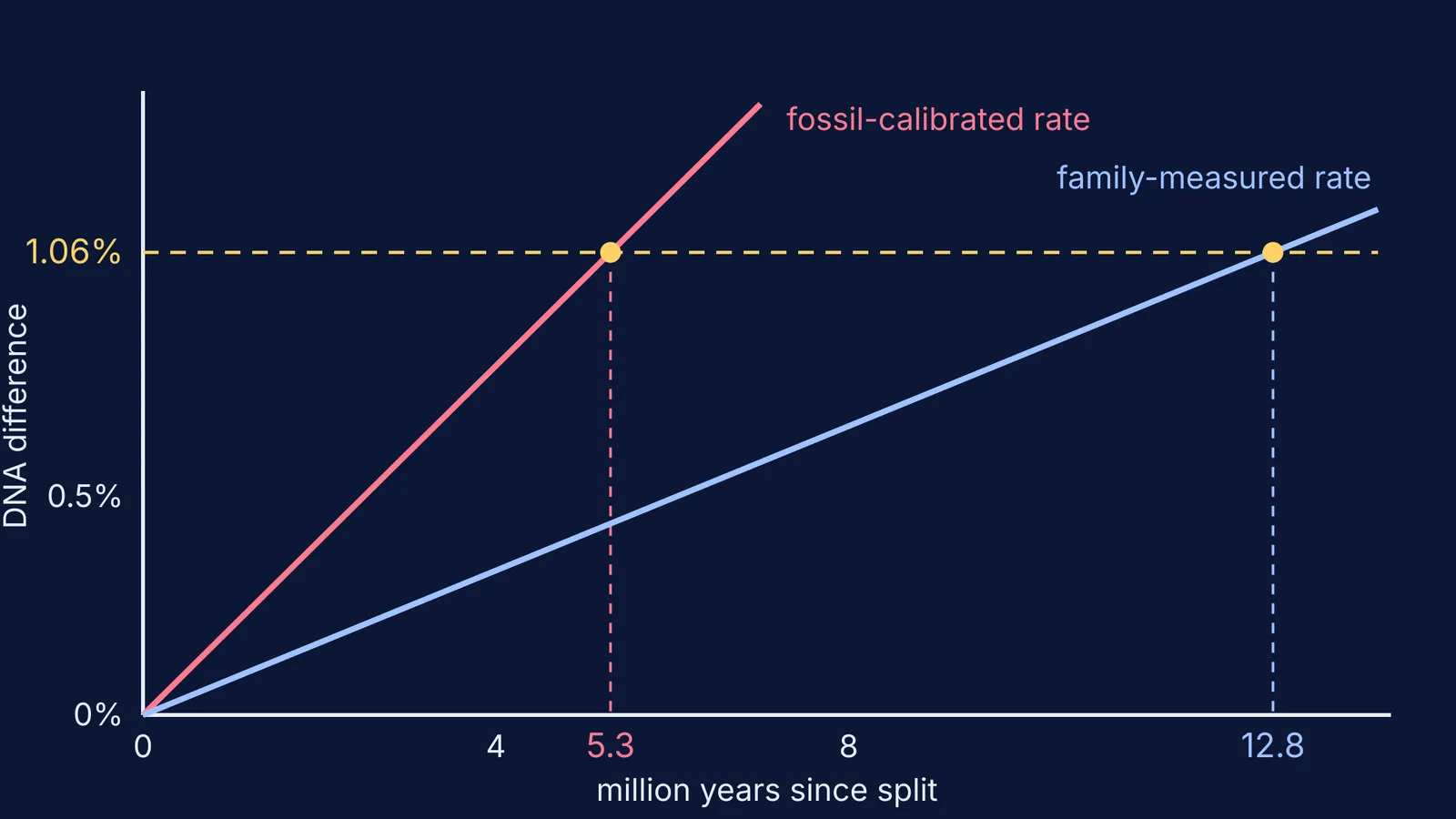
Here is the whole method, worked with real numbers. The 2005 chimpanzee genome paper measured a genome-wide single-letter divergence of 1.23% between human and chimpanzee, and estimated that once differences within each species are removed, the fixed divergence is about 1.06% or less (Chimpanzee Sequencing and Analysis Consortium, 2005).
Write the divergence per site: d = 1.06% = 0.0106.
Remember both lineages have been changing since the split, so each contributed about half: split time T = d / (2 x rate per site per year).
Use the older, commonly used fossil-calibrated rate of 1 x 10^-9 mutations per site per year (Langergraber and colleagues, 2012): T = 0.0106 / (2 x 10^-9) = 5.3 million years.
Now swap in a rate measured directly in families. Sequencing 78 Icelandic parent-child trios gave 1.20 x 10^-8 new mutations per letter per generation (Kong and colleagues, 2012).
Convert to years with a human generation time of about 29 years, the figure used by Langergraber and colleagues: 1.20 x 10^-8 / 29 = about 0.41 x 10^-9 per year.
Recalculate: T = 0.0106 / (2 x 0.41 x 10^-9) = about 12.8 million years.
Same DNA, two rates, and the answer more than doubles: the count of differences is precise, but the date is only as good as the rate. Direct measurements put the human mutation rate at roughly half the earlier fossil-based value (Scally and Durbin, 2012). Using measured generation times of wild chimpanzees and gorillas, Langergraber and colleagues dated the split to at least 7 to 8 million years, which they say need not conflict with 6- to 7-million-year-old fossils on the human lineage (PNAS, 2012).
Why is the molecular clock not perfectly steady?
The genome and family studies show where the clock wobbles (Chimpanzee Sequencing and Analysis Consortium, 2005; Kong and colleagues, 2012).
Chromosomes tick at different speeds: human-chimp divergence is 1.9% on the Y and 0.94% on the X, most likely because of a higher mutation rate in the male germ line.
Older fathers pass on about two extra new mutations per year of age, so the rate per generation depends on when people have children.
Generation times differ: wild chimpanzee parents average 24.6 years (Langergraber and colleagues, 2012), so one per-generation rate gives different yearly rates.
Genes split before species do. Gene copies in the shared ancestral population were already different, a gap the chimpanzee paper says may be on the order of 1 to 2 million years.
Fossil calibrations are uncertain, because a fossil's place on the tree is often ambiguous (Kumar and Hedges, 2016).
Modern studies use relaxed clocks, models that let the rate drift from branch to branch (Yang and Donoghue, 2016). Read any molecular date as a range, not a single number.
How can you check a molecular clock claim yourself?
When a textbook, news story or project source gives a divergence date, run through these questions:
What was compared: one gene, a protein, or whole genomes?
Is the divergence fixed between species, or does it include variation within them?
Is the rate per year or per generation, and what generation time was used?
Did the calculation divide by 2 for the two lineages?
Was the rate calibrated with fossils or measured in families?
Is a range given?
To place a date on a tree, see reading a phylogenetic tree or cladogram; for what happens at the split itself, see how geographic isolation leads to new species.
If the unit conversions in steps 4 to 6 trip you up, the Fermi Problem Library has worked problems with a step-by-step solver that explains the reasoning. For mutation, drift and speciation, the Fermi Concept Library gives each concept its own lesson.
Run the calculation once with a different rate, and you will see why every molecular date needs a range beside it.