

On this page
In a geographic isolation speciation simulation, you split a population with a physical barrier and watch them diverge through genetic drift and natural selection. While major evolutionary changes in nature take around 1 million years to persist (Uyeda et al., 2011), laboratory experiments show the beginnings of reproductive isolation can appear in as few as 40 generations (Dodd, 1989).
Evolution is often too slow to observe directly. You cannot stand by a river for a million years to see a population of beetles split into two distinct species. Instead, students and scientists use a geographic isolation speciation simulation to compress deep time into a few minutes, testing how physical barriers drive evolutionary change.
What splits a population?
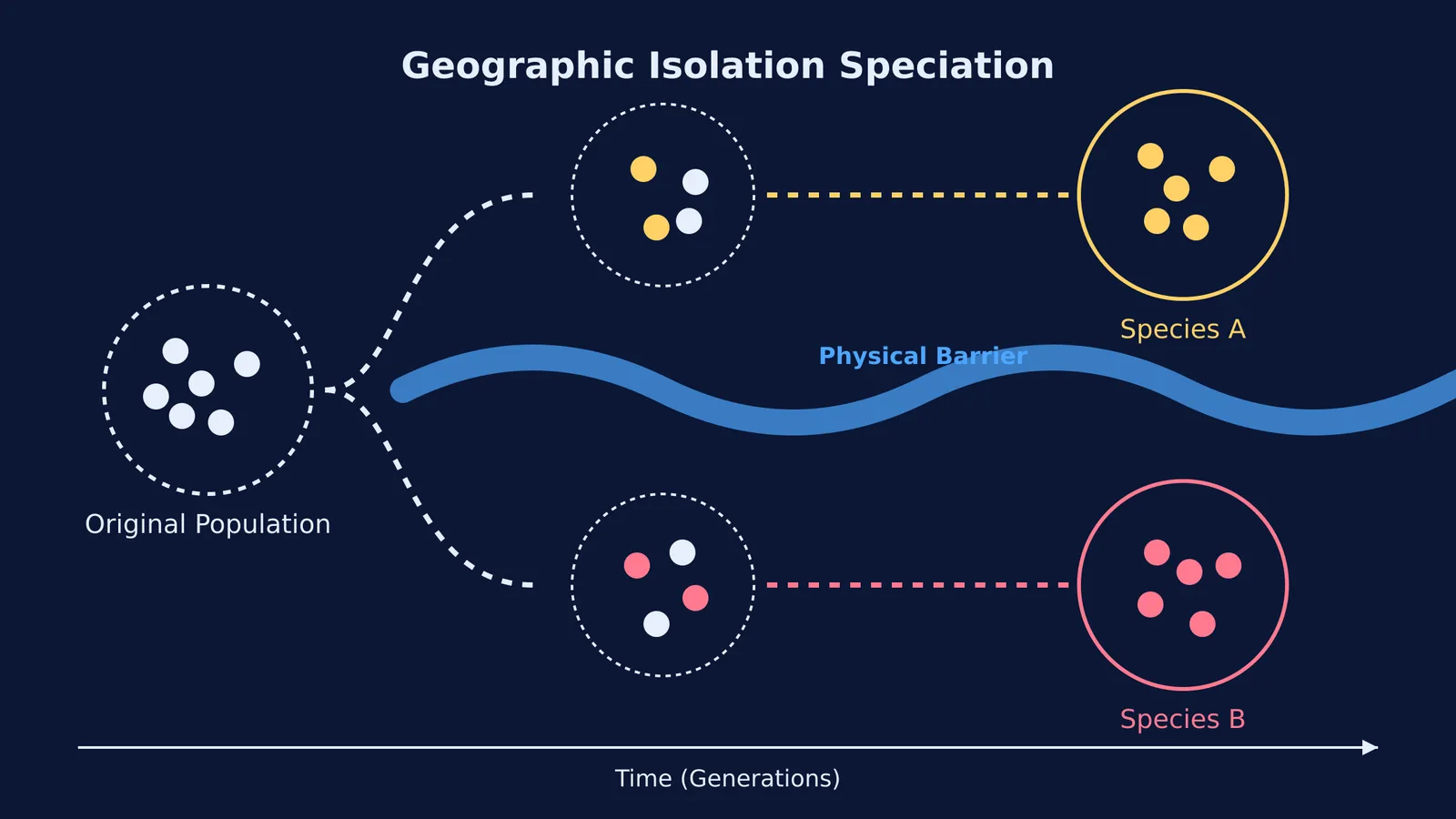
Geographic isolation, or allopatric speciation, begins with a physical barrier. A river changes course, a mountain range rises, or a few individuals are blown onto a remote island during a storm.
Once the barrier is in place, gene flow stops. The two populations can no longer interbreed or share new mutations. Over time, two distinct forces drive them apart:
Natural selection: The environments on either side of the barrier often differ. One side of the mountain might be drier, favouring plants with thicker cuticles to prevent water loss. As the populations adapt to their distinct habitats, their genetic makeup diverges.
Genetic drift: Even if the environments are completely identical, random chance will cause the populations to drift apart. Certain traits may become more common in one group simply because the individuals carrying them happened to reproduce more. This is especially true if one population is very small, an effect pioneered by Sewall Wright and genetic drift: why small populations wander.
Eventually, the two groups accumulate so many genetic differences that they can no longer interbreed if the barrier is removed. They have become separate species, a concept rooted in John Ray's seed test: an early definition of species.
How long does speciation take?
In the wild, speciation is a slow and halting process. A 2011 study of thousands of species found that it takes approximately 1 million years for major evolutionary changes to persist and accumulate across a broad range of lineages (Uyeda et al., 2011).
However, the earliest stages of reproductive isolation can begin much faster when the selection pressure is intense. In a classic 1989 experiment, evolutionary biologist Diane Dodd divided a single population of *Drosophila pseudoobscura* fruit flies into two groups (Dodd, 1989). She fed one group a starch-based diet and the other a maltose-based diet.
After about 40 generations (roughly one year of separation), the populations were reunited. Dodd found that the flies had developed a significant behavioural isolation. Despite being physically capable of mating, "starch flies" strongly preferred to mate with other "starch flies," and "maltose flies" preferred "maltose flies." The dietary adaptation had triggered the first steps of speciation.
How does a geographic isolation speciation simulation work?
A typical simulation lets you control the variables that are impossible to manipulate in the real world. You start with a single, uniform population roaming a virtual habitat.
Drop a barrier: You draw a river or a mountain through the middle of the habitat, instantly cutting off gene flow. The population is now divided into two isolated gene pools.
Change the environment: You can introduce different selective pressures. You might make the left side of the river colder, or introduce a new predator to the right side that only hunts brightly coloured individuals.
Run the clock: As generations tick by, you watch the distribution of traits shift in real-time histograms. You might see the left population evolve thicker fur, while the right population shifts towards a duller, camouflaged colour.
Test for isolation: Finally, you remove the barrier to allow secondary contact. If the simulation's "mating probability" between the two groups has dropped to zero, or if any hybrid offspring fail to survive, speciation is complete.
Testing the split yourself
Reading about mutations and gene flow can feel abstract, but changing the parameters and watching a population diverge makes the mechanics of evolution concrete. This hands-on approach reflects how Theodosius Dobzhansky and evolution seen through genetics bridged the gap between theoretical genetics and observable populations.
For interactive models of ideas that are easier to see than to read, the Fermi Simulation Lab allows you to explore complex STEM concepts visually. When you run a geographic isolation speciation simulation, you stop taking the millions of years of evolution on faith and start testing the mechanics yourself.


