On this page
A man can go on making sperm into old age. A woman is born with all the egg-forming follicles she will ever have, and that stock runs down until menopause. The difference comes down to one type of cell, and it is a common exam comparison.
Why can men produce sperm throughout life?
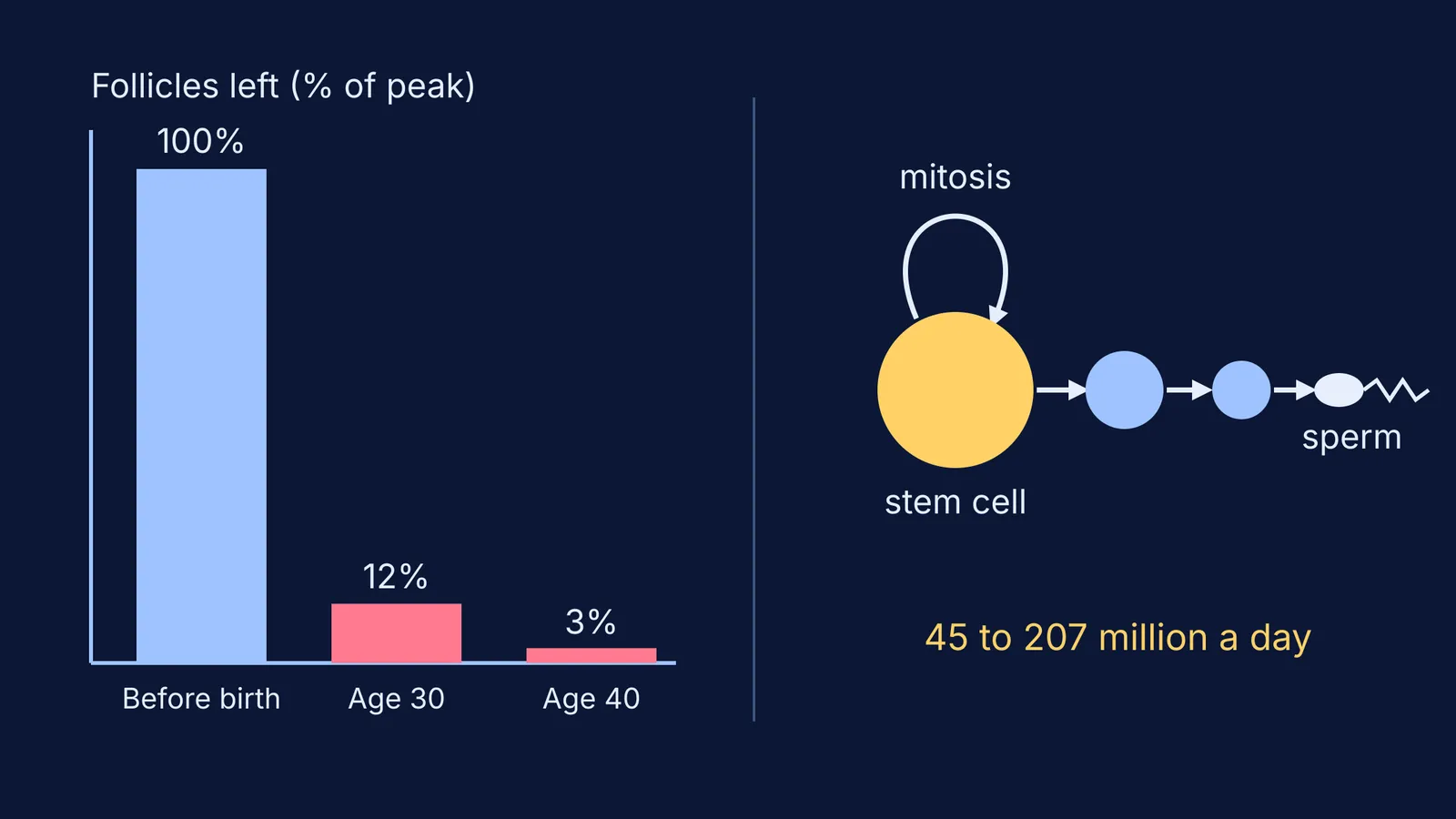
Because the testes keep a pool of stem cells. Spermatogonial stem cells (SSCs) are adult stem cells in the testis that can either copy themselves or start the path to becoming sperm, according to a 2022 review in Frontiers in Endocrinology by Diao and colleagues.
The key line from that review: SSCs “can undergo mitotic divisions for self renewal to maintain a steady stem cell pool or they can differentiate” into spermatozoa. Mitosis keeps the chromosome number the same, so a stem cell can make another stem cell as well as cells that go on to meiosis. The pool is topped up as it is used.
The same review says this balance is what keeps spermatogenesis going “throughout the life of the male”. Sertoli cells support the germ cells, and GDNF, a growth factor made by the surrounding niche cells, is critical for maintaining SSCs.
The output is large. In a classic study of 23 men, Amann and Howards (1980, Journal of Urology)55377-x) estimated that about two-thirds (67%) of men aged 20 to 50 probably produce between 45 million and 207 million sperm a day.
Why do women run out of eggs?
The ovary has no renewing stem cell pool of this kind. Wallace and Kelsey (2010, PLoS ONE), who modelled data on 325 ovaries from eight studies, describe “a fixed number of non-growing follicles (NGFs) established before birth” that falls with age until menopause.
In their model, the pool peaks at about 300,000 follicles per ovary on average, at 18 to 22 weeks after conception. For 95% of women, only 12% of that peak is left by age 30, and 3% by age 40. We go through the counts by age in are girls born with all their eggs?
Sperm vs eggs: what is the difference in lifelong output?
Use this list when a question asks you to contrast spermatogenesis and oogenesis:
Source: males have self-renewing spermatogonial stem cells; females have a follicle pool fixed before birth.
Refill: in males, mitosis tops up the stem cell pool; in females, nothing refills it.
Timing: sperm production starts at puberty; the egg pool is built before birth.
Output per meiosis: one primary spermatocyte gives four sperm; one primary oocyte gives one egg (see counting cells in gametogenesis).
With age: sperm production continues; the egg pool shrinks towards menopause.
A worked example: lifetime output in numbers
Take the daily range from Amann and Howards55377-x): 45 million to 207 million sperm a day, their estimate for about two-thirds of men aged 20 to 50. Assume the rate holds steady across those 30 years.
Days in those 30 years: 30 × 365 = 10,950 days.
Low end: 45 million × 10,950 ≈ 490 billion sperm.
High end: 207 million × 10,950 ≈ 2.3 trillion sperm.
Now the female side, from Wallace and Kelsey. Two ovaries at about 300,000 each give roughly 600,000 follicles at the average peak. By age 30, 12% of that is about 72,000. By age 40, 3% is about 18,000.
So on these figures, a man in that range makes more sperm in a single day than the average woman has follicles even at her peak before birth. This is a rough illustration, not a medical estimate, and real numbers vary between people. For questions about your own fertility, speak to a doctor.
Does lifelong production come with a cost?
It seems so. Sperm-forming cells keep dividing for decades, and each division is a chance for a copying error. Sequencing the genomes of 78 Icelandic parent-child trios, Kong and colleagues (2012, Nature) found about two more new mutations in a child for every extra year of the father's age, and estimated that paternal mutations double every 16.5 years.
How to write this in a 3-mark answer
Name the cell: spermatogonial stem cells in the testis.
Name the division: they renew themselves by mitosis.
Contrast: the female follicle pool is fixed before birth and only shrinks.
If mitosis and meiosis still blur together, the Fermi Concept Library gives each concept its own lesson and shows where it sits on the map. For the timeline, read how long spermatogenesis takes.