

On this page
Cell-counting questions on gametogenesis look like simple arithmetic. What they really test is whether you know which steps are divisions and which are not. "Gametogenesis-spermatogenesis & oogenesis" sits under Human Reproduction in Unit 6 of the NEET (UG)-2026 syllabus, finalised by the National Medical Commission and published by NTA. If you can trace one cell, you can work out the answer for any number of cells.
How many sperms form from one primary spermatocyte?
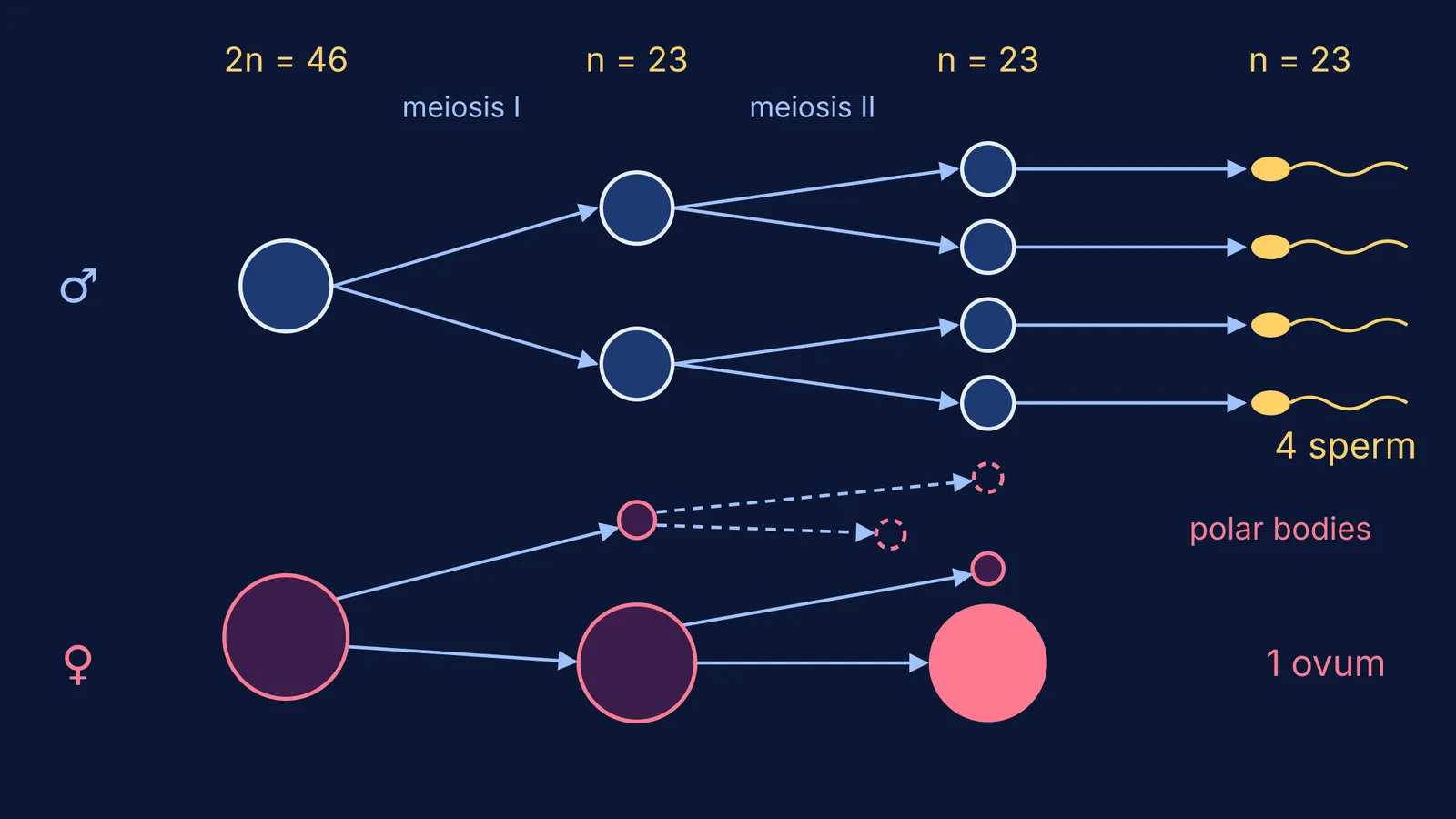
Four. According to the NIH StatPearls review of spermatogenesis, each diploid primary spermatocyte gives 2 haploid secondary spermatocytes, and each secondary spermatocyte gives rise to 2 haploid spermatids, making 4 haploid cells in all. The same review describes how spermatids then mature into spermatozoa through a series of changes in shape (spermiogenesis); there is no further division at this step.
Humans have 23 pairs of chromosomes, 46 in total, and gametes carry just one copy of each chromosome, so 23 (NHGRI chromosomes fact sheet). Follow the chromosome number through each stage:
Spermatogonium: diploid, 46 chromosomes; multiplies by mitosis
Primary spermatocyte: diploid, 46
Secondary spermatocyte: haploid, 23
Spermatid: haploid, 23
Sperm: haploid, 23
How do you count from any starting stage?
Count how many divisions are left before you reach a sperm. Each division doubles the number of cells. Maturation does not change it.
Starting from primary spermatocytes: multiply by 4 (two divisions left)
Starting from secondary spermatocytes: multiply by 2 (one division left)
Starting from spermatids: multiply by 1 (no division, only maturation)
Here is a worked set:
100 primary spermatocytes give 200 secondary spermatocytes, then 400 spermatids, then 400 sperm.
100 secondary spermatocytes give 200 spermatids and 200 sperm.
100 spermatids give 100 sperm.
Working backwards: 400 sperm need 400 spermatids, 200 secondary spermatocytes and 100 primary spermatocytes.
"How many meiotic divisions make 400 sperm?" If one complete meiosis counts as one division, the answer is 100. If meiosis I and meiosis II are counted separately, it is 100 + 200 = 300 cell divisions. Read the question carefully.
The same idea, tracing one cell and its chromosome sets, is used in our guide to ploidy of endosperm, nucellus and embryo sac. If the stages of meiosis feel shaky, revisit the cell cycle, mitosis and meiosis with chromosome counts first.
Why does one primary oocyte give only one ovum?
The OpenStax Anatomy and Physiology 2e chapter on the ovarian reproductive system sets out the steps. Primary oocytes form in the fetal ovary before birth and stay arrested in meiosis I. When meiosis I finishes, the cytoplasm divides unequally: the larger cell is the secondary oocyte, and the smaller one is the first polar body. Meiosis of the secondary oocyte is completed only if a sperm gets through its barriers, producing one haploid ovum and a second polar body. The first polar body may or may not divide, and either way it eventually breaks down.
The same chapter gives the numbers: the primary oocytes in the ovaries fall from one to two million in an infant to approximately 400,000 at puberty.
So counting from 100 primary oocytes:
Meiosis I gives 100 secondary oocytes and 100 first polar bodies.
If all 100 secondary oocytes are fertilised, meiosis II gives 100 ova and 100 second polar bodies.
Total polar bodies: 200 if the first polar bodies do not divide, 300 if they do.
Which counting traps should you watch for in NEET?
Work through this checklist before you mark an answer:
Spermatids and sperm are equal in number, because no division happens in between.
If the question starts at secondary spermatocytes, multiply by 2, not 4.
A secondary spermatocyte is haploid (23), not diploid.
An unfertilised secondary oocyte has not completed meiosis II, so it has not yet produced a second polar body.
Polar bodies per primary oocyte can be 2 or 3. If the options include both totals, check the wording about the first polar body.
Try these before checking the answers in brackets:
250 primary spermatocytes form how many sperm? (1,000)
60 secondary spermatocytes form how many spermatids? (120)
50 primary oocytes form how many ova, and at most how many polar bodies? (50 ova; 150 polar bodies)
800 sperm came from how many secondary spermatocytes? (400)
If you get one wrong, write out the chain of stages for one cell and find the step where your multiplier changed. The Fermi Problem Library has worked problems with a step-by-step solver that explains the reasoning rather than printing an answer. If the gap is in the idea rather than the arithmetic, the Fermi Concept Library gives every biology concept its own lesson and its place in the map.
For the rest of the chapter, including the menstrual cycle and its hormones, continue with human reproduction for NEET: gametogenesis, cycle and hormones.


