

On this page
If you are revising oogenesis for Class 12 or NEET-UG, one line in the NCERT chapter answers a question many people search for: are girls born with all their eggs? The short answer is yes. The longer answer is a countdown, and its numbers are the kind examiners like to test.
Are girls born with all their eggs?
Yes. The NCERT Class 12 Biology chapter Human Reproduction says oogenesis starts in the embryo, when "a couple of million gamete mother cells (oogonia) are formed within each fetal ovary; no more oogonia are formed and added after birth."
Those oogonia enter prophase I of meiosis and stop there; NCERT calls these arrested cells primary oocytes. Each primary oocyte is wrapped in a layer of granulosa cells, and the pair is a primary follicle (NCERT). So a baby girl is born with her whole stock of future eggs already made, paused partway through their first division. We explain the two pauses in detail in when oogenesis completes meiosis.
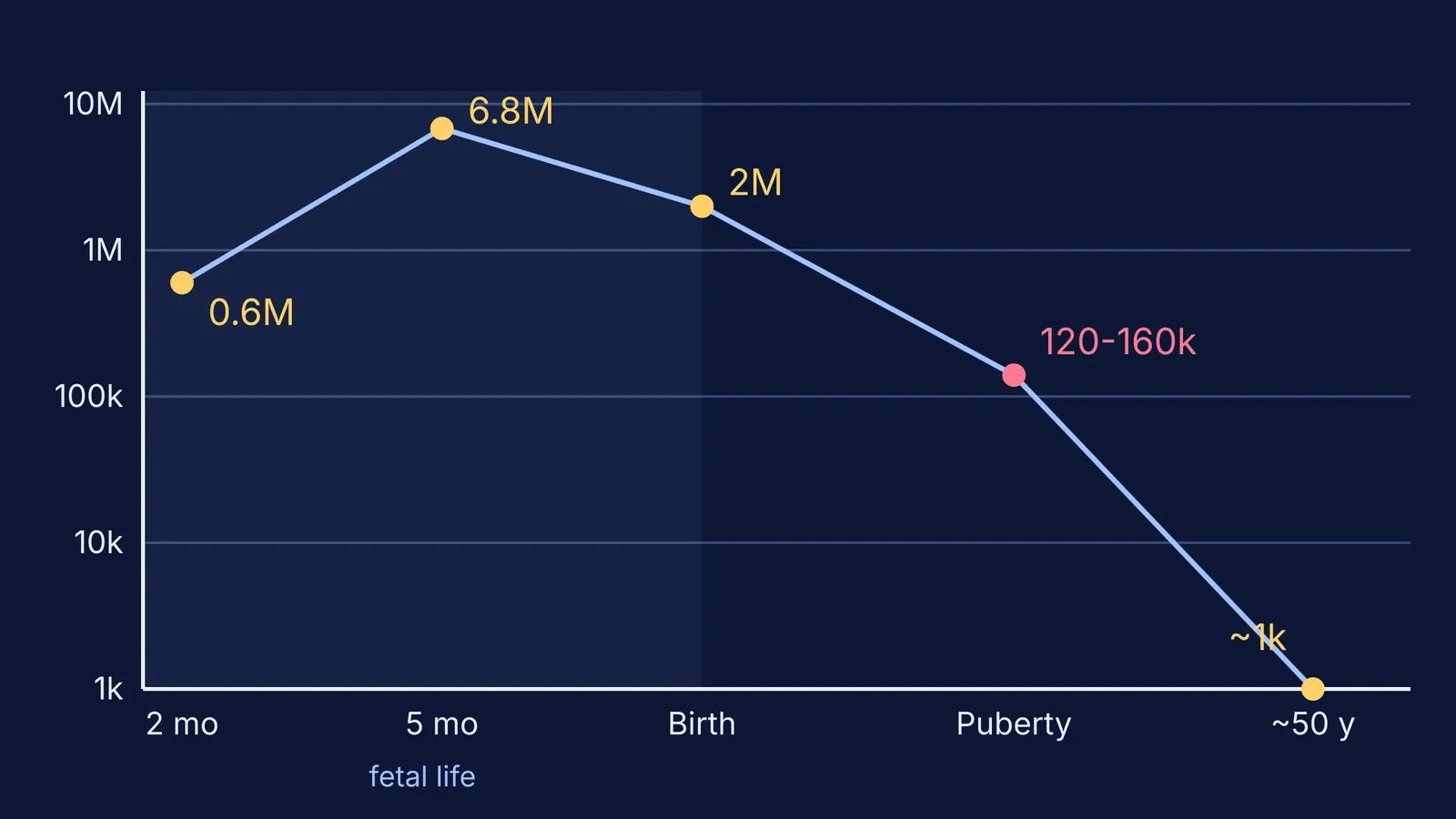
How many eggs does a girl have at each age?
2 months after conception: about 600,000 germ cells in both ovaries together, in the classic counts by T. G. Baker (Proceedings of the Royal Society B, 1963).
5 months after conception: the peak, about 6.8 million germ cells (Baker, 1963).
Birth: about 2 million germ cells remain, about half of them already degenerating (Baker, 1963).
Puberty: only 60,000-80,000 primary follicles are left in each ovary (NCERT).
Age 30 and 40: a model of human ovarian reserve estimated that by 30 only 12% of the pre-birth maximum of non-growing follicles is present, and by 40 only 3% (Wallace and Kelsey, PLoS ONE, 2010).
Menopause: menstrual cycles cease around 50 years of age (NCERT). Defining menopause as fewer than 1,000 follicles left, Wallace and Kelsey's model predicts it at 49.6 years.
Only some 400 oocytes are ovulated across all the menstrual cycles of a lifetime (Kerr and Rodgers, Human Reproduction Update, 2025).
What is follicular atresia?
Atresia is the name for the degeneration of follicles, and the oocytes inside them, without ever being ovulated. NCERT describes it without the label: "a large number of these follicles degenerate during the phase from birth to puberty" (NCERT). Baker's 1963 study described three waves of germ cell degeneration in the ovaries he examined (Baker, 1963).
Atresia, not ovulation, is how almost every egg is lost. A quick worked example makes that concrete:
Follicles at puberty, both ovaries: 2 x 60,000 = 120,000 at the low end, 2 x 80,000 = 160,000 at the high end (NCERT).
Eggs ovulated in a lifetime: about 400 (Kerr and Rodgers, 2025).
Share ovulated: 400 / 160,000 = 0.25%, and 400 / 120,000 = about 0.33%.
So more than 99.6% of the follicles present at puberty are never ovulated; almost all of them are lost to atresia.
This also explains a classic odd-one-out: NCERT notes that sperm formation continues even in old men, while formation of ovum ceases in women around the age of fifty (NCERT).
Why do books give different egg numbers?
Because researchers counted different things, in small samples. Baker counted all germ cells. Wallace and Kelsey modelled only non-growing follicles and got a peak of about 300,000 per ovary at 18-22 weeks after conception (PLoS ONE, 2010).
A 2025 review by Jeffrey Kerr and Raymond Rodgers went further: it says Baker's calculations have not been confirmed in the six decades since, and that other estimates are generally lower, often by a factor of 10 (Human Reproduction Update). The basic pattern, a stock made before birth that shrinks with age, is not in question; the size of the fetal peak and how many cells die before birth are.
For school and entrance exams, stick to the NCERT wording. Quote research figures only when a question asks about a study.
How do you memorise the egg timeline?
Try this three-step plan the night before a test.
Draw the curve: a sharp rise in fetal life, a steep fall to birth, a slow slide to puberty, then to menopause.
Pin four NCERT labels on it: millions per fetal ovary, none added after birth, 60,000-80,000 per ovary at puberty, menopause around 50 (NCERT).
Test yourself with three questions: When are primary oocytes formed? What is the stage of arrest? Why do so few follicles reach ovulation?
If your answers to question 2 or 3 are shaky, the Fermi Concept Library covers every concept in biology, each with its own lesson, and the Fermi Problem Library has worked problems with a step-by-step solver that explains the reasoning rather than printing an answer.
Next, put names to the stages in follicle stages from primary to Graafian, and fix the two end points of the timeline with menarche and menopause definitions.


