On this page
Menarche and menopause mark the two ends of the menstrual cycle story, and both are worth knowing as one-line definitions. Here is what NCERT says, where each sits on the timeline, and how both link to Figure 2.9.
What is menarche in Class 12 Biology?
Section 2.4 (Menstrual Cycle) of the chapter Human Reproduction says: "The first menstruation begins at puberty and is called menarche" (NCERT Class 12 Biology, Chapter 2).
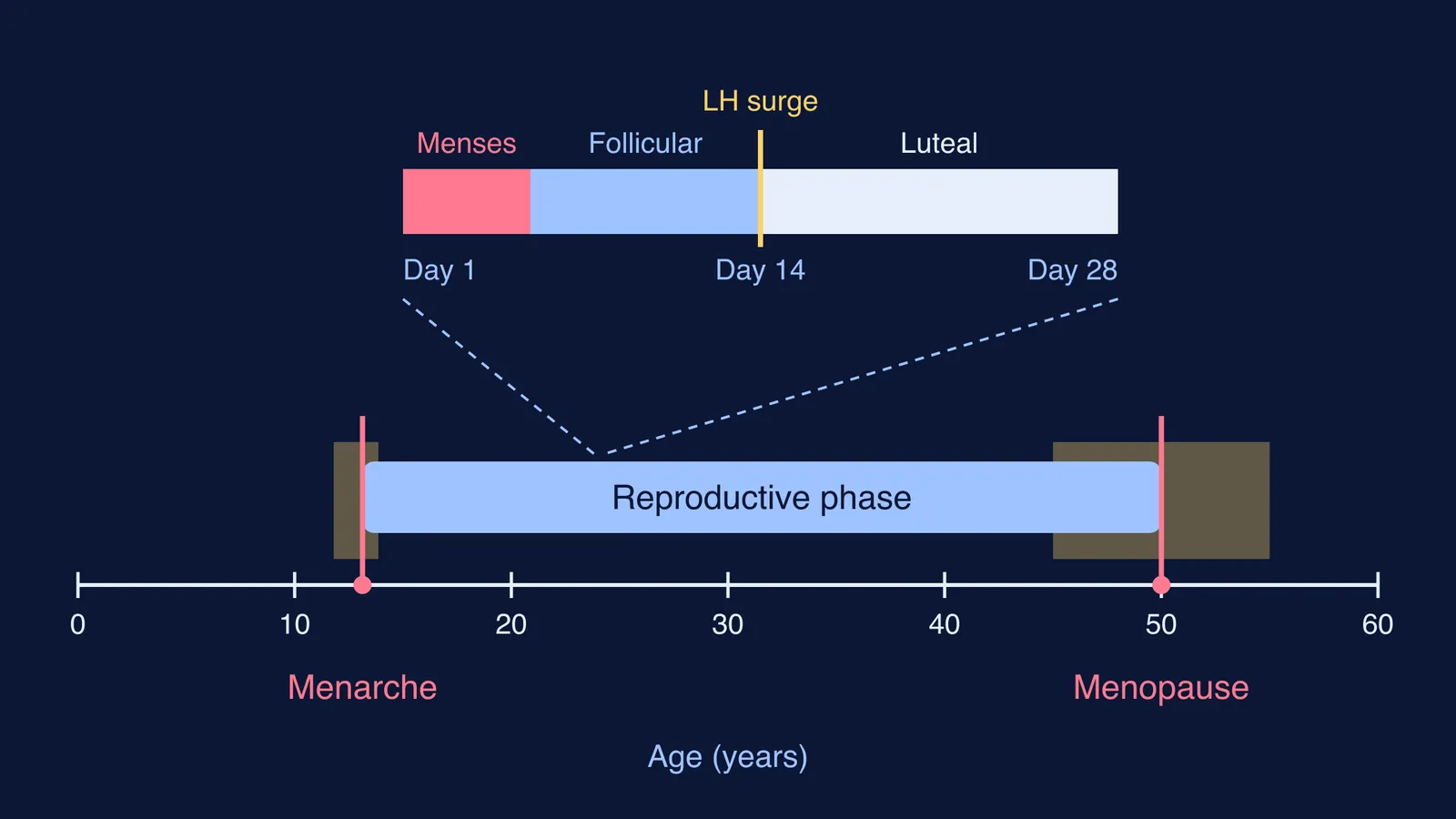
The textbook gives no age, but Indian studies do. A 2023 prospective study of 470 girls in Barabanki, Uttar Pradesh, found a mean age at menarche of 13.13 years (Bajpai et al., Cureus, 2023). The same paper reviews Indian studies from 2000 onward, which report averages from about 11.8 to 13.86 years depending on the region. In the exam, write "at puberty"; the age is background.
Egg-making starts much earlier: NCERT's Figure 2.8 places the start of oogenesis in fetal life. Our explainer on why oogenesis pauses midway through meiosis follows that thread, and our guide to the body changes of puberty covers what else changes at this age.
What is menopause in NCERT?
The same section says: "In human beings, menstrual cycles ceases around 50 years of age; that is termed as menopause" (NCERT Class 12 Biology, Chapter 2).
The World Health Organization adds the definition it uses: natural menopause is deemed to have occurred after 12 consecutive months without menstruation, with no other obvious cause (WHO menopause fact sheet). WHO says women generally reach menopause between the ages of 45 and 55. It also gives the cause in one line: menopause is caused by the loss of ovarian follicular function and a decline in circulating oestrogen levels.
Where do menarche and menopause sit on the reproductive timeline?
NCERT links the two in one sentence: "Cyclic menstruation is an indicator of normal reproductive phase and extends between menarche and menopause" (NCERT Class 12 Biology, Chapter 2). Read the timeline in four steps:
Before birth: oogenesis begins (Figure 2.8).
Puberty: menarche, the first menstruation.
Reproductive phase: cycles repeat at an average interval of about 28/29 days, and stop during pregnancy.
Around 50 years: menopause, when the cycles stop for good.
How are menarche and menopause linked to the menstrual cycle hormones?
NCERT's Figure 2.9 tracks four hormones across each cycle between the two endpoints. Section 2.4 describes the sequence (NCERT Class 12 Biology, Chapter 2):
Menstrual phase: the endometrium and its blood vessels break down, and the flow lasts 3-5 days.
Follicular phase: LH and FSH rise gradually, the follicles grow and secrete estrogens, and the endometrium regenerates.
Mid-cycle, about the 14th day: LH and FSH peak, and the LH surge ruptures the Graafian follicle and releases the ovum (ovulation).
Luteal phase: the corpus luteum secretes large amounts of progesterone, which maintains the endometrium. Without fertilisation, the corpus luteum degenerates and menstruation begins a new cycle.
So menarche is the first menstrual flow, the start of this loop, and menopause is when the loop stops. To watch the curves rise and fall, try our interactive guide to menstrual cycle hormones next to Figure 2.9.
Exam-ready one-line definitions
These follow NCERT's own wording in Section 2.4 (NCERT Class 12 Biology, Chapter 2):
Menarche: the first menstruation, which begins at puberty.
Menopause: the stopping of menstrual cycles, around 50 years of age in humans.
Reproductive phase: the span between menarche and menopause, marked by cyclic menstruation.
Menstrual cycle: the events from one menstruation to the next, repeated at an average interval of about 28/29 days.
Worked example. Try this question: "A human female experiences two major changes, menarche and menopause, during her life. Mention the significance of both." A short answer:
Menarche is the first menstruation at puberty. It marks the beginning of the reproductive phase.
Menopause is the stopping of menstrual cycles around 50 years of age. It marks the end of the reproductive phase.
Cyclic menstruation between the two indicates a normal reproductive phase.
Before you submit, check your answer against these four slips:
Writing "first ovulation" for menarche.
Giving a fixed age for menarche as if it were part of the definition.
Mixing up menses (a phase of each cycle) with menarche (a one-time event).
Leaving out the significance when the question asks for it.
If a definition keeps slipping because the hormone loop underneath is hazy, the Fermi Concept Library covers every concept in biology, each with its own lesson and its place in the map. For practice, the Fermi Problem Library has worked problems with a step-by-step solver that explains the reasoning rather than printing an answer.