

On this page
Adolescence often feels like an unpredictable wave of physical disruptions, from sudden growth spurts and voice cracks to oily skin and shifting body shapes. In human physiology, however, puberty is not random chaos. It is a strictly choreographed neuroendocrine program governed by the hypothalamic-pituitary-gonadal (HPG) axis. Every visible change—whether in the vocal cords, the hair follicles, or the epiphyseal plates of long bones—stems from precise chemical messengers activating specific tissue receptors.
Understanding these mechanisms turns confusing bodily milestones into clear science for teenagers and parents alike.
What hormonal trigger starts puberty in the human body?
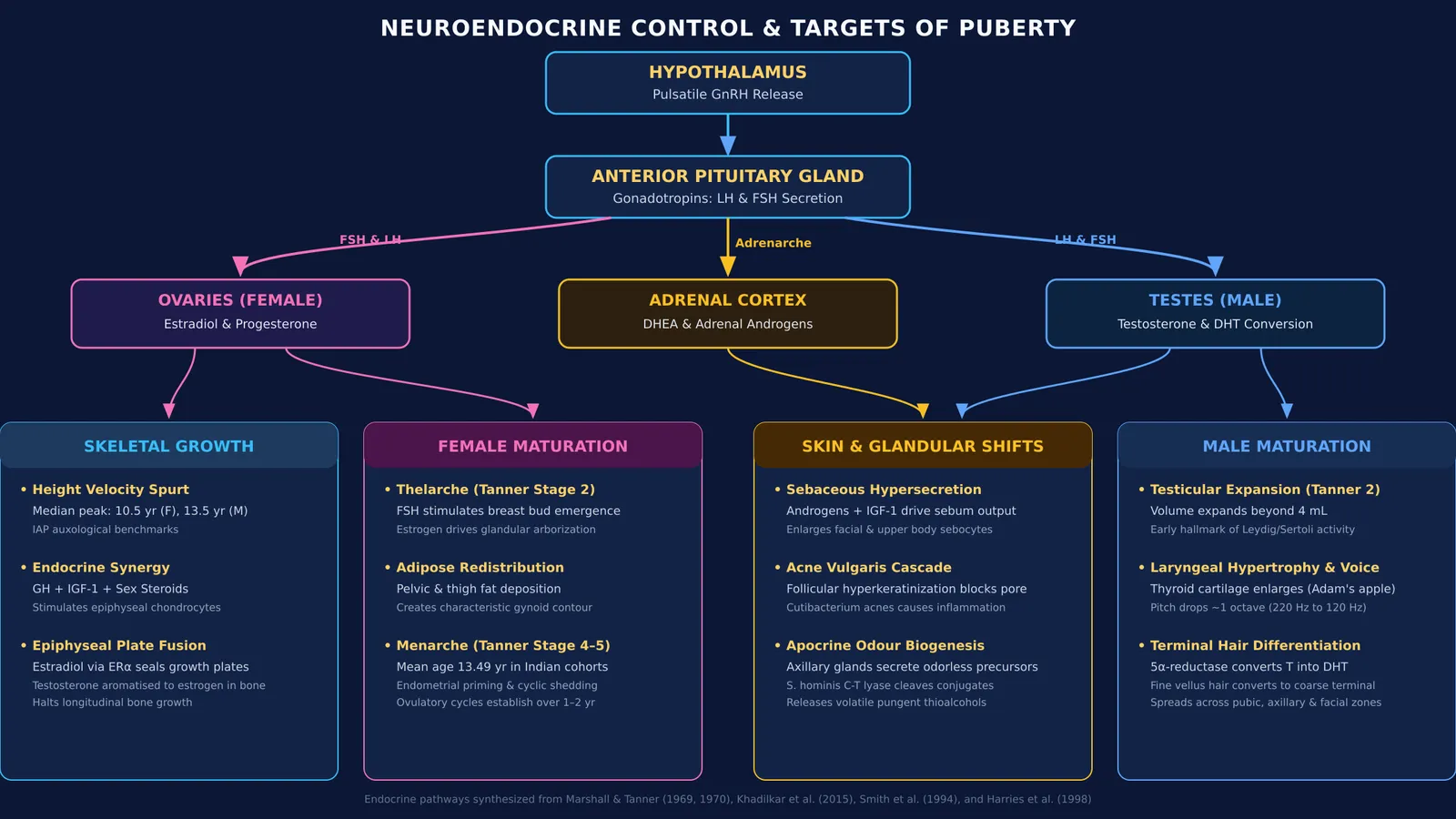
Puberty begins quietly in the brain. During mid-childhood, higher cortical regions keep the HPG axis suppressed. The transition begins when specialized neurons in the arcuate nucleus and preoptic area of the hypothalamus awaken, releasing pulses of gonadotropin-releasing hormone (GnRH), initially during deep sleep.
GnRH travels through the hypophyseal portal circulation to the anterior pituitary gland, as detailed in our guide to chemical coordination for NEET. There, it binds to surface receptors on gonadotrope cells, triggering the release of two glycoprotein hormones into the bloodstream:
Luteinizing Hormone (LH): In males, LH stimulates Leydig cells in the testes to synthesize and secrete testosterone. In females, LH pulses stimulate the ovarian theca cells and later trigger ovulation.
Follicle-Stimulating Hormone (FSH): In males, FSH targets Sertoli cells in the seminiferous tubules to support spermatogenesis. In females, FSH stimulates ovarian follicle maturation and drives granulosa cells to convert androgens into estrogens, predominantly estradiol.
As these sex steroids enter circulation, they initiate downstream physical transformations while establishing closed hormonal feedback loops with the brain to regulate future hormone release.
Why do height, voice, and hair change during adolescence?
The most prominent physical transitions of puberty reflect the selective action of sex steroids on distinct peripheral tissues:
The height spurt and growth plate fusion
During puberty, rising sex steroids work synergistically with growth hormone (GH) and insulin-like growth factor 1 (IGF-1) to accelerate chondrocyte proliferation within the epiphyseal plates of long bones. In the revised Indian Academy of Pediatrics growth benchmarks, Vaman Khadilkar and colleagues noted that the median age for peak height velocity occurs around 10.5 years in girls and 13.5 years in boys.
Crucially, linear bone growth does not stop because testosterone runs out. It stops because of estrogen. A landmark investigation in the *New England Journal of Medicine* by Eric P. Smith and colleagues (DOI: 10.1056/nejm199410203311604) demonstrated that in both males and females, estradiol acting on estrogen receptor alpha (ERα) drives terminal chondrocyte exhaustion and epiphyseal fusion. In adolescent boys, circulating testosterone is converted locally in bone tissue into estradiol by the enzyme aromatase, sealing the growth plates.
Vocal fold hypertrophy
Before puberty, children have similar vocal fold lengths and vocal pitches. When testosterone levels surge in boys, androgen receptors in the thyroid and cricoid cartilages stimulate rapid laryngeal enlargement, visibly forming the laryngeal prominence or Adam's apple. In *The Journal of Laryngology & Otology*, Meredydd Harries and co-authors (DOI: 10.1017/s0022215100140757) observed that vocal folds lengthen and increase in mass during male puberty. This structural shift lowers the fundamental frequency of the male voice by approximately one octave, dropping from ~220–250 Hz down to ~120–130 Hz. While muscles and mucosal layers remodel unevenly, vocal pitch can temporarily crack.
Terminal hair development
Body hair growth begins with adrenarche—the independent maturation of the adrenal zona reticularis, which secretes weak androgens like dehydroepiandrosterone (DHEA). In hair follicles, the enzyme 5-alpha-reductase converts circulating testosterone into dihydrotestosterone (DHT). DHT binds nuclear androgen receptors in follicle dermal papillae, converting fine, unpigmented vellus hair into coarse, pigmented terminal hair across the pubic region, axillae, and eventually the face and chest.
How do skin and sweat glands react to rising sex steroids?
Rising androgens also remodel the skin's exocrine glands, creating two hallmarks of adolescence: acne and adult body odour.
Sebaceous glands are highly sensitive to steroid cues. In the *British Journal of Dermatology*, S. Vora and colleagues (DOI: 10.1111/j.1365-2133.2008.08764.x) established a significant positive correlation between serum IGF-1 levels and increased facial sebum production in acne patients. When excess sebum combines with shedding follicular keratinocytes, pores plug. Commensal anaerobic bacteria (*Cutibacterium acnes*) feast on the lipid surplus, releasing chemotactic factors that trigger local inflammatory acne.
Concurrently, apocrine sweat glands in the axillae and groin become functional under androgen signaling. Apocrine sweat itself is completely odorless. However, Michelle Rudden and co-researchers reported in *Scientific Reports* (DOI: 10.1038/s41598-020-68860-z) that commensal skin bacteria (*Staphylococcus hominis*) employ a specialized cysteine-thiol lyase (C-T lyase) to cleave odorless sweat precursors into volatile thioalcohols such as 3-methyl-3-sulfanylhexan-1-ol, producing characteristic body odour.
How can students and parents map the biological changes?
To make sense of these concurrent transitions, researchers W. A. Marshall and J. M. Tanner developed five standardized stages of physical maturation (DOI: 10.1136/adc.44.235.291 for girls and DOI: 10.1136/adc.45.239.13 for boys). The sequence follows a predictable biological matrix:
Early Phase (Tanner Stage 2): In girls, rising FSH stimulates follicular estrogen synthesis, producing the first breast buds (thelarche). In boys, LH stimulates Leydig cells, increasing testicular volume beyond 4 mL. Both sexes begin producing sparse pubic hair.
Mid Phase (Tanner Stage 3): The linear growth spurt reaches maximum velocity. Muscle mass expands in boys under testosterone, while estrogen redistributes adipose tissue across the hips and thighs in girls.
Late Phase (Tanner Stage 4–5): Vocal deepening stabilizes in boys, while facial and axillary hair coarsens. In girls, sustained estrogen stimulation thickens the uterine endometrium until cyclical withdrawal produces menarche. A 2024 analysis of National Family Health Survey data across birth cohorts by Trupti Meher and Harihar Sahoo in *Scientific Reports* (DOI: 10.1038/s41598-024-55657-7) identified the overall mean age at menarche among Indian women as 13.49 years.
When studying human physiology for school curricula or competitive exams, connecting structural anatomy with hormonal mechanisms replaces rote memorization with first-principles understanding, building directly on foundational topics like control and coordination in Class 10.
The Fermi Concept Library covers every concept in physics, chemistry, biology, mathematics and computing, each with its own lesson and its place in the concept map. For mechanisms that are easier to see than to read—such as steroid hormone signaling and negative feedback loops—the Fermi Simulation Lab provides interactive simulations that show molecular processes in motion. When reviewing physiology, Fermi's AI tutor works out what you already know, builds a plan for the session, and teaches through the material while checking understanding as you go.


