On this page
Most of your DNA sits in the nucleus of your cells, a shuffled mix from both parents. A small loop sits inside your mitochondria, and that loop came from your mother alone. Follow it back, mother to mother, and every living person's line meets at one woman. Geneticists call her Mitochondrial Eve.
What is mitochondrial Eve?
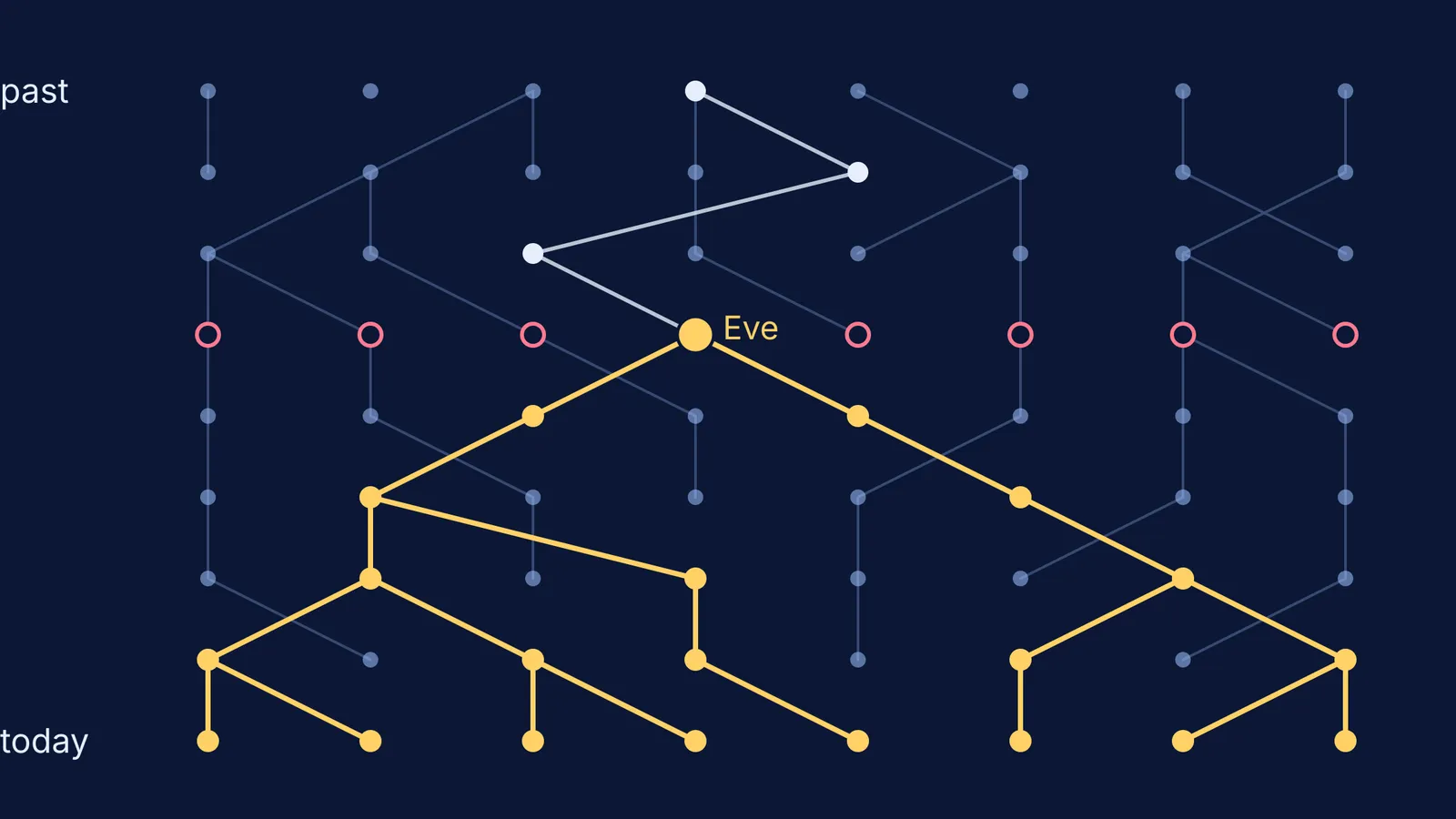
Mitochondrial Eve is the most recent woman from whom every person alive today inherited their mitochondrial DNA (mtDNA) through an unbroken chain of mothers.
The idea comes from a 1987 Nature paper by Rebecca Cann, Mark Stoneking and Allan Wilson, Mitochondrial DNA and human evolution. They compared mtDNA from 147 people drawn from five geographic populations and concluded that all of it stems from one woman who probably lived in Africa about 200,000 years ago.
"Eve" is a later nickname; the 1987 paper does not use it. She was not the first woman, and she was not alone.
Why does mitochondrial DNA follow only the mother line?
Human mtDNA contains 37 genes and spans about 16,500 base pairs, according to MedlinePlus Genetics. For why an organelle has its own DNA at all, see why mitochondria are semi-autonomous.
Children inherit their mitochondria, and so their mtDNA, from their mother, as the US National Human Genome Research Institute explains. Sons get it too, but they do not pass it on. Because it is not reshuffled each generation the way nuclear chromosomes are, mtDNA changes mainly by slow mutation, which makes it a clean record of one line.
There may be rare exceptions. A 2018 PNAS study reported three families, with 17 people in all, in which mtDNA appeared to come from both parents, while noting that maternal inheritance remains the rule.
How did scientists date her?
Two people whose mother lines split long ago carry more mtDNA differences than two whose lines split recently. Build a family tree from the sequences, find its root, and use a mutation rate to turn differences into years.
That last step is where the uncertainty lives. Cann and colleagues assumed mtDNA diverges by 2 to 4 percent per million years, which gave 140,000 to 290,000 years for the common ancestor in the 1987 paper. Applying the same methods to mtDNA and the Y chromosome, a 2013 Science study by Poznik and colleagues estimated the mitochondrial common ancestor at 99,000 to 148,000 years ago.
So the honest answer is "roughly 100,000 to 300,000 years ago, probably in Africa", with a range that shifts as methods improve.
What does mitochondrial Eve not mean?
She was the only woman alive. No. Other women lived alongside her; none of their mother lines reaches everyone alive today, but many of them can still be your ancestors through other routes.
All your DNA comes from her. No. Only your mtDNA traces to her through mothers alone. Your nuclear DNA comes from many ancestors of her time.
She was the first human. No. She had a mother and grandmother, and they also sit on everyone's mother line. Eve is the most recent woman on it, not the earliest.
She was Y-chromosomal Adam's partner. No. Adam is the matching ancestor on the father-to-son line, placed at 120,000 to 156,000 years ago in the same Science paper. Nothing says the two ever met.
The title is permanent. No. If every surviving line on one side of the tree's deepest split died out, the meeting point would move to a more recent woman. "Eve" is a position in a tree, not a fixed person.
Mother lines vanish by chance, which is genetic drift at work. Our genetic drift simulation shows how fast a small population loses alleles, and gene flow vs genetic drift separates the two ideas.
Worked example: whose mtDNA do you carry?
Take Meera, a Class 11 student in Pune, and trace three generations.
Meera's mtDNA came from her mother, Anita.
Anita's came from Kamala, Meera's nani.
Kamala's came from her own mother.
Meera's brother Rohan carries the same mtDNA, but his children will carry their own mother's.
Meera's dadi passed her mtDNA to Meera's father. It stops with him.
Meera has 8 great-grandparents, and exactly 1 of them gave her mtDNA. Ten generations back she has up to 1,024 ancestor slots, still with one mother line. So mtDNA traces one thread far back but says little about the rest of a family.
Check yourself:
Does a son carry his father's mtDNA? (No, his mother's.)
Can two cousins share mtDNA? (Yes, if their mothers are sisters.)
If Eve's sister had daughters, why is the sister not Mitochondrial Eve? (Her daughters' mother lines later died out. Had both sisters' lines survived, their mother would hold the title.)
The Fermi Concept Library gives each biology concept its own lesson and its place in the map. Not sure where to begin? Fermi's AI tutor can work out what you already know and build a plan for the session.
Next time someone says we all descend from one woman, you can say which part is true: one mother line, not one mother.