

On this page
In population genetics, gene flow and genetic drift are two primary forces that alter allele frequencies without natural selection. Because both disrupt Hardy-Weinberg equilibrium, students often confuse their mechanisms on exam day.
What is the difference between gene flow and genetic drift?
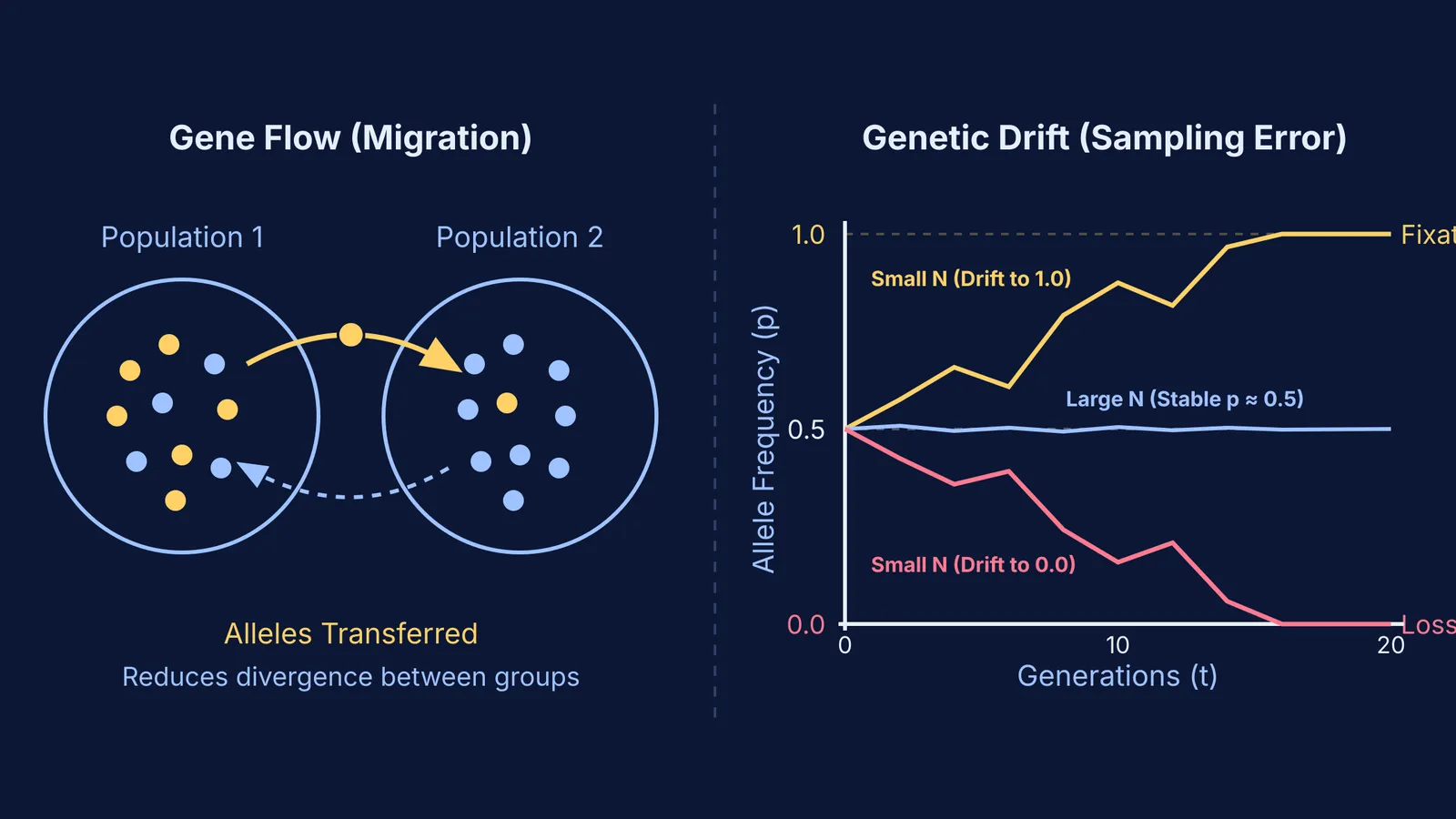
Gene flow, or gene migration, transfers genetic material between established populations through the movement of fertile individuals or gametes. When pollen drifts across a valley or animals disperse into a new herd, novel alleles enter the recipient gene pool. As outlined in the NCERT Class 12 Biology curriculum, repeated migration homogenises allele frequencies across geographic divides, decreasing differences between populations while maintaining diversity within them.
Genetic drift, by contrast, is the change in allele frequencies caused purely by random sampling error in finite populations. Parents produce vast gametes, but only a fraction form the next generation. In any finite group, chance dictates which alleles are passed down. Genetic drift operates within an isolated population without immigrants. Over generations, it eliminates alleles or fixes them at 1.0, eroding variation within a group and driving isolated populations apart.
Why does population size make genetic drift so powerful?
The mathematics of genetic drift, established by Sewall Wright in 1931, shows that sampling variance in allele frequencies is inversely proportional to population size. In infinite populations, frequencies remain constant without selection. In small breeding groups, chance dictates survival.
Peter Buri demonstrated this experimentally in his classic study in Evolution. Buri tracked 107 replicate lines of fruit flies (*Drosophila melanogaster*), each started with 16 heterozygous individuals carrying brown eye alleles at an initial frequency of 0.5. Each generation, exactly 8 males and 8 females were chosen at random to breed. Over 19 generations, allele frequencies in the isolated vials drifted unpredictably. By the end, 28 vials reached complete fixation (frequency 1.0) and 30 reached complete loss (0.0) of the tracked allele. Buri estimated an effective population size of approximately 9, showing that reproductive variance accelerates drift beyond raw census headcounts.
In small groups, rare alleles vanish purely because the few carriers fail to breed. You can see how random fluctuations contrast with adaptive curves in our guide to stabilising, directional and disruptive selection.
How does gene flow counteract genetic drift in wild populations?
Because genetic drift relentlessly discards alleles in small habitats, isolated wildlife suffers from inbreeding depression and accumulated harmful mutations. Gene flow provides the natural antidote. Under Sewall Wright's island model of population structure, introducing just one fertile migrant per generation—or even one every two generations, satisfying the condition 4N_e m > 1—provides enough gene flow to prevent local populations from fixing alternative neutral alleles.
Conservation biologists demonstrated this rescue during the restoration of the Florida panther (*Puma concolor coryi*). By the 1990s, the isolated Florida panther population had plummeted to roughly 20 to 25 individuals, causing severe genetic defects from drift. In 1995, managers introduced 8 female cougars from Texas. In a study published in Science, researchers found that this managed gene flow doubled genetic heterozygosity and tripled the population over 15 years, demonstrating that immigrant alleles swiftly reverse the damage caused by drift.
The Fermi Concept Library maps every concept in physics, chemistry, biology, mathematics and computing, each with its own lesson and its place in the map, helping students understand how gene flow and genetic drift interact across evolutionary biology.
How do bottleneck and founder effects show up on exam day?
In competitive exams like NEET-UG, examiners test genetic drift through bottlenecks and founder effects.
A bottleneck occurs when a sudden disaster—such as a flood or epidemic—drastically reduces population size, leaving survivors whose gene pool reflects chance rather than fitness. A founder effect occurs when a few pioneers establish a new colony, carrying only a fraction of the parent population's alleles. For deeper context on these dynamics, explore our profile of Sewall Wright and genetic drift and our breakdown of Hardy-Weinberg equilibrium and natural selection.
Use this checklist to solve exam questions on population genetics:
Boundary check: Are alleles travelling between separate populations (gene flow) or fluctuating inside an isolated group (genetic drift)?
Population size: Is the population small? Drift is negligible in massive groups but dominant in small ones.
Diversity impact: Does the event make populations more alike (gene flow) or cause random divergence (genetic drift)?
Selection role: Does allele survival depend on fitness (natural selection) or random sampling (genetic drift)?
When questions combine migration rates with genotype frequencies, the Fermi Problem Library offers worked problems with a step-by-step solver that explains the reasoning rather than printing an answer.


