On this page
Most cell organelles are built entirely from instructions kept in the nucleus. Mitochondria and chloroplasts are the exceptions. They carry their own DNA, run their own ribosomes and make a handful of their own proteins. Even so, they cannot survive on that alone. That half-independence is what "semi-autonomous" means. Here is the evidence for each half, and a structure for writing it up in an exam.
What does semi-autonomous mean for mitochondria and chloroplasts?
"Autonomous" would mean the organelle could build and copy itself with no outside help. "Semi" means it does some of that work itself and outsources the rest to the nucleus.
A strong piece of evidence for the autonomous half is that new mitochondria come only from old ones. As Scott and Youle put it in a 2010 review of mitochondrial fission and fusion, "mitochondria cannot be formed de novo", so a cell has to divide the ones it already has before it splits.
The dependent half comes from history. A 2012 review by Michael Gray describes the mitochondrion as "of unquestioned bacterial ancestry", descended from the Alphaproteobacteria. Over time, many of that ancestor's genes moved into the host's nucleus. If you want the full origin story, read our post on Lynn Margulis and the endosymbiosis theory.
What can mitochondria and chloroplasts make on their own?
Each organelle keeps a small, circular genome and the machinery to read it.
Mitochondrial DNA: The human mitochondrial genome is 16,569 base pairs long, according to the complete sequence published in Nature in 1981. It codes for 2 ribosomal RNAs (12S and 16S), 22 transfer RNAs and 13 proteins, most of them parts of the respiratory chain such as cytochrome c oxidase subunits and cytochrome b.
Chloroplast DNA: The chloroplast genome of the model plant Arabidopsis is a 154,478 bp circle carrying 87 potential protein-coding genes, 4 rRNA genes and 37 tRNA genes, according to its 1999 sequencing paper in DNA Research. Land-plant chloroplast genomes keep about 120 genes on average, says a 2023 review in Plant Communications.
Ribosomes: The same review states that chloroplasts translate their genes on "a bacterial-type 70S ribosome" made of a 50S and a 30S subunit. Mitochondria also contain "a translation system distinct from that of the cytosol" (Gray, 2012). Over evolution, mitochondrial ribosomes have become specialised for making membrane proteins, as Greber and Ban's 2016 review explains.
For how 70S and 80S ribosomes differ and where the subunit numbers come from, see 70S vs 80S ribosomes and their subunits.
Why do mitochondria still depend on nuclear genes?
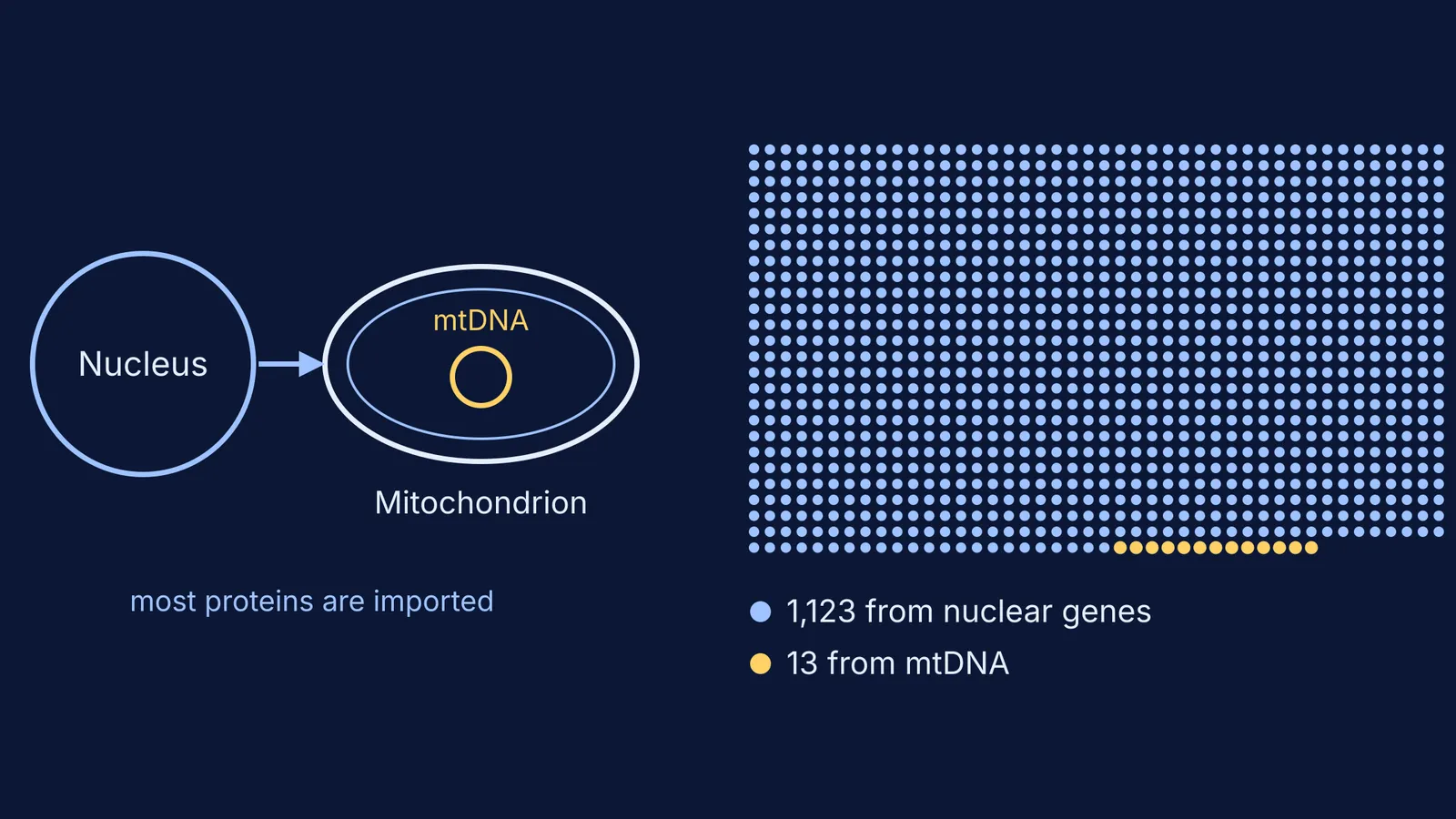
Because the nucleus now holds most of their instructions. The MitoCarta3.0 inventory (Nucleic Acids Research, 2021) lists 1,136 human genes for mitochondrial proteins and states that 99% of mitochondrial proteins are encoded by the nuclear genome, with 13 coming from mtDNA.
That leaves 1,123 made from nuclear genes. Gray's review describes the route: most mitochondrial proteins are "encoded in the nucleus, synthesized in the cytosol, and imported back into the organelle".
Chloroplasts work the same way, and Rubisco is the cleanest example. A 2018 review in Frontiers in Molecular Biosciences explains that plant Rubisco has 8 large subunits encoded by the chloroplast genome and 8 small subunits encoded in the nucleus. The small subunits are imported into the chloroplast before the enzyme is assembled. One enzyme, two genomes: that is semi-autonomy in a single molecule.
How do you write this answer in a CBSE or NEET-UG exam?
A complete answer covers both halves. Use this four-step structure for a 3- or 5-mark answer:
Define it. Semi-autonomous organelles can make some of their own proteins but depend on the nucleus for the rest.
Give the autonomous evidence. Own circular DNA, own bacteria-like ribosomes (70S in chloroplasts), own tRNAs and rRNAs, and new mitochondria arising only by division of existing ones.
Give the dependent evidence. Most of their proteins are coded by nuclear genes, made on cytoplasmic ribosomes and imported.
Add one example and the reason. Rubisco's large subunit is made in the chloroplast and its small subunit comes from the nucleus. The reason for this split is gene transfer to the nucleus after endosymbiosis.
Check your answer against these common slips:
Writing "fully autonomous" or "independent of the nucleus": both are wrong.
Saying the organelle DNA codes for all of the organelle's proteins: in humans, mtDNA codes for only 13 (MitoCarta3.0).
Listing only the DNA and forgetting the ribosomes, which are what let the organelle make proteins at all.
Leaving out the "most proteins are imported" half, which is the whole reason for the word "semi".
For where these genes sit inside the organelle, our post on mitochondrial cristae and matrix structure pairs well with this one. If the link between endosymbiosis, ribosomes and gene transfer still feels loose, the Fermi Concept Library gives each idea in biology its own lesson and shows where it sits in the map. To practise the reasoning, the Fermi Problem Library has worked problems with a step-by-step solver that explains the reasoning rather than printing an answer.