

On this page
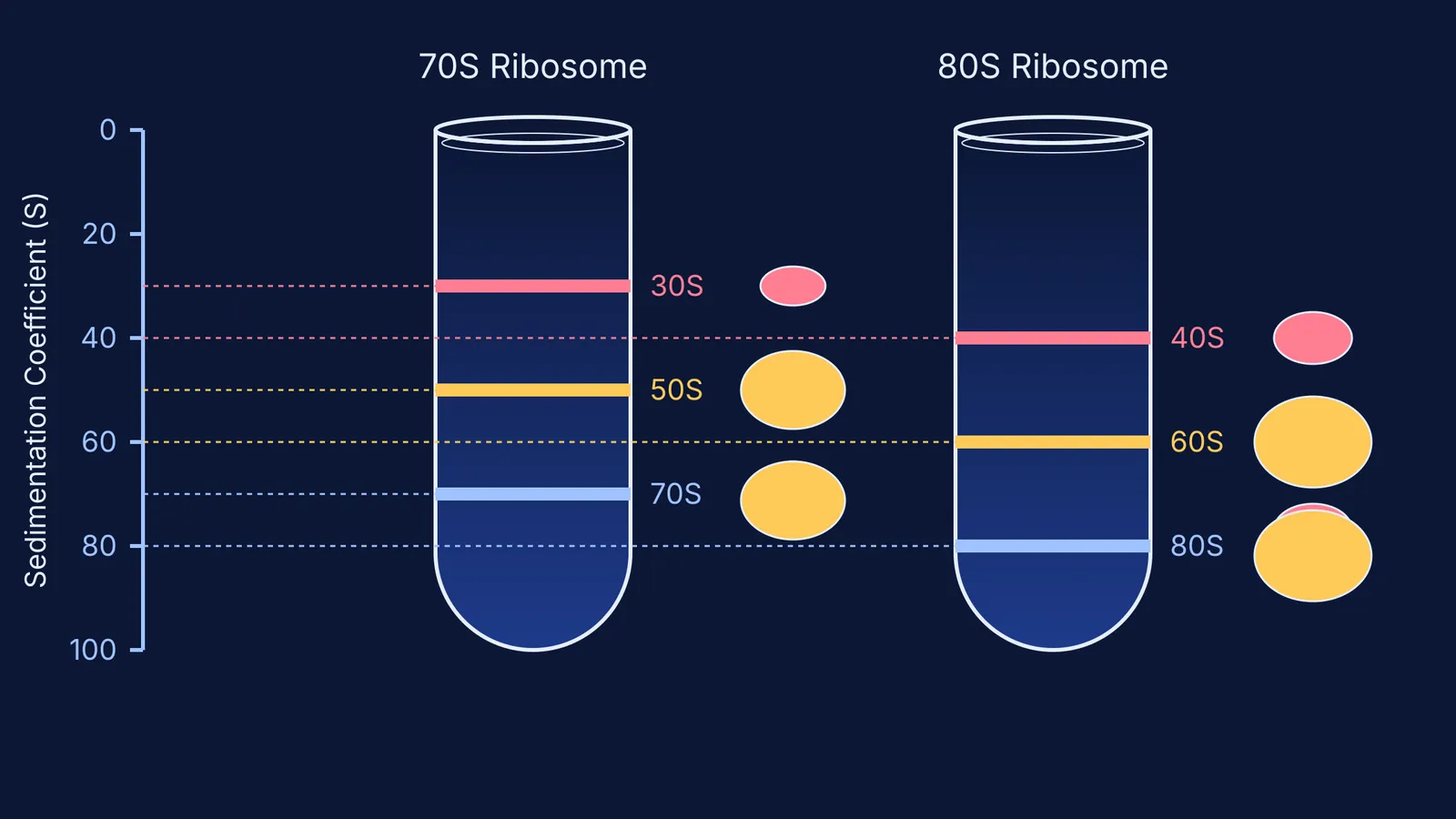
Ribosomes are the factories that build proteins inside every living cell. If you look at a textbook diagram, you will notice they come with strange numbers attached: prokaryotes have 70S ribosomes made of 50S and 30S subunits, while eukaryotes have 80S ribosomes built from 60S and 40S parts.
At first glance, the math is obviously wrong. Fifty plus thirty is eighty, not seventy. To understand why ribosomal subunits do not add up perfectly, you have to look at what the "S" actually measures.
What is a Svedberg unit (S)?
The "S" stands for the Svedberg unit. A Svedberg unit is a measure of time—exactly 10⁻¹³ seconds—used to describe how fast a particle settles out of a solution in an ultracentrifuge (Wikipedia).
Instead of simply weighing a particle, scientists spin it at extreme speeds to see how fast it sinks. This sedimentation rate is based on the size, shape, and surface qualities of the structure being analyzed (OpenStax Microbiology). A heavier molecule generally sinks faster, but a bulky or irregularly shaped molecule experiences more drag, which slows it down.
Why do 50S and 30S make 70S?
Because Svedberg units measure how a shape moves through a liquid, they are not additive.
When the 50S large subunit and the 30S small subunit combine, they do not simply stack on top of each other. They interlock tightly. This combination reduces their total exposed surface area relative to their mass, giving the assembled ribosome a more aerodynamic shape. Because the new structure experiences a different amount of drag than its separate parts, it sediments at a rate of 70S (OpenStax Microbiology).
The same rule applies to eukaryotic ribosomes. The 60S large subunit and 40S small subunit fold together to form an 80S ribosome, rather than a 100S complex (OpenStax Microbiology).
Where are 70S ribosomes found?
Prokaryotic ribosomes are entirely 70S. This means bacteria and archaea rely on 70S ribosomes for all of their protein synthesis (OpenStax Microbiology).
However, you will also find 70S ribosomes inside eukaryotic cells, specifically hidden within organelles. Both mitochondria and chloroplasts contain their own 70S ribosomes (OpenStax Microbiology). This shared trait is a key piece of evidence for the endosymbiotic theory, which suggests these organelles originally evolved from free-living bacteria.
If you are trying to picture how organelles relate to the wider cell, the Fermi Concept Library maps out every concept in biology. It gives each idea its own lesson, so you can trace the evolutionary link between bacterial cell walls and human mitochondria.
Where are 80S ribosomes found?
Eukaryotic cells (such as those in animals, plants, and fungi) use the larger 80S ribosomes (OpenStax Microbiology) for the bulk of their protein manufacturing.
These 80S ribosomes are located in two places. Free ribosomes float in the cytoplasm to build water-soluble proteins for the cell's own use. Membrane-bound ribosomes are attached to the rough endoplasmic reticulum, where they build proteins destined for the cell membrane or for secretion. The discovery of this pathway from ribosomes to secretion changed how we view cellular machinery. Building proteins also relies on eukaryotic RNA polymerases to read the DNA instructions first.
The structural difference between 70S and 80S ribosomes is crucial in medicine. Because bacterial ribosomes (70S) look different from human cytoplasmic ribosomes (80S), certain antibiotics can target and shut down a bacterial infection without harming the patient's own cellular factories.
Framework: Identifying the ribosome in exam questions
If a biology exam asks you to identify a cell or organelle based on its ribosomes, use this three-step test:
Look at the subunit numbers. If the problem mentions 30S or 50S, you are dealing with a 70S ribosome (OpenStax Microbiology). If it mentions 40S or 60S, it is an 80S ribosome (OpenStax Microbiology).
Check the location. The cytoplasm of a bacterium, plant or fungus will guide you. Cytoplasm of a bacterium? 70S. Rough ER of a human cell? 80S. Inside a plant's chloroplast? 70S.
Note the antibiotic effect. If a drug stops protein synthesis in the pathogen but the host is unharmed, the target is the 70S ribosome. If the drug affects both the pathogen and the host's mitochondria, it is likely targeting the 70S structures they share.


