On this page
In 1921 George Pólya published a short paper in Mathematische Annalen about a walker who wanders at random through a network of streets (Pólya, Math. Ann. 84, 149–160). His answer is now a classic of probability: whether the walker is certain to come home depends on how many dimensions they can move in.
What does Pólya's recurrence theorem say?
Picture a walker on a lattice of whole-number points. At every tick they step to one of the 2d nearest neighbours, each with probability 1/(2d): left or right on a line (d = 1), north, south, east or west on a grid (d = 2), and also up or down in a cubic lattice (d = 3). A walk is called recurrent if it returns to the start with probability 1, and transient if there is a positive chance it never comes back (Michael Kozdron, Duke University lecture slides).
Pólya's theorem: the simple random walk is recurrent in one and two dimensions and transient in three or more (Kozdron).
In three dimensions, the probability of ever returning to the start is about 0.3405 (0.3405373295...), a value worked out after Pólya by Watson (1939), McCrea and Whipple (1940) and others (Wolfram MathWorld, Pólya's random walk constants). The same table gives about 0.193 in four dimensions and 0.135 in five.
In everyday terms: someone wandering a flat street map always gets home in the end, but a bird with a third direction to drift in may not.
Why does the expected number of returns decide everything?
Let u be the probability that the walk ever returns. Each return is a fresh start, so the walker is at the start exactly k times, counting time zero, with probability u^(k−1)(1 − u), and the expected number of visits to the start is m = 1/(1 − u) (Kozdron). If m is infinite, u must be 1; if m is finite, u is less than 1.
There is a second way to count m. Let u_n be the probability that the walker is at the start at step n. Adding a 0-or-1 indicator for every step gives m = Σ u_n, so a walk is recurrent exactly when Σ u_n diverges and transient exactly when it converges (Kozdron).
Why is a 2D random walk recurrent but a 3D walk transient?
To be back at the start after 2n steps, the walker must take as many steps left as right, as many up as down, and so on. On a line that gives u_2n = C(2n, n)/4^n, and Stirling's formula turns it into about 1/√(πn). On a flat grid the exact answer is the square of the line's, about 1/(πn). In three dimensions the same counting bounds u_2n by a constant times 1/n^(3/2) (Kozdron).
The pattern is 1/n^(d/2): roughly, each extra direction is one more coordinate that must also balance out, and each costs a factor of about 1/√n. The question becomes a p-series with p = d/2:
d = 1: Σ 1/n^(1/2) diverges, so the walk is recurrent.
d = 2: Σ 1/n is the harmonic series, which diverges only just, so the walk is recurrent.
d = 3: Σ 1/n^(3/2) converges, so the walk is transient.
If the test is rusty, our guide to when 1/nᵖ converges and the comparison test covers exactly the tool used here.
Can you check it by hand?
Yes, for the first few steps. Every path of 2n steps has probability (1/(2d))^(2n), so you only need to count the paths that end where they began.
Line, 2 steps: LR and RL out of 4 paths, so u_2 = 1/2. Four steps: 6 of 16, so u_4 = 3/8.
Grid, 2 steps: 4 of 16 paths go out and straight back, so u_2 = 1/4. Four steps: 36 of 256, which is (3/8)² = 9/64.
Cube, 2 steps: 6 of 36 paths, so u_2 = 1/6. Four steps: 18 paths use one axis twice and 72 use two different axes, so 90 of 1,296, or 5/72.
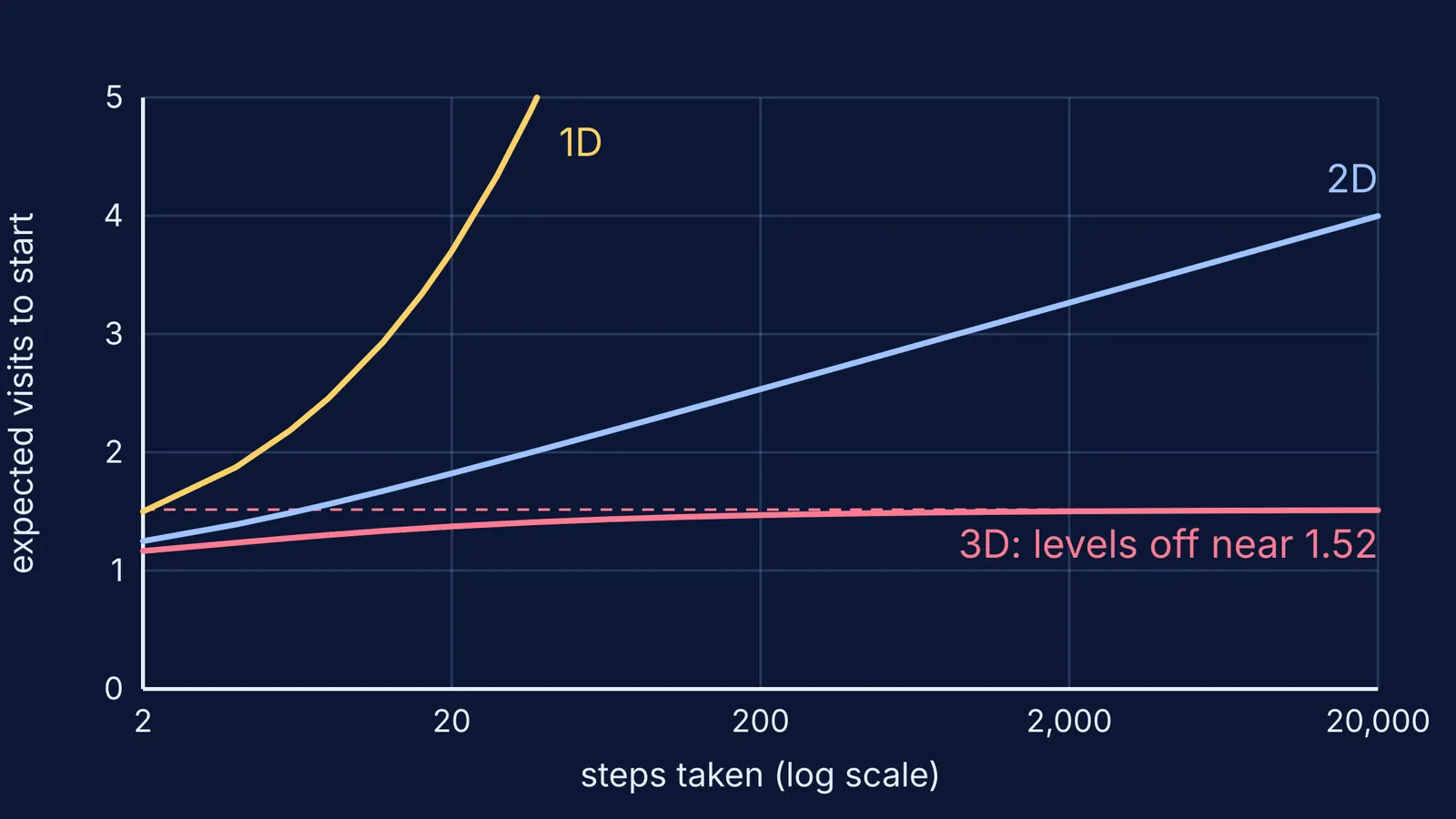
Now add them up. We summed the exact terms for the first 10 pairs of steps: the expected number of visits to the start (counting time zero) reaches about 3.70 on a line, 1.82 on a grid and 1.37 in three dimensions. Push on towards 20,000 steps and the line passes 100, the grid creeps up to about 4, and the 3D total settles just under 1/(1 − 0.3405) ≈ 1.52, using the return probability from MathWorld. The grid's slow, logarithmic climb is the lesson: certain does not mean quick.
For practice with this kind of counting, try these probability JEE Main numerical value questions. Pólya's name sits on another classic of chance too: the Pólya urn model, where the red share settles at random.
If a step of the proof is where you get stuck, the Fermi Concept Library covers every concept in physics, chemistry, biology, mathematics and computing, each with its own lesson. For ideas easier to see than read, the Fermi Simulation Lab has interactive simulations.