On this page
The Mollusca section of NCERT Class 11 Biology packs eight animals into one line, each with a genus and a common name in brackets. They are easy to mix up, especially Sepia and Loligo. Here is the full list, where the odd names come from, a mnemonic, and a two-minute match-the-column check.
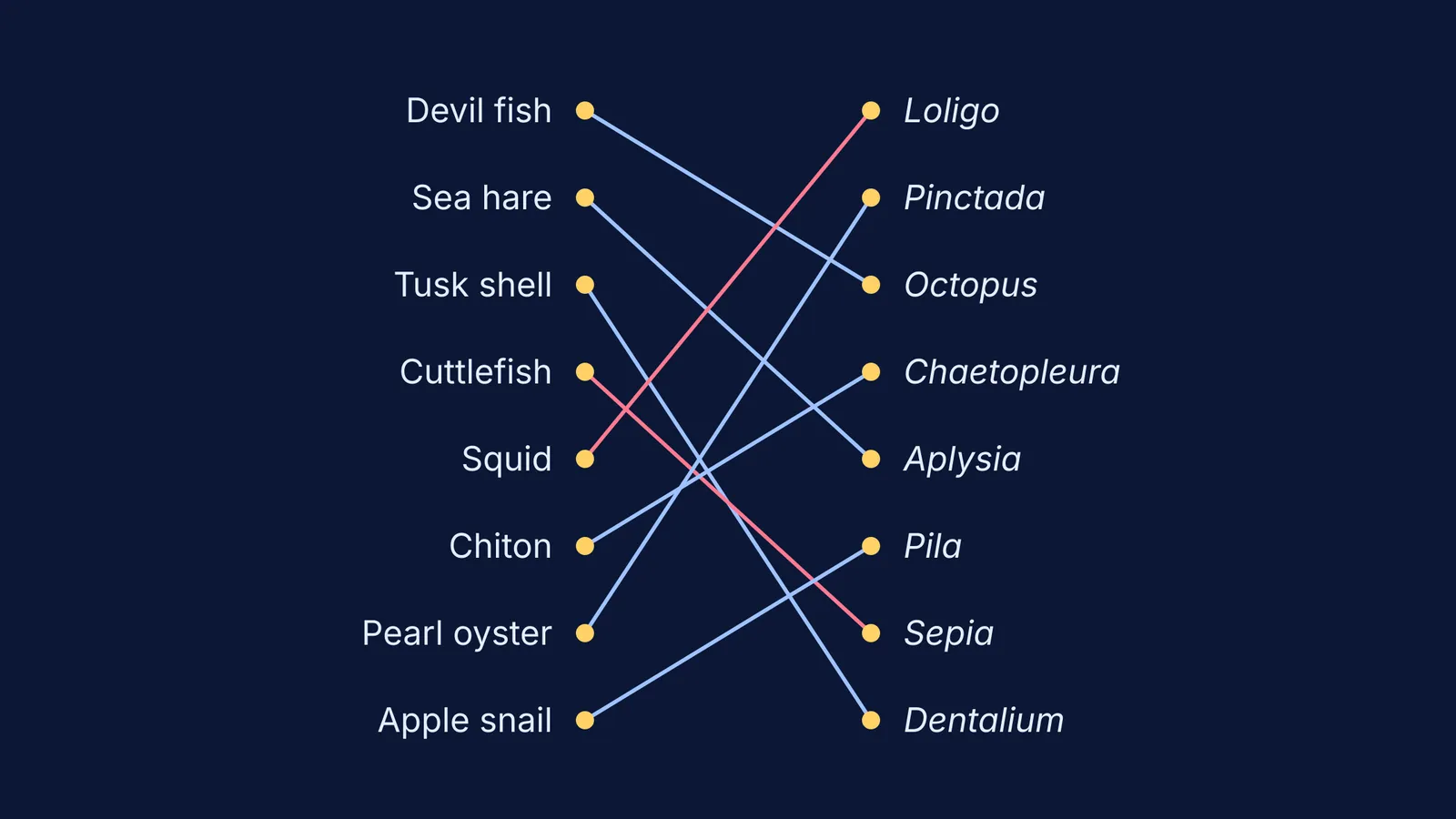
What are the NCERT examples of Mollusca with common names?
Section 4.2.8 of the NCERT Class 11 Biology chapter Animal Kingdom (Reprint 2026-27) calls Mollusca the second largest animal phylum and ends with this list of examples:
Pila: apple snail
Pinctada: pearl oyster
Sepia: cuttlefish
Loligo: squid
Octopus: devil fish
Aplysia: sea hare
Dentalium: tusk shell
Chaetopleura: chiton
Figure 4.13 in the same section draws only two of them, Pila and Octopus. A question can give either the genus or the common name, so learn the pairs in both directions.
Why is an octopus called a devil fish and Aplysia a sea hare?
Most of these names describe what the animal looks like, which makes them easy to remember.
Octopus (devil fish). The word octopus comes from the ancient Greek for eight and foot (Wiktionary: octopus). Devilfish is an old name for the octopus, but it has also been used for manta and Mobula rays, anglerfish and even the gray whale (Wiktionary: devilfish). In NCERT, devil fish means Octopus and nothing else.
Aplysia (sea hare). Sea hares are named for their rounded shape and the two long rhinophores on the head, which look a little like the ears of a hare (Wikipedia: Sea hare).
Dentalium (tusk shell). The genus name comes from the Latin for dental, after the tooth-like shape of the shell (Wiktionary: Dentalium). A tusk is a tooth, so Dentalium and tusk shell say the same thing.
Sepia (cuttlefish). Sepia was the Latin and ancient Greek word for cuttlefish, and the dark brown pigment called sepia was made from cuttlefish secretions (Wiktionary: sepia).
Chaetopleura (chiton). Chitons have a shell made of eight separate plates and are sometimes called coat-of-mail shells (Wikipedia: Chiton).
Pila, Pinctada and Loligo have no handy story, so the mnemonic below uses their sounds and first letters instead.
Is there a mnemonic for mollusc common names?
Use one hook per pair. Say each line aloud once, then cover the right-hand half and test yourself.
Octopus, devil fish: the devil has eight arms, and octo means eight.
Aplysia, sea hare: A for a hare whose ears stand up.
Dentalium, tusk shell: a dentist works on teeth, and a tusk is a tooth.
Sepia, cuttlefish: sepia ink is cuttlefish ink.
Loligo, squid: Loligo is Long, like a squid.
Chaetopleura, chiton: Ch matches Ch, and both wear a chain-mail coat.
Pinctada, pearl oyster: the longer P word makes the Precious Pearl.
Pila, apple snail: the short P word is a small snail, sitting on a pile of apples.
Can you match the column without looking?
Cover the answers and match each common name in Column A with a genus in Column B.
Column A:
Tusk shell
Squid
Sea hare
Pearl oyster
Devil fish
Chiton
Cuttlefish
Apple snail
Column B:
(a) Sepia
(b) Pila
(c) Dentalium
(d) Octopus
(e) Chaetopleura
(f) Loligo
(g) Aplysia
(h) Pinctada
Answers: 1-c, 2-f, 3-g, 4-h, 5-d, 6-e, 7-a, 8-b.
If you scored eight, do not stop there. In a 2006 study in Psychological Science, Henry Roediger and Jeffrey Karpicke found that students who had taken recall tests on prose passages retained substantially more after two days and after one week than students who had restudied them, even though restudying looked better on a test five minutes later (Roediger and Karpicke, 2006). Recalling is what makes the pairs stick, not rereading them.
Where do these molluscs fit in the rest of the chapter?
The common names are only one layer of the topic. For the body plan that links all eight animals, read our guide to the Mollusca radula, mantle and gills and what each one does. Cuttlefish is one of several animals named fish that are not fish, sorted by phylum in jellyfish, cuttlefish, crayfish: not fish, so which phylum?. And for more traps like devil fish, see animal common names that mislead NEET biology students.
If a pair keeps slipping because you cannot picture the animal or its class, look it up in the Fermi Concept Library, where every biology concept has its own lesson and its place in the map. When you move on to mixed questions, the Fermi Problem Library has worked problems with a step-by-step solver that explains the reasoning rather than printing an answer.