

On this page
Common names are old guesses. People called anything that lived in water, or moved like it did, a fish long before anyone sorted animals by body plan. Biology uses the word more strictly, and exam questions test exactly that gap.
In NCERT's Class 11 Animal Kingdom chapter, Super Class Pisces ("bear fins") sits inside subphylum Vertebrata, under the jawed vertebrates (Gnathostomata). It has two classes: Chondrichthyes, the cartilaginous fish such as sharks and sting rays, and Osteichthyes, the bony fish such as rohu and katla.
What makes an animal a fish in biology?
The same NCERT chapter gives you three gates. An animal has to pass all three, in order.
Chordate: it has a notochord, a dorsal hollow nerve cord and paired pharyngeal gill slits.
Vertebrate: the notochord is replaced by a cartilaginous or bony vertebral column in the adult.
Pisces: it has jaws and bears fins rather than limbs.
NCERT's comparison table lists "Notochord absent" for every non-chordate. That is the quick test: all five animals below fail at gate 1.
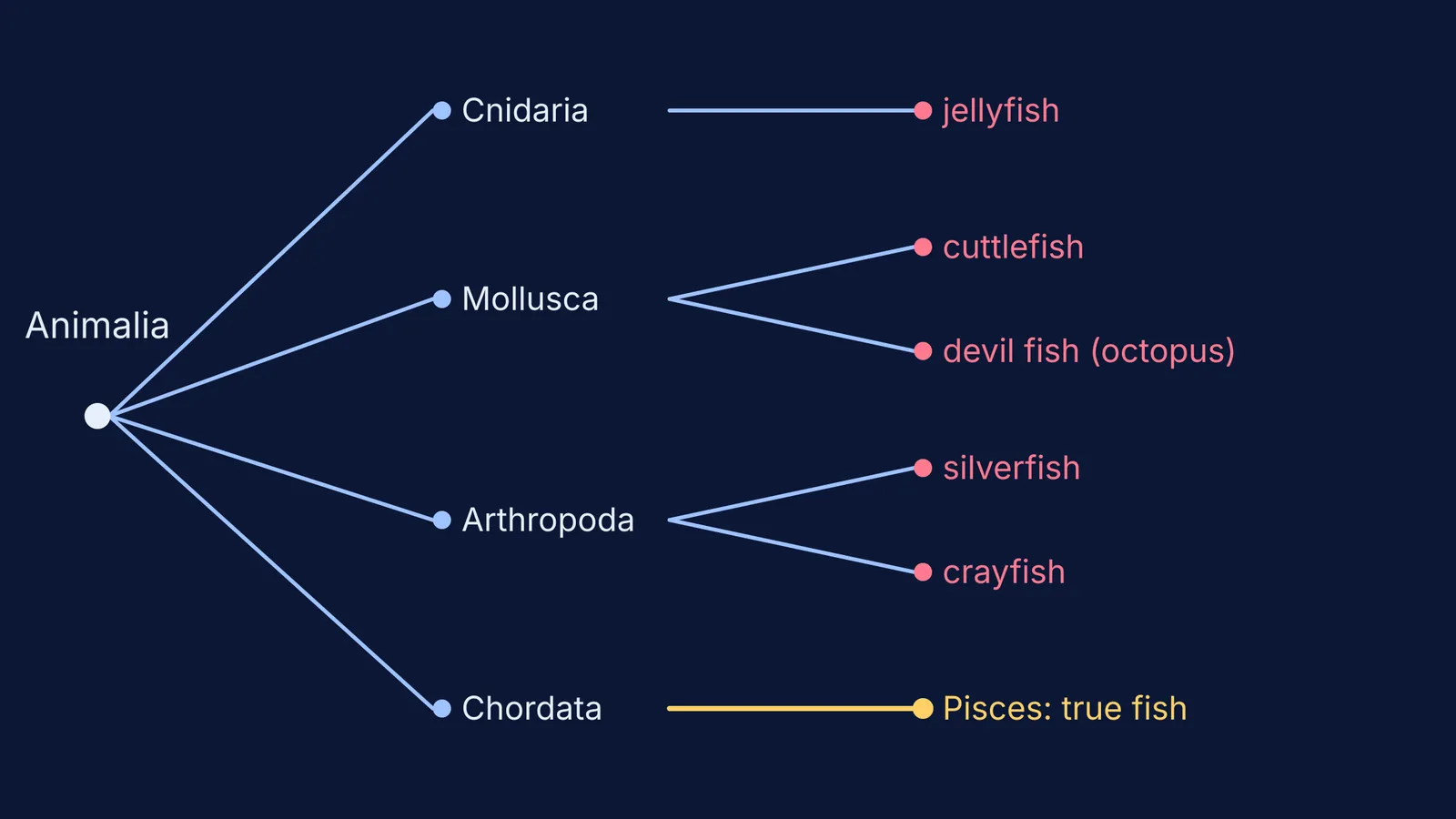
Which phylum are jellyfish, cuttlefish and devil fish in?
Jellyfish belong to phylum Cnidaria. NCERT names Aurelia, the jelly fish, as the free-swimming medusa form of Phylum Coelenterata (Cnidaria) in its Animal Kingdom chapter. The feature that rules it out: cnidarians are diploblastic, built from two germ layers around a gut with a single opening, while chordates are triploblastic. A jellyfish is about 95 percent water, according to NOAA's National Ocean Service, which also places it in phylum Cnidaria.
Cuttlefish belong to phylum Mollusca. NCERT lists Sepia (Cuttlefish) among the molluscs, next to the snail Pila and the squid Loligo. The feature that rules it out is its "bone". A cuttlebone is an internal shell made of aragonite (calcium carbonate), chambered so the animal can control its buoyancy, according to the Digital Atlas of Ancient Life. It is a mollusc shell carried inside the body, not a vertebral column. For the rest of the mollusc body plan, see our guide to the mollusc mantle, radula and gills.
Devil fish is the octopus, also in Mollusca. NCERT's example list reads "Octopus (Devil fish)". Victor Hugo's 1866 novel Toilers of the Sea calls the octopus the "devil-fish", as the Biodiversity Heritage Library explains. The feature that rules it out is the molluscan body plan NCERT describes: an unsegmented body with a head, a muscular foot and a visceral hump covered by a mantle.
The ray name is on the US Fish and Wildlife Service species page, and NOAA Fisheries places a close relative, the giant manta ray Mobula birostris, in class Chondrichthyes.
Which phylum are silverfish and crayfish in?
The silverfish, Lepisma saccharina, is a small, wingless insect in class Insecta, order Zygentoma, according to Animal Diversity Web. It is usually 10 to 12 mm long and gets its name from the silver, fish-like scales covering its body. The feature that rules it out: it is a six-legged land insect, and the NCERT chapter puts insects in phylum Arthropoda, animals with jointed appendages and a chitinous exoskeleton.
The crayfish is an arthropod too, a crustacean. A decapod is "a 10-legged crustacean (e.g., crayfishes, shrimps, lobsters, crabs)", in the NC Wildlife crayfish glossary. The feature that rules it out: its skeleton is on the outside, a hard chitinous exoskeleton that it sheds as it grows. A fish's skeleton is inside, built around the backbone.
The broader picture of every phylum is in our Animal Kingdom Class 11 guide to phyla, coelom and chordate classes. For the reverse mistake, an animal that looks like a fish and is not one, read why a whale is a mammal, not a fish.
How do you answer an odd-one-out question on these names?
Try this one: which of these is a true fish? (a) Sepia (b) Hippocampus (c) Aurelia (d) Octopus.
Ignore the common names. Write the genus: Sepia, Hippocampus, Aurelia, Octopus.
Ask gate 1: notochord? Sepia and Octopus are molluscs and Aurelia is a cnidarian, so all three fail.
Check the survivor: NCERT lists Hippocampus (sea horse) under Osteichthyes, the bony fish.
Answer (b). The one animal without "fish" in its name is the only fish.
The same logic works the other way. NCERT's own fish list includes Scoliodon (dog fish), Pristis (saw fish) and Trygon (sting ray), so do not mark something "not a fish" just because its name sounds odd.
If the phylum features still blur together, the Fermi Concept Library gives every concept in biology its own lesson and its place in the map. To practise, the Fermi Problem Library has worked problems with a step-by-step solver that explains the reasoning rather than printing an answer.
Next time a name says fish, run the three gates before you believe it.


