

On this page
Molluscs include snails, mussels, squid and octopuses. Ask what makes a mollusc a mollusc and the first answer is often "a shell". The NCERT description goes further. Alongside the shell, it picks out three parts of the body: the radula in the mouth, the mantle over the visceral hump, and the gills in the mantle cavity. Learn where these three sit and the core Mollusca facts fall into place.
Mollusca is the second largest animal phylum, after Arthropoda, according to the NCERT Class 11 Biology chapter on the animal kingdom. The University of California Museum of Paleontology gives at least 50,000 living species, and more likely around 200,000.
What is the body plan of a mollusc?
In the NCERT chapter, molluscs are bilaterally symmetrical, triploblastic and coelomate, with an organ-system level of organisation. The body is unsegmented and covered by a calcareous shell. It has a distinct head, a muscular foot and a visceral hump.
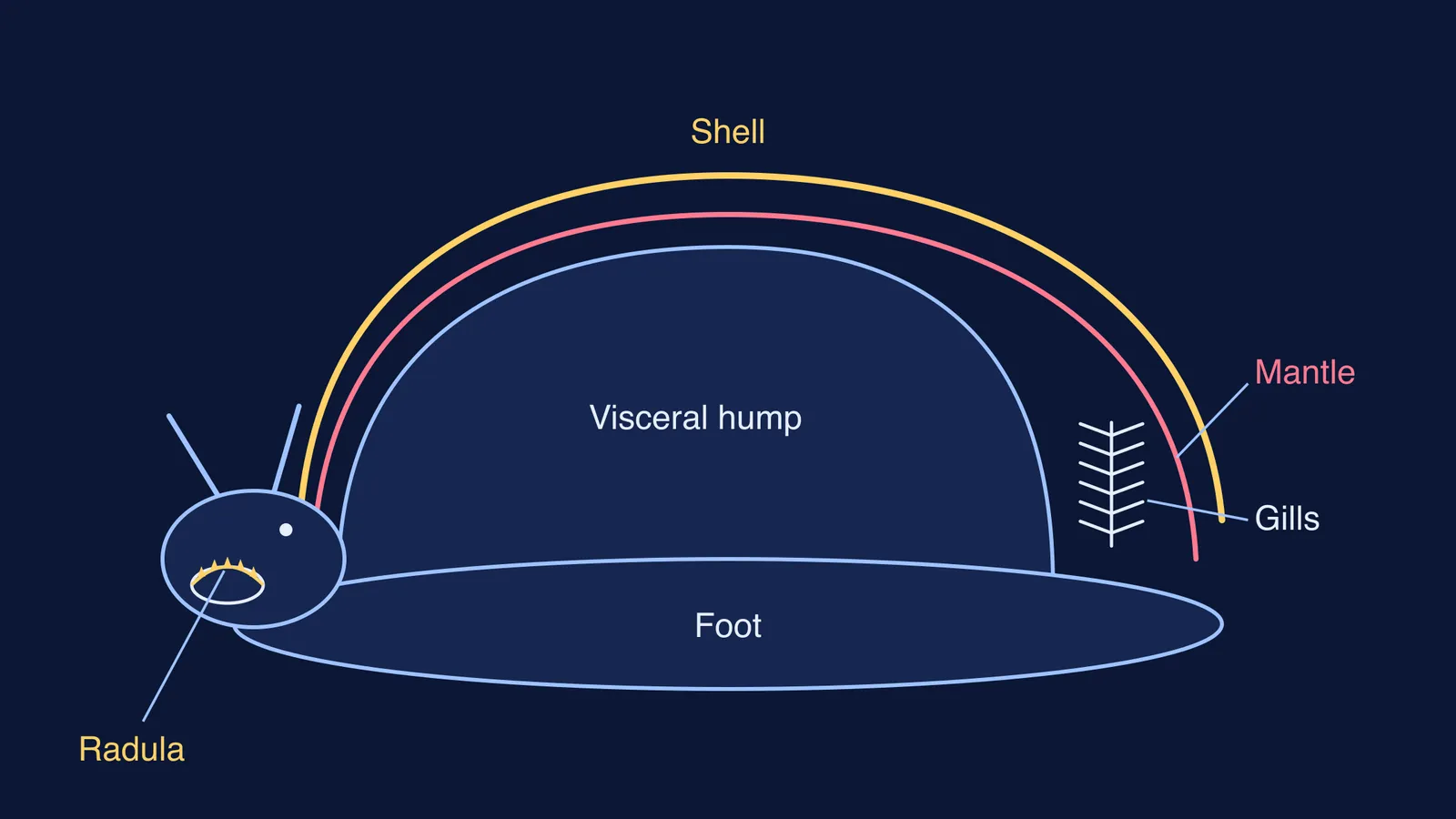
Picture a garden snail. The foot is the flat sole it glides on. The head carries the sensory tentacles. The visceral hump is the coiled mass of organs inside the shell. The radula, mantle and gills all fit around those three regions.
What is the radula in Mollusca?
The NCERT textbook defines the radula as a file-like rasping organ in the mouth that molluscs use for feeding (NCERT, section 4.2.8).
The radula is a ribbon of teeth supported by a muscular structure called the odontophore, according to the UCMP mollusc page. Think of a strip of sandpaper over a muscular tongue, scraped across food.
The teeth can be very tough. In a 2015 study, Asa Barber, Dun Lu and Nicola Pugno tested the teeth that limpets use to rasp over rock. The tooth material had a tensile strength of 3.0 to 6.5 GPa, which they reported as the highest recorded for a biological material, above spider silk (Journal of the Royal Society Interface). The authors attribute the strength to goethite nanofibres, an iron mineral, packed inside a softer protein.
You can check this on the UCMP bivalve page. The NCERT list of examples includes *Pinctada*, the pearl oyster, which is a bivalve, so the exception sits inside your own syllabus.
What is the mantle and the mantle cavity?
NCERT describes the mantle as a soft and spongy layer of skin that forms over the visceral hump (NCERT, section 4.2.8). The mantle cavity is the space between the visceral hump and the mantle.
The mantle also makes the shell. UCMP says the mantle, also called the pallium, typically secretes the shell. That helps explain how an octopus can be a mollusc without an outer shell: it still has a mantle. Our post on why an octopus is a mollusc without a shell works through that case.
Where are the gills in molluscs, and what do they do?
The feather-like gills sit inside the mantle cavity and have both respiratory and excretory functions, according to NCERT. Learn both functions together, not respiration alone.
Zoologists call these gills ctenidia. UCMP notes that the kidneys, gonads and anus also open into the same cavity. In most bivalves the gills are very large and also capture food particles from the water current. Without a radula, they use their gills to gather food.
How do you remember radula, mantle and gills for an exam?
Close the book and draw it from memory.
Draw the foot as a long oval and the visceral hump as a dome on top of it. Add the head at the front, with two tentacles.
Draw the mantle as a curve over the hump, hanging down at the back to leave a pocket. Write "mantle cavity" in the pocket.
Draw a feather in the pocket and label it "gills: respiration + excretion".
Draw a tiny file in the mouth and label it "radula: rasping, feeding".
Write the exception under the drawing: "bivalves: no radula, gills feed".
Then test yourself with these, saying each answer aloud before you check:
Which organ is file-like and found in the mouth? (Radula.)
What is the space between the visceral hump and the mantle called? (Mantle cavity.)
Name two functions of mollusc gills. (Respiration and excretion.)
Which mollusc group lacks a radula? (Bivalves.)
If one of these parts still feels vague, the Fermi Concept Library covers every concept in biology, each with its own lesson and its place in the map. To practise on full questions, the Fermi Problem Library has worked problems with a step-by-step solver that explains the reasoning rather than printing an answer.
Next, see why Pila is the standard NCERT Mollusca example, then place every phylum with six questions for the animal kingdom.


