

On this page
When you prepare for the National Eligibility cum Entrance Test (NEET-UG) in biology, Phylum Mollusca is typically introduced with familiar shelled animals: the freshwater apple snail (*Pila*) and the pearl oyster (*Pinctada*). In the NCERT Class 11 Biology textbook, molluscs are defined as unsegmented, bilaterally symmetrical coelomates with a soft body, a head, a visceral hump, a mantle, and a muscular foot. Right alongside these armored species sits *Octopus* (designated as the Devil fish), an active marine predator with no visible shell.
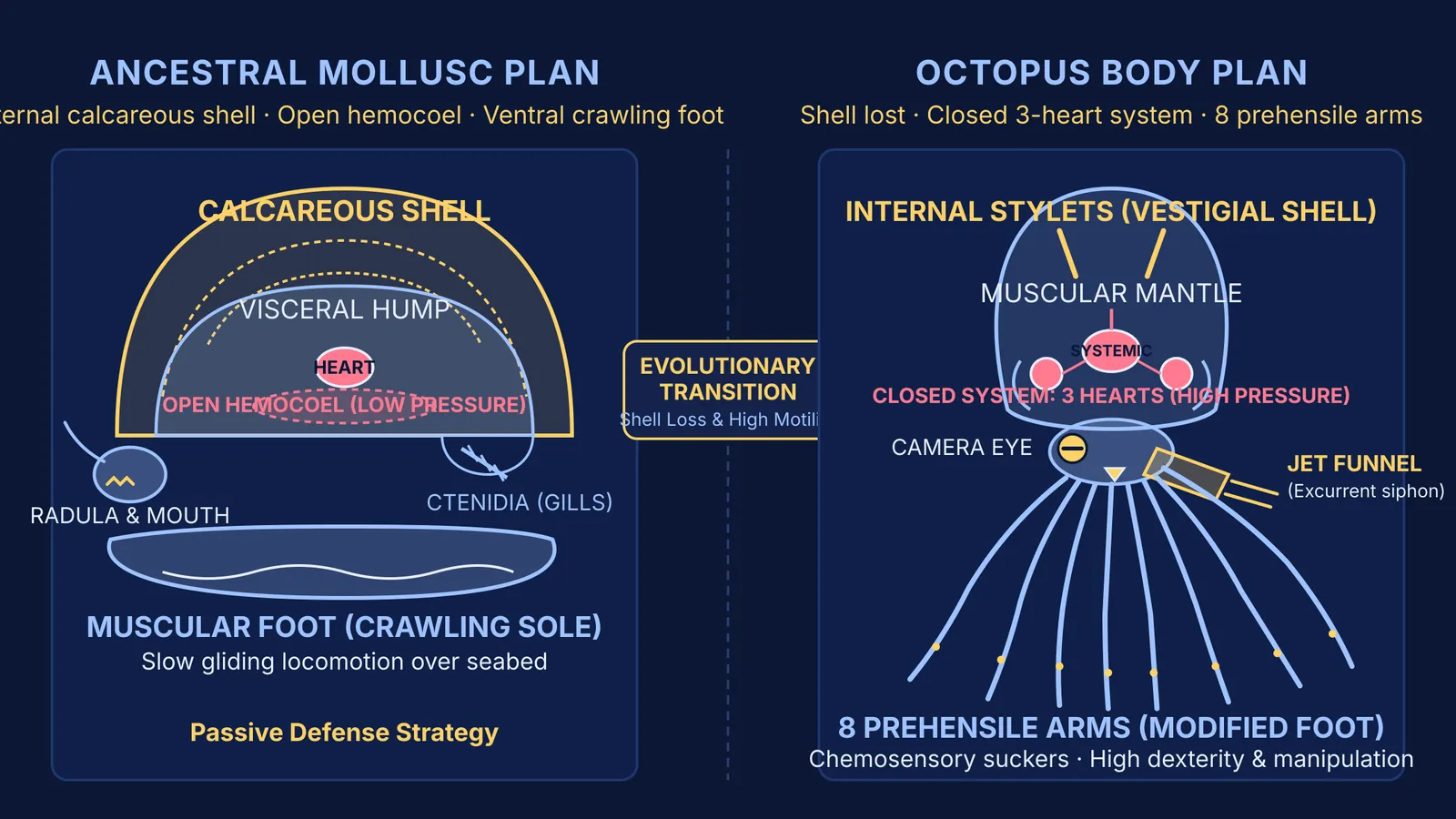
Zoological classification depends on homologous anatomy rather than external armor. An octopus retains the essential molluscan body plan: its visceral hump is enclosed by a muscular mantle, creating a mantle cavity with paired respiratory gills (ctenidia). Inside its mouth lies a chitinous rasping organ called the radula. Instead of never developing a shell, octopuses lost it secondarily. In *Octopus vulgaris*, the ancestral shell is reduced to paired internal chitinous rods known as stylets embedded in the mantle. In a study published in the ICES Journal of Marine Science, Consuelo A. Hermosilla and colleagues examined wild-caught *Octopus vulgaris* (including 19 marked with oxytetracycline in Vigo and 6 with tetracycline in Naples) and demonstrated that stylets deposit concentric growth rings at a mean rate of 1.02 increments per day, validating them as homologous vestigial shells. Students learning diagnostic rules for animal kingdom phyla recognize that deep morphological homologies always outrank surface traits.
How did cephalopods lose their ancestral shell?
Cephalopod evolution represents a dramatic transition from armored grazers to agile predators. In a phylogenetic review published in BioEssays, Björn Kröger, Jakob Vinther, and Dirk Fuchs showed that ancestral cephalopods arose during the Cambrian period (~530 million years ago) with external, gas-filled shells used for hydrostatic buoyancy, much like the modern pearly *Nautilus*.
During the mid-Palaeozoic (~416 million years ago), cephalopods diverged into nautiloids and coleoids. Coleoids internalized their shells and diverged in the late Palaeozoic (~276 million years ago) into Vampyropoda (including octopuses) and Decabrachia (squids and cuttlefishes). While cuttlefish (*Sepia*) retained an internal cuttlebone and squids (*Loligo*) kept a chitinous pen, octopuses reduced or lost the shell entirely.
Trading heavy mineral armor for a soft body removed rigid volume constraints. An octopus can squeeze through any crevice larger than its beak. To compensate for losing passive defense, the ancestral molluscan foot evolved into two specialized structures: eight prehensile arms with chemosensory suckers for prey capture, and a muscular funnel (siphon) for jet propulsion.
How does the octopus circulatory system support high activity?
Most molluscs possess an open circulatory system, where a dorsal heart pumps hemolymph into open body sinuses (the hemocoel) under low pressure. That sluggish flow supports crawling snails, but it cannot meet the oxygen demands of active predation.
Cephalopods solved this by evolving a closed circulatory system with true capillary beds. As R. K. O'Dor and D. M. Webber noted in the Canadian Journal of Zoology, jet propulsion is energetically expensive, driving cephalopods to maximize metabolic rates and oxygen extraction using blue copper-based hemocyanin.
To maintain high blood pressure, an octopus uses three myogenic hearts:
Two branchial hearts: Located at the base of each gill, these pumps push deoxygenated hemolymph through high-resistance gill capillaries.
One systemic heart: A central pump that distributes oxygenated hemolymph through the aorta to the body and brain.
This arrangement has limits. In the Journal of Experimental Biology, M. J. Wells and colleagues showed that jetting pressures compress the great veins, temporarily halting venous return and arresting the systemic heartbeat. With a small oxygen debt capacity of about 22 ml O₂ kg⁻¹, an octopus restricts jetting to short escapes, preferring arm-crawling for foraging. High metabolic turnover also favors ammonotelic waste excretion in marine invertebrates, discharging ammonia directly across the gills.
When studying physiological adaptations, the Fermi Concept Library covers every concept in biology, each with its own lesson and its place in the map.
How can you solve NEET classification questions on atypical molluscs?
In NEET-UG, examiners use *Octopus* to catch students who rely on superficial definitions like "all molluscs have shells." To classify atypical invertebrates quickly, apply this four-step diagnostic protocol:
Verify symmetry and coelom: Confirm bilateral symmetry and an unsegmented coelomate body, eliminating adult echinoderms and coelenterates.
Locate the mantle: Look for a muscular mantle and visceral hump, even if the external shell is absent.
Check the feeding organ: Spotting a radula immediately confirms molluscan affinities (*Octopus*, *Sepia*, *Loligo*, and *Pila* possess one; filter-feeding bivalves do not).
Note circulatory type: Identify the closed circulatory system with three hearts as a cephalopod hallmark.
Consider this NEET-style statement pair:
Statement 1: *Octopus* belongs to Phylum Mollusca because it possesses a mantle cavity, gills, and a radula.
Statement 2: *Octopus* shares an open circulatory system and an external calcareous shell with *Pila*.
Aspirants mastering NCERT lines for NEET biology mark Statement 1 correct and Statement 2 incorrect: *Octopus* has closed circulation and lacks an outer shell.
For students working through multi-statement classification exercises, the Fermi Problem Library provides worked problems with a step-by-step solver that explains the reasoning rather than printing an answer.


