On this page
Toss a fair coin forever. Will heads come up infinitely often? Will a running sum built from the tosses settle down? If the tosses are independent, the answer is never "with probability 0.3". It is almost surely yes or almost surely no. That is Kolmogorov's zero-one law, named after Andrey Kolmogorov, who laid the axiomatic foundations of probability in a 1933 book (Andrey Kolmogorov, Wikipedia).
What is a tail event?
Take random variables X1, X2, X3, … and write S_n = X1 + … + X_n. In Rick Durrett's graduate textbook, the tail σ-field is the intersection over all n of σ(X_n, X_{n+1}, …), the information in "the future after time n" (Durrett, Probability: Theory and Examples, section 2.5).
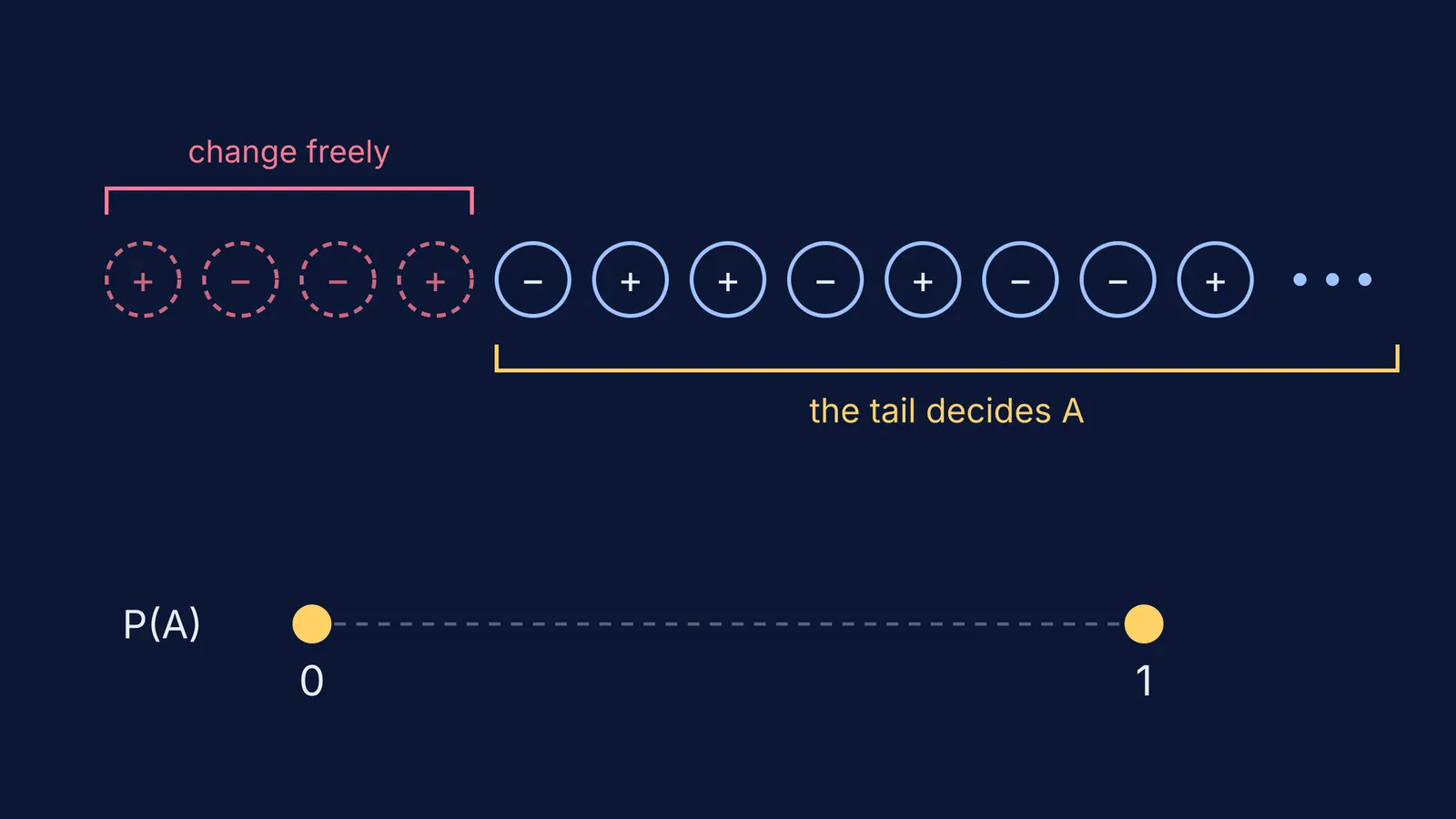
A tail event is one whose occurrence cannot be changed by changing any finite number of the X values (Durrett, section 2.5).
Test events from Durrett's Example 2.5.2 against that rule:
"S_n converges" is a tail event. Changing X1 shifts every later S_n by the same fixed amount, and a shifted sequence converges exactly when the original does.
"limsup S_n / c_n > x" with c_n → ∞ is a tail event, because a fixed shift divided by c_n shrinks to 0.
"limsup S_n > 0" is not a tail event. If S_n hovers just below 0, raising X1 by 10 lifts the whole tail above 0.
"X_n = 1 for infinitely many n" is a tail event (a special case of Durrett's Example 2.5.1): the first few values cannot decide what happens infinitely often.
What does Kolmogorov's zero-one law say?
If X1, X2, … are independent and A is a tail event, then P(A) = 0 or 1 (Durrett, Theorem 2.5.3).
In words, a tail event of independent random variables "will either almost surely happen or almost surely not happen" (Kolmogorov's zero–one law, Wikipedia). The same page shows why independence matters: if the sequence is all 0s or all 1s, each with probability 1/2, its sum converges with probability 1/2.
Does Σ ±1/n converge with random signs?
Flip a fair coin for each n. Add 1/n for heads and subtract 1/n for tails. The fixed-sign version, 1 − 1/2 + 1/3 − …, converges by the Leibniz test for alternating series, and the Dirichlet test for convergence handles other regular sign patterns. Random signs have no pattern, so use three steps.
Is it a tail event? Yes. Whether the sum converges does not depend on its first terms.
Apply the law. The signs are independent, so P(converges) is 0 or 1.
Decide which. Durrett's Example 2.5.7 takes X_n = +n^(−α) or −n^(−α) with probability 1/2 each (Durrett, section 2.5). Each X_n has mean 0 and variance n^(−2α). Theorem 2.5.6 says independent, mean-zero terms with a finite sum of variances converge with probability one, and the three-series theorem shows α > 1/2 is also necessary.
For α = 1 the variances are 1/n², whose sum is finite, so the random harmonic series converges with probability 1, even though Σ 1/n itself diverges. Byron Schmuland studied the distribution of that random sum in Random Harmonic Series, The American Mathematical Monthly, 2003. For α = 1/2, the three-series theorem rules out almost-sure convergence of Σ ±1/√n, so the law leaves only one option: it diverges with probability 1.
Why is the proof so short?
Durrett's proof shows that a tail event A is independent of itself (Durrett, Theorem 2.5.3):
Anything decided by X1, …, X_k is independent of anything decided by X_{k+1}, X_{k+2}, ….
A tail event is decided by X_{k+1}, X_{k+2}, … for every k, so it is independent of every event that uses only finitely many Xs. A standard extension result then makes it independent of everything in σ(X1, X2, …).
A itself is in σ(X1, X2, …). So P(A) = P(A ∩ A) = P(A) × P(A).
The only numbers with p = p² are 0 and 1.
Why doesn't the law tell you whether it is 0 or 1?
The proof never looks at the distribution of the Xs. The same four steps work for Σ ±1/n, which converges almost surely, and for Σ ±1/√n, which diverges almost surely. The law only rules out the middle; deciding the side takes a separate tool, such as the variance test above, the three-series theorem or the Borel–Cantelli lemmas Durrett develops in chapter 2.
How do you check a long-run event in four questions?
Are the X_n independent? If not, stop: the law does not apply.
Does changing X1, …, X_k, for any fixed k, leave the event unchanged? If yes, it is a tail event.
Write down "P = 0 or 1" before calculating.
Pick a tool to decide: sum of variances, the three-series theorem, Borel–Cantelli, or a positive-probability argument.
If σ-fields or "almost surely" still feel slippery, the Fermi Concept Library has a lesson for every concept in mathematics, so you can rebuild independence and limits first. To practise, try the random-sign series with α = 3/4 yourself, then work through series problems in the Fermi Problem Library, whose step-by-step solver explains the reasoning.