On this page
Some series converge only because their terms cancel. Σ sin(nx)/n is the classic case: its signs change irregularly, so the alternating series test does not apply, and comparing with 1/n fails because the harmonic series diverges. Dirichlet's test is built for exactly this.
What does Dirichlet's test say?
Dirichlet's test: if the partial sums Aₙ = a₁ + a₂ + … + aₙ are bounded, so that |Aₙ| ≤ M for every n, and bₙ is a monotonic sequence that tends to 0, then Σaₙbₙ converges, as stated in the Wikipedia article on Dirichlet's test. MathWorld's entry states it with a decreasing positive sequence. Some books swap the letters, so check which sequence does which job.
The test is named after Peter Gustav Lejeune Dirichlet; his proof, Démonstration d'un théorème d'Abel, was published posthumously in the Journal de Mathématiques Pures et Appliquées in 1862, according to the same Wikipedia article.
How do you prove Dirichlet's test with Abel summation?
Abel summation is the discrete analogue of integration by parts; the summation by parts article attributes the formula to Niels Henrik Abel in 1826. Take bₙ decreasing to 0; if it increases to 0 instead, run the same argument on −bₙ. Write each term as aₖ = Aₖ − Aₖ₋₁, with A₀ = 0, and regroup. You get
a₁b₁ + a₂b₂ + … + aₙbₙ = Aₙbₙ + A₁(b₁ − b₂) + A₂(b₂ − b₃) + … + Aₙ₋₁(bₙ₋₁ − bₙ).
The first piece goes to 0: |Aₙbₙ| ≤ M·bₙ, and bₙ tends to 0.
Because bₙ is decreasing, every bracket bₖ − bₖ₊₁ is at least 0, so each term of the second piece obeys |Aₖ(bₖ − bₖ₊₁)| ≤ M(bₖ − bₖ₊₁).
Those upper bounds telescope: their sum up to n − 1 is M(b₁ − bₙ), which is never more than M·b₁. So the second piece converges absolutely, and therefore converges.
Both pieces have limits, so the partial sums of Σaₙbₙ have a limit. That is the whole proof.
Notice where each hypothesis was used: boundedness in steps 1 and 2, monotonicity in step 2, and the limit 0 in steps 1 and 3.
Why does Σ sin(nx)/n converge?
Take aₙ = sin(nx) and bₙ = 1/n. Since 1/n decreases to 0, the work is bounding the partial sums of sin(kx).
Multiply by 2 sin(x/2) and use the product-to-sum identity 2 sin(kx) sin(x/2) = cos((k − ½)x) − cos((k + ½)x). Adding these for k = 1 to n, everything cancels except the ends:
2 sin(x/2) · [sin x + sin 2x + … + sin nx] = cos(x/2) − cos((n + ½)x).
The right side is at most 2 in size. So when x is not a multiple of 2π,
|sin x + sin 2x + … + sin nx| ≤ 1/|sin(x/2)|.
That bound does not depend on n, so Dirichlet's test applies and Σ sin(nx)/n converges. When x is a multiple of 2π every term is 0, so the series converges for every real x. The Wikipedia article records the same corollary for x = 1: Σaₙ sin n converges whenever aₙ decreases to 0.
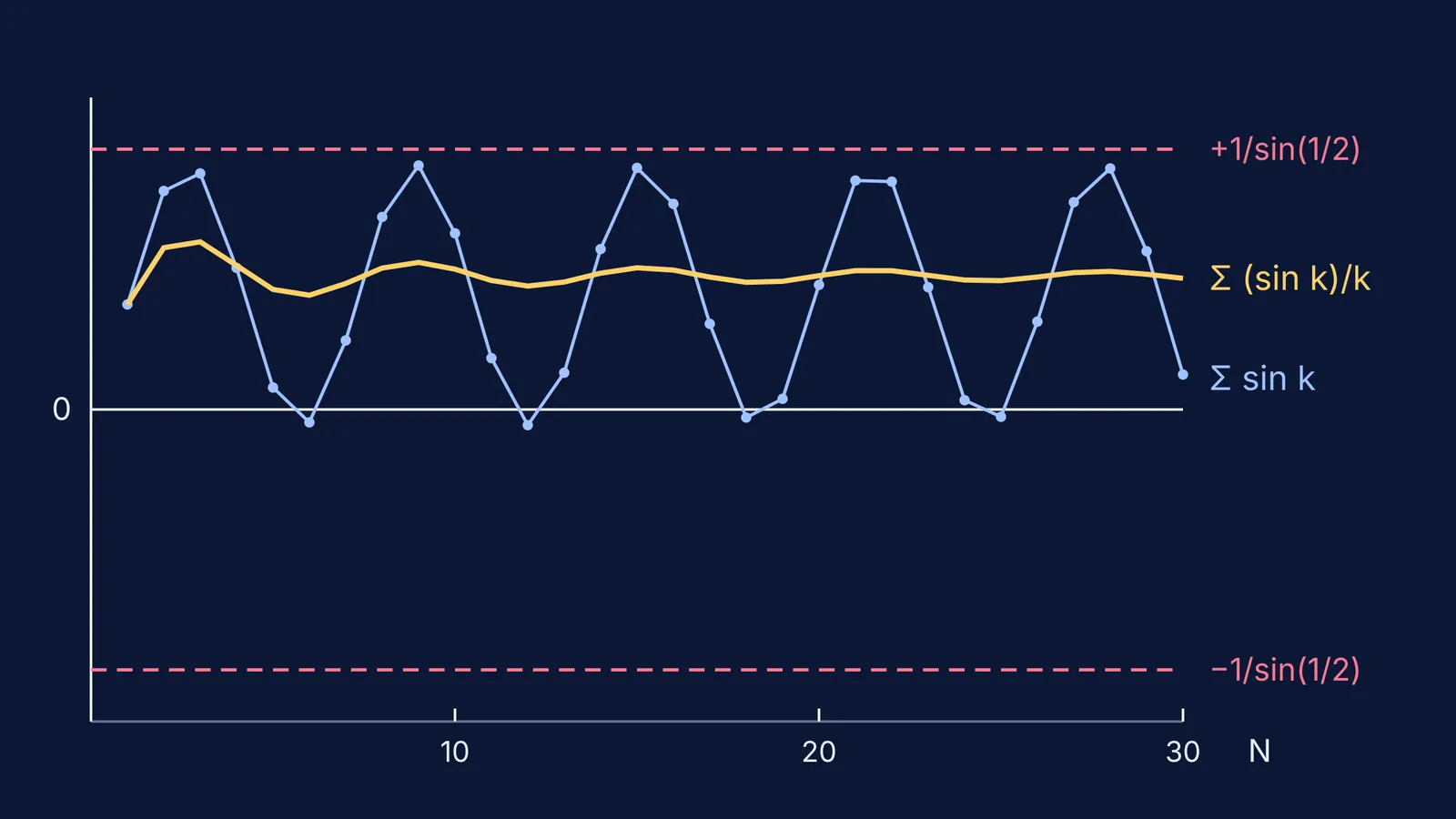
A quick check with x = 1, the case in the chart at the top of this post: the bound is 1/sin(0.5), about 2.09, and the closed form shows the partial sums of sin k never go below about −0.13 or above about 1.96.
How is the alternating series test a special case?
Take aₙ = (−1)ⁿ⁺¹. Its partial sums run 1, 0, 1, 0, …, so they are bounded by 1. Dirichlet's test then says Σ(−1)ⁿ⁺¹bₙ converges whenever bₙ decreases to 0, which is exactly the alternating series (Leibniz) test; the Wikipedia article names it as a particular case. So 1 − 1/2 + 1/3 − 1/4 + … converges.
A checklist before you use Dirichlet's test
Check absolute convergence first. If Σ|aₙbₙ| converges, you do not need Dirichlet.
Split each term into a cancelling factor and a shrinking factor.
Bound the partial sums of the cancelling factor with a constant that does not depend on n. Telescoping, a closed form or periodicity usually does it.
Show the shrinking factor is monotone and tends to 0. Being monotone from some point on is enough.
State the conclusion carefully: the series converges, which does not by itself say it converges absolutely.
If the telescoping step is where you get stuck, the Fermi Concept Library has a lesson for every concept in mathematics, each with its place in the map, so you can revisit sequences and series. To practise, the Fermi Problem Library has worked problems with a step-by-step solver that explains the reasoning rather than printing an answer.
Try Σ cos(nx)/√n next: the same trick, with 2 sin(x/2) cos(kx) = sin((k + ½)x) − sin((k − ½)x), bounds its partial sums whenever x is not a multiple of 2π.