On this page
The NCERT Class 11 Animal Kingdom chapter gives Pheretima (earthworm) and Hirudinaria (blood-sucking leech) as examples of Annelida and says both are monoecious. Both are segmented worms, so why does one have bristles and the other not? The answer also covers the leech's suckers and fixed segment count.
Why does a leech have no setae unlike an earthworm?
Setae are tiny bristles that give an earthworm grip. The Wikipedia entry on earthworms describes a ring of S-shaped setae on every segment except the first, the last and the clitellum. An earthworm crawls by peristalsis: circular and longitudinal muscles change the shape of each segment, and the shortened part is anchored to the soil by its setae while other parts move forward.
That grip matters. A 2011 modelling study in the Journal of the Royal Society Interface by Tanaka and colleagues found that adequate control of friction with the ground is indispensable for turning a peristaltic wave into directional movement. In an earthworm, setae are one way of controlling that friction.
Leeches went another way. In a review titled On the origin of leeches by evolution of development (Development, Growth & Differentiation, 2019), Dian-Han Kuo and Yi-Te Lai trace leeches to an ancestor resembling a freshwater oligochaete. They discuss four leech-specific traits: suckers, loss of chaetae (setae), loss of septa and a fixed number of segments, and suggest the body plan changes were likely driven by a change in the ancestor's feeding behaviour. A simple way to remember it: a leech grips with two suckers, not with bristles on every segment.
How does a leech move with two suckers?
Most leeches have a sucker at the front and one at the back, and use them to move by looping or inching along like a geometer moth caterpillar, as the Wikipedia entry on leeches describes. One loop goes like this:
The posterior sucker holds the ground.
The body stretches forward and the anterior sucker attaches.
The posterior sucker lets go and the body shortens, bringing the rear end forward towards the head.
The posterior sucker attaches again and the cycle repeats.
An earthworm anchors many segments at once; a leech grips at its two ends.
How many segments does a leech have?
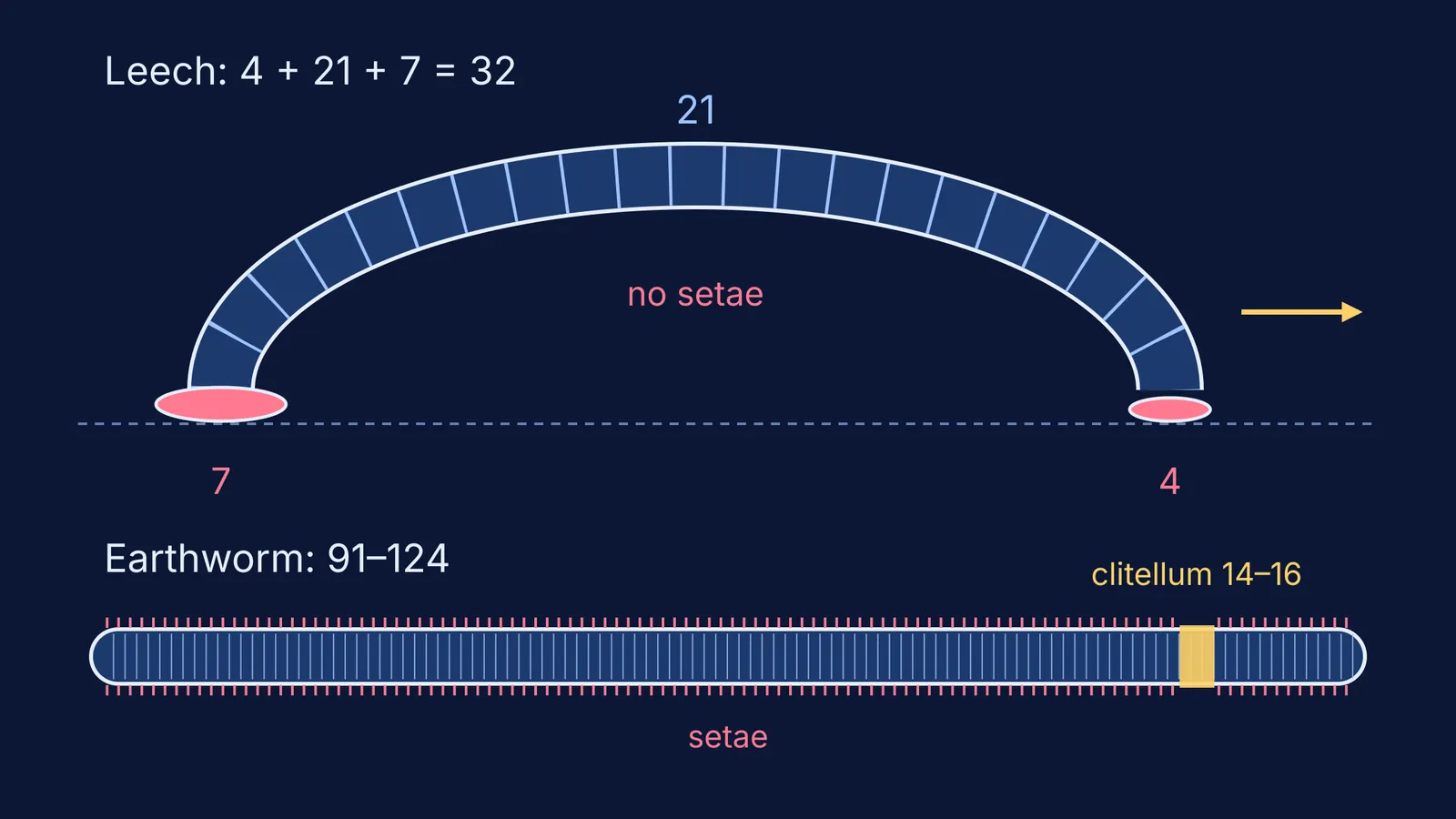
All leech species have 32 segments, according to the Wikipedia entry on leeches, which notes that the count is 34 if two head segments are included, so follow your textbook's convention. A 2021 BMC Genomics paper by Heath-Heckman, Weisblat and colleagues shows where the 32 sit: the nerve cord has 32 segmental ganglia, 4 fused in the head brain, 21 in the midbody and 7 fused in a tail brain that serves the posterior sucker. The many rings you see on a leech are annuli, which mask the true segments.
Earthworms do not share one number. A 2018 survey in the Records of the Zoological Survey of India describes Metaphire posthuma, the species long known as Pheretima posthuma, with 91 to 124 segments and the clitellum on segments 14 to 16. Kuo and Lai link the leech's fixed count to a change in its teloblast stem cells, which may also account for why leeches cannot regrow lost segments.
Do not overread the word fixed. A 1998 study of Lumbricus terrestris in the Journal of Experimental Biology found that segment number stayed constant as the earthworms grew from 0.01 to 8 g.
Hirudinaria vs Pheretima: what goes in your answer?
Each line reads feature: Pheretima, then Hirudinaria. Segment counts are from the Zoological Survey of India record and Wikipedia.
Setae: a ring on most segments; none
Suckers: none; anterior and posterior
Movement: peristalsis anchored by setae; looping between two suckers
Segments: 91 to 124 in Metaphire posthuma; 32 in every leech
Septa: present between segments; lost
Regrowing lost segments: possible in many earthworms, varying by species; not in leeches
Sexes: monoecious; monoecious
For the earthworm side in more detail, read our post on earthworm segments, setae and the clitellum. For the leech's feeding, see how hirudin stops blood clotting.
What does a model 3-mark answer look like?
Question: Why does a leech lack setae, unlike an earthworm?
Answer: An earthworm moves by peristalsis and uses setae on its segments to anchor the body to the soil. A leech has an anterior and a posterior sucker and moves by looping, attaching one sucker at a time, so it does not need segment-by-segment grip. Leeches evolved from oligochaete-like ancestors; a change in feeding behaviour likely went with suckers, loss of setae and septa, and a fixed number of segments.
For the bigger picture, our Annelida vs Arthropoda feature list compares the two phyla point by point. The Fermi Concept Library covers every concept in biology, each with its own lesson and its place in the map, so you can revise Annelida alongside related ideas.