On this page
An earthworm's body is a row of repeating units. Three features carry most of the questions: the segments, the setae and the clitellum. Here is what each does, the numbers worth knowing, and a five-minute drill.
How many segments does an earthworm have?
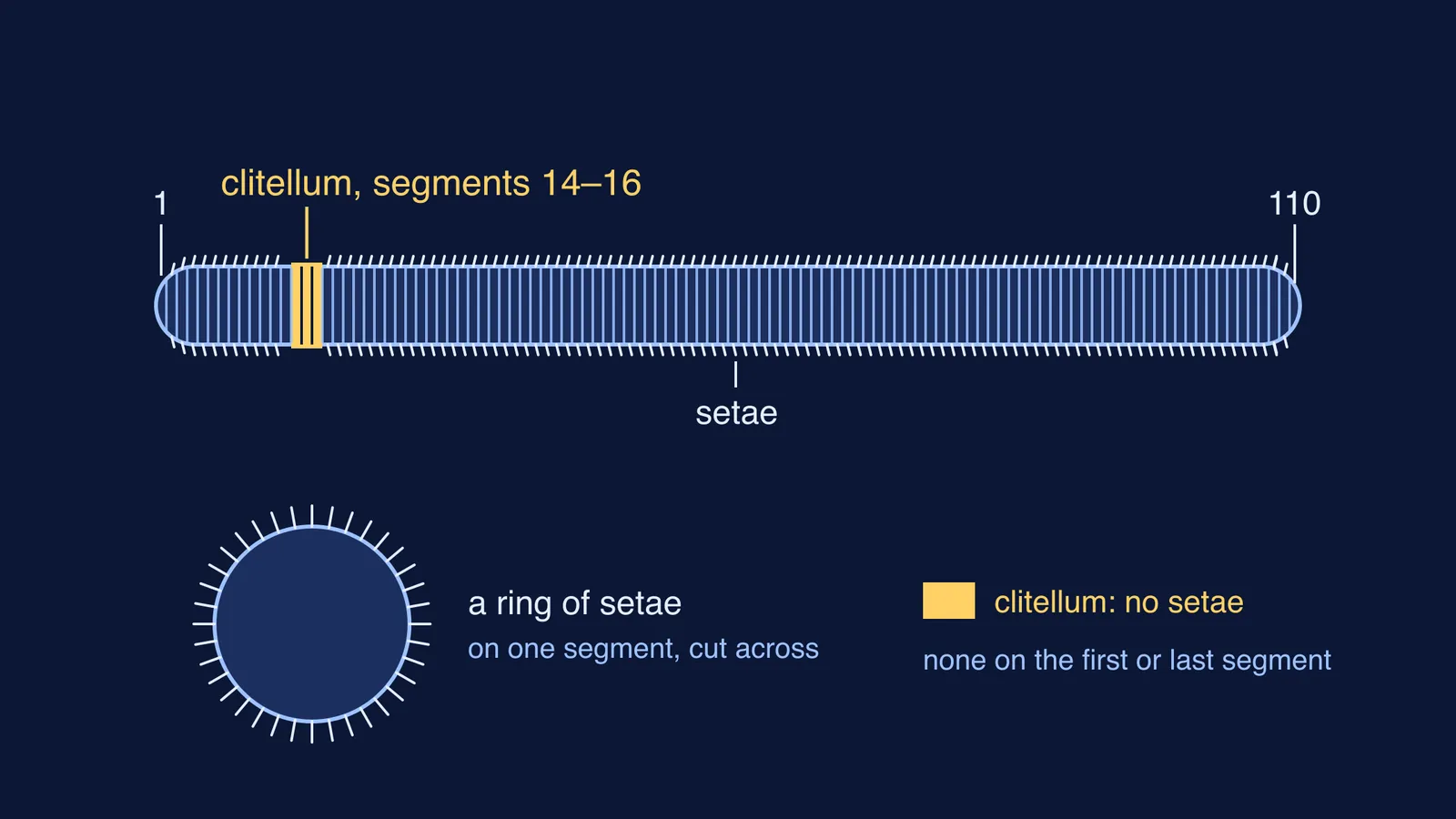
The body of Pheretima, the earthworm in Indian textbooks, is divided by circular furrows into 100 to 120 ring-like segments, or metameres, according to St Philomena College's zoology notes on Pheretima.
The rings are not just skin-deep. Inside, the body cavity of one segment is separated from the next by sheets called septa, as Richard Fox's Invertebrate Anatomy OnLine at Lander University describes.
Why build a body this way? Segments let the worm change shape one section at a time. In a 1999 study in the Journal of Experimental Biology, Kim Quillin measured the crawling of earthworms (Lumbricus terrestris) weighing from 0.012 g to 8.5 g. As the paper explains, a soft-bodied animal moves by changing the dimensions of its body segments themselves; the worms crawled faster mainly by taking longer strides (Quillin, 1999). To see how this compares with animals that have shells or wings, read our post on how earthworms, snails and birds move.
What are setae and what do they do?
Setae are tiny bristles that stick out of the body wall and give the worm grip. In Pheretima, every segment except the first, the last and the clitellar segments carries a ring of tiny, curved, S-shaped setae made of chitin, an arrangement called perichaetine (PW's notes on earthworm morphology).
The common European earthworm, Lumbricus terrestris, is set up differently: it has eight setae in four pairs on every segment except the first and the last (Grand Valley State University biology lab guide).
Each seta has protractor and retractor muscles, so the worm can push it out or pull it in, and setae act as anchors that hold parts of the worm in place while it burrows (Fox, Lander University). New Zealand's Science Learning Hub describes the sequence: the worm anchors the front of its body with its setae, then withdraws the front setae and anchors the back with its rear setae.
What is the function of the clitellum?
The clitellum is the glandular ring, or saddle, that mature earthworms have; having one means the worm is an adult and ready to mate and lay eggs (Science Learning Hub).
In Pheretima, the clitellum is a glandular band around segments 14, 15 and 16 (SATHEE, IIT Kanpur practice question). In Lumbricus terrestris, it covers segments 32 to 37 (GVSU lab guide).
Its job is the cocoon. The clitellum secretes a mucous cocoon into which eggs and albumen are released, and fertilisation happens inside it (Fox, Lander University). The cocoon then slides off the worm's body and is left in the soil (Science Learning Hub).
Where are the other reproductive openings in Pheretima?
According to PW's earthworm notes:
a single female genital pore sits in the mid-ventral line of segment 14, inside the clitellum
a pair of male genital pores sits on segment 18
four pairs of spermathecal pores sit in the grooves between segments 5/6, 6/7, 7/8 and 8/9
A quick way to hold this: everything reproductive is in the front fifth of the worm, and the clitellum is the landmark you count from.
A five-minute drill: draw it from memory
Use a blank sheet, no book. The positions come from PW's notes.
Draw a long tube and write 1 at the head end.
Count along and shade segments 14 to 16 as the clitellum.
Mark the female pore on 14, the male pores on 18, and the spermathecal pores in the grooves from 5/6 to 8/9.
Add setae to every segment except the first, the last and 14 to 16.
Beside each part, write its job in five words or fewer: segments, change shape section by section; setae, grip and anchor; clitellum, makes the cocoon.
Open this post and check. Every slip becomes a flashcard for tomorrow.
Three traps show up again and again:
Mixing up the two worms: 14 to 16 for Pheretima (SATHEE), 32 to 37 for Lumbricus (GVSU).
Saying setae are on every segment: in Pheretima the first, last and clitellar segments have none.
Mixing up ring and pairs: a ring of setae per segment in Pheretima, four pairs in Lumbricus.
If the words underneath the diagram, such as coelom or metamerism, are the real gap, the Fermi Concept Library covers every concept in physics, chemistry, biology, mathematics and computing, each with its own lesson and its place in the map. For more practice, the Fermi Problem Library has worked problems with a step-by-step solver that explains the reasoning rather than printing an answer.
Next, see how the earthworm compares with insects and crabs in Annelida vs Arthropoda, feature by feature, or try the earthworm choice chamber experiment on light and moisture.