

On this page
An earthworm and a cockroach are both segmented, both bilaterally symmetrical and both have a true body cavity. That shared ground is why exams pair the two phyla. The differences that matter sit in four places: the body covering, the limbs, the blood system and the excretory organs.
Everything below follows the NCERT Class 11 Biology chapter Animal Kingdom (sections 4.2.6 and 4.2.7), the chapter most CBSE and NEET-UG students revise from, with details added from two university-level references.
What is the difference between Annelida and Arthropoda?
NCERT describes both phyla as triploblastic, coelomate and bilaterally symmetrical, with organ-system level organisation, so none of those can be your answer to a "distinguish between" question (NCERT, Animal Kingdom). Use these rows instead, written annelid first, arthropod second:
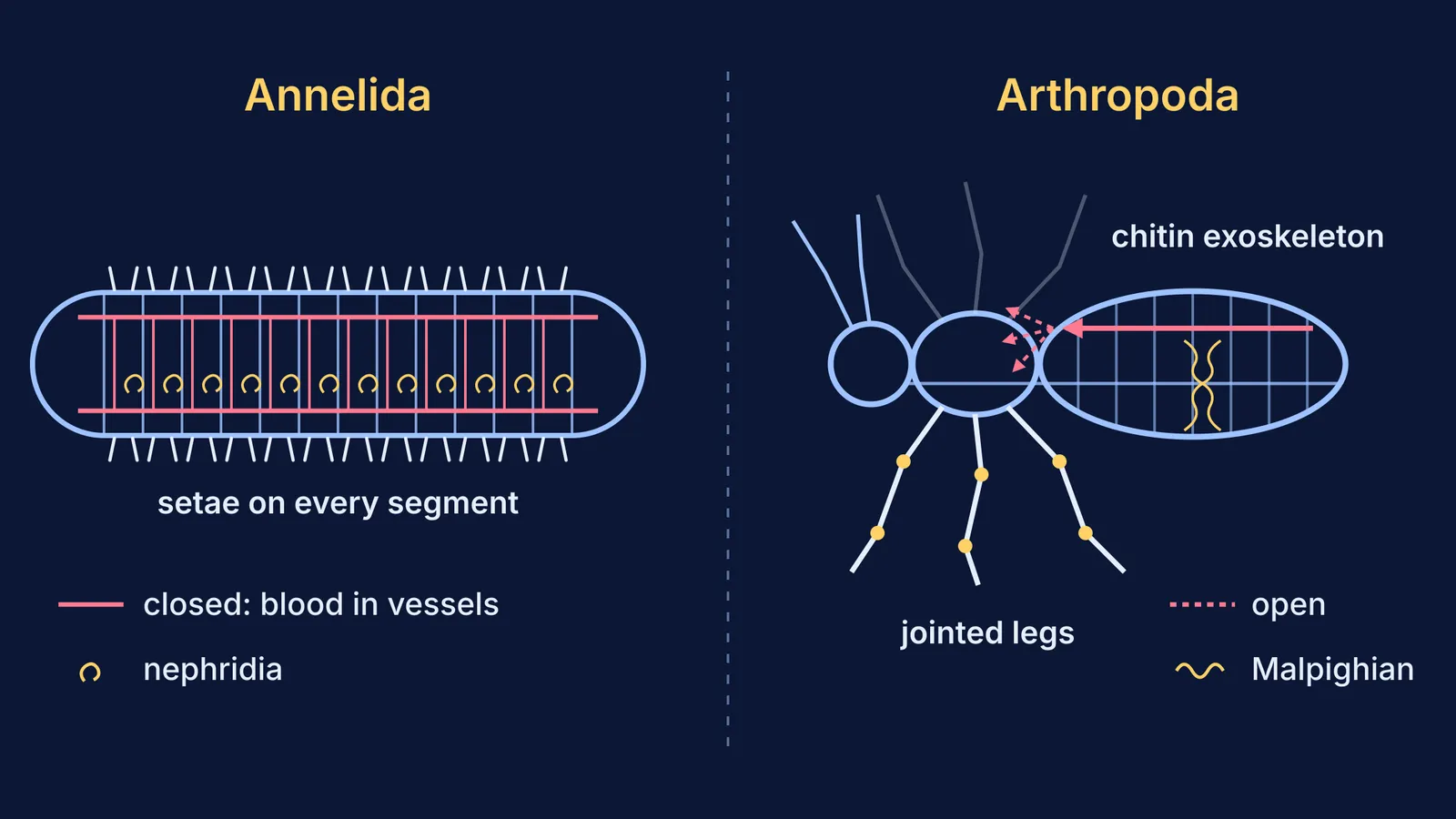
Body covering: annelids have a muscular body wall with longitudinal and circular muscles under a thin cuticle; arthropods are covered by a chitinous exoskeleton.
Segmentation: annelids are metamerically segmented into rings (Latin annulus, little ring); the arthropod body consists of head, thorax and abdomen.
Locomotion: annelid longitudinal and circular muscles help in locomotion, and aquatic forms like Nereis swim with lateral appendages called parapodia; arthropods have jointed appendages (arthros, joint; poda, appendages).
Circulation: closed in annelids; open in arthropods.
Excretion: nephridia in annelids, which also handle osmoregulation; Malpighian tubules in arthropods.
Respiration: annelids lack a well-developed respiratory system and exchange gases across the moist body surface (Biology LibreTexts); arthropods use gills, book gills, book lungs or a tracheal system.
Sexes: Nereis is dioecious, but earthworms and leeches are monoecious; arthropods are mostly dioecious.
Examples: Nereis, Pheretima (earthworm), Hirudinaria (leech); Apis, Bombyx, Laccifer, Anopheles, Culex, Aedes, Locusta, Limulus (king crab).
Size is a difference too. NCERT calls Arthropoda the largest phylum of Animalia, with over two-thirds of all named species on earth (NCERT). By contrast, approximately 16,500 species have been described in phylum Annelida (Biology LibreTexts, Phylum Annelida).
How are annelid setae different from arthropod jointed legs?
Setae are not limbs. In an annelid, each segment is limited by a membranous septum that divides the coelom into a series of compartments, and chitinous, hair-like extensions called setae (or chaetae) are anchored in the epidermis, project from the cuticle and are present in every segment (Biology LibreTexts).
An arthropod's limbs are different in kind. Its exoskeleton is made mainly of chitin, a polysaccharide, in a protein matrix, and each body segment primitively bears a pair of jointed appendages (Animal Diversity Web, Arthropoda). Arthropods generally grow by moulting the exoskeleton, a process called ecdysis (same source).
How do circulation and excretion differ in annelids and arthropods?
In annelids, blood stays inside vessels: dorsal and ventral vessels run parallel to the gut, with loops in each segment and capillaries serving the tissues (Biology LibreTexts). In arthropods, the circulatory system is open and consists of a heart, arteries and the open spaces of the haemocoel (Animal Diversity Web). For the insect side, see why insect blood is colourless and how tracheae carry oxygen.
Excretion mirrors the body plan. Annelid nephridia (metanephridia) come as a pair in every segment, each a convoluted tubule with an open, ciliated funnel (Biology LibreTexts). Arthropods instead use Malpighian tubules (NCERT). For the cockroach counts that NCERT questions ask about, see cockroach organ numbers in NCERT.
How do you classify an unknown animal in an exam?
When a question names or shows an animal, ask three questions in order:
Is the body soft, with no hard outer covering? If yes, think Annelida; if it has a hard jointed covering, think Arthropoda.
Does it have jointed legs or antennae? Jointed appendages settle it as Arthropoda.
Which excretory or blood system is named? Nephridia or a closed system point to Annelida; Malpighian tubules or an open system point to Arthropoda.
Worked example: "Hirudinaria has a segmented body. To which phylum does it belong, and why is segmentation not enough to decide?" Answer: Annelida. NCERT lists the blood-sucking leech under Annelida; it has no jointed appendages and, like the earthworm, it is monoecious. Segmentation alone cannot decide because both phyla are segmented. One trap: NCERT mentions parapodia only for aquatic forms like Nereis, so do not write parapodia as a universal annelid feature.
A second worked example: Limulus, the king crab, is listed by NCERT as a living fossil, and the word "crab" plus that label can make students hesitate. NCERT places it under Arthropoda, and its jointed appendages and exoskeleton fit that phylum.
How should you revise this comparison?
Cover the arthropod half of the list above and write it from memory, then swap. The same method works for the next phylum on your list, as in the three fundamental features of chordates. Then draw both body plans once, labelling setae, nephridia, the dorsal vessel, jointed legs and Malpighian tubules.
If a term such as coelom, metamerism or haemocoel still feels shaky, the Fermi Concept Library has every concept in biology with its own lesson and its place in the map, so you can fix the gap before the comparison questions.


