

On this page
Leeches have long fascinated and repelled us with their ability to feed on blood. For biology students, particularly those preparing for exams like NEET-UG, the leech is more than just a parasite. It is a classic example of an annelid and a masterclass in biochemistry, thanks to its potent anticoagulant, hirudin.
Where do leeches sit among the annelids?
In the animal kingdom, leeches belong to the phylum Annelida, the same group that includes the earthworm (Wikipedia). However, they are placed in their own subclass, Hirudinea.
Unlike earthworms, leeches have evolved highly specialised bodies for their parasitic or predatory lifestyles. They feature suckers at both ends. The anterior (front) sucker surrounds the mouth and is used for feeding, while the posterior (rear) sucker is used for attachment and movement. Their segmented bodies, consisting of precisely 32 segments, can stretch and contract as they loop along surfaces, searching for a host (Wikipedia).
Internally, their anatomy is also adapted to their unique needs. Their internal body cavity, known as the coelom, is reduced to small channels rather than the spacious compartments seen in other annelids.
When studying animal classification, mapping out these features helps you remember why a leech is grouped with earthworms despite looking so different. The Fermi Concept Library maps every concept in biology, letting you trace the evolutionary steps from simple worms to complex parasites.
How does hirudin stop blood from clotting?
When a medicinal leech (*Hirudo medicinalis*) bites, it needs the host's blood to keep flowing. To ensure this, it secretes hirudin from its salivary glands directly into the wound.
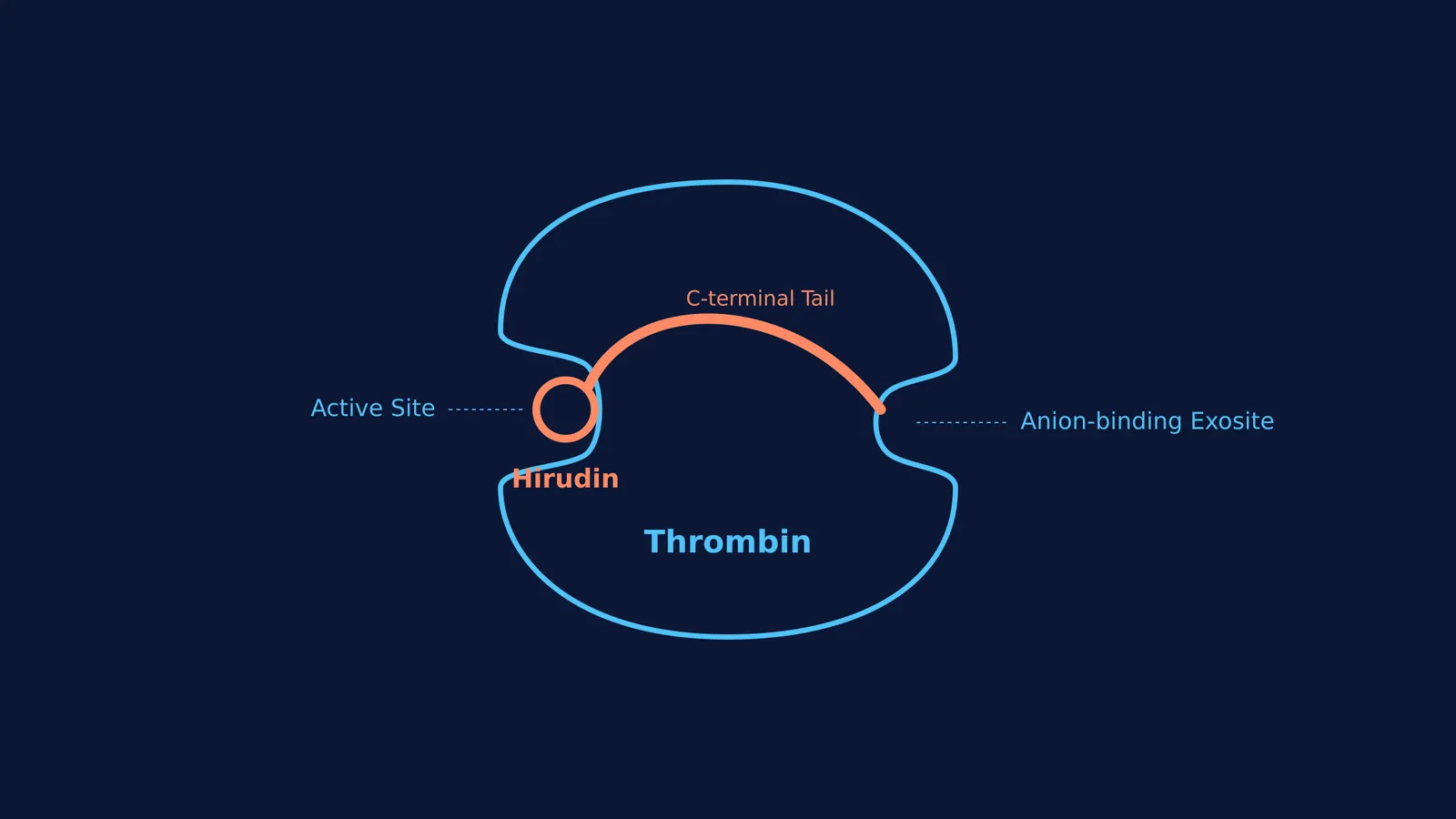
Hirudin is a small peptide made of exactly 65 amino acids (Wikipedia). It acts as a powerful anticoagulant by targeting a specific step in the blood clotting cascade. When a blood vessel breaks, the body normally triggers a series of reactions that activate the enzyme thrombin. Thrombin's job is to convert soluble fibrinogen into tough, stringy fibrin, which forms the structural web of a clot.
According to a key study on its mechanism, hirudin binds directly to the active site and an adjacent region on the thrombin molecule (Fenton et al., 1991). By capping the enzyme, hirudin completely neutralises it. It features a compact N-terminal domain that locks onto the target and a disordered C-terminal domain that interacts further with thrombin. With thrombin blocked, fibrinogen cannot turn into fibrin, and the blood cannot clot.
This direct, one-to-one blocking is a textbook example of enzyme inhibition, a frequent topic in enzymes for NEET biology.
How is hirudin used in modern medicine?
While the practice of using live leeches was common for centuries, modern medicine has found far more precise applications for their unique biochemistry. Today, medicinal leeches are sometimes used in microsurgery. When surgeons reattach a severed finger or toe, they may apply leeches to the site. The leeches remove pooling venous blood, while the hirudin they secrete prevents clots from blocking the delicate repaired vessels, giving new capillaries time to grow and restore natural circulation (Wikipedia).
Furthermore, scientists have analysed the exact structure of hirudin to create synthetic versions. Because milking live leeches for large quantities of the peptide is impractical, pharmaceutical companies now use recombinant biotechnology to produce it. These laboratory-made versions, such as lepirudin, are used as targeted direct thrombin inhibitors in patients who cannot tolerate other anticoagulants like heparin (Wikipedia).
A study plan for animal classification?
Memorising the animal phyla can feel overwhelming. Instead of just reading lists, try this active recall framework for each phylum:
Name a representative animal: (e.g. *Hirudo medicinalis* for Annelida).
List two defining features: (e.g. segmented body, suckers at both ends).
Identify a unique adaptation: (e.g. secretes hirudin to stop clotting).
If you are unsure how to connect these facts, Fermi's AI tutor can work out what you already know and build a plan for the session, teaching you the animal kingdom step by step.


