On this page
Zorn's lemma is how mathematicians prove that something as large as possible exists when they cannot build it step by step.
What are a partial order, a chain and an upper bound?
A partially ordered set (poset) is a set P with a relation ≤ that is reflexive, antisymmetric and transitive; some pairs may not be comparable. Sets under inclusion are typical: {1} and {2} both sit inside {1, 2}, but neither sits inside the other.
These definitions follow the Stanford Encyclopedia of Philosophy entry on the axiom of choice:
A chain is a subset of P in which any two elements are comparable.
An upper bound for a subset X of P is an element a of P with x ≤ a for every x in X. It must lie in P, not necessarily in X.
A maximal element has nothing in P strictly above it.
What does Zorn's lemma say?
The Stanford Encyclopedia states it as "Every nonempty inductive partially ordered set has a maximal element", where inductive means every chain has an upper bound (SEP, section 3). Kazimierz Kuratowski worked with similar maximal principles in 1922, and Max Zorn published his version in 1935 as A remark on method in transfinite algebra.
Many textbooks drop the word nonempty and instead require every chain, including the empty chain, to have an upper bound. The versions agree: any element of P bounds the empty chain, so such a bound exists exactly when P is not empty.
How does Zorn's lemma prove every vector space has a basis?
The theorem goes back to Georg Hamel in 1905 (SEP, section 4). Adding vectors one at a time works in finite dimensions but never finishes for the reals over the rationals.
Let P be the set of linearly independent subsets of a vector space V, ordered by inclusion.
P is not empty: ∅ is linearly independent.
For a chain C in P, let U be the union of its sets (∅ if C is empty). Every set in C lies inside U.
U is independent. A linear relation uses finitely many vectors of U; each comes from a set in C, and since C is a chain, one of those sets contains the rest. That set is independent, so the relation is trivial.
So every chain has an upper bound in P, and Zorn's lemma gives a maximal element B.
B spans V: if v were outside its span, B with v added would be a larger independent set. An independent spanning set is a basis.
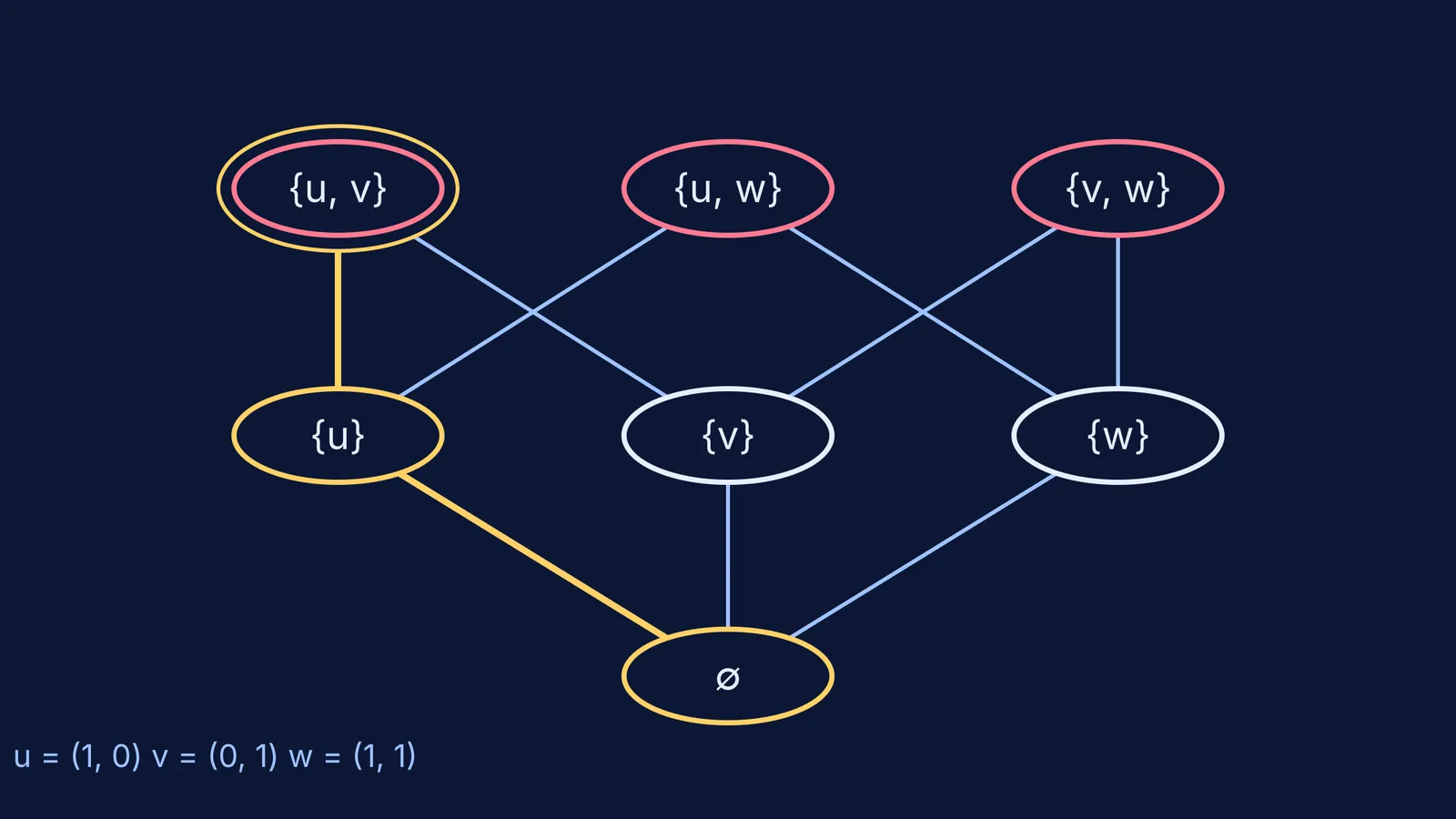
A check in R², drawn above: take u = (1, 0), v = (0, 1), w = (1, 1). The independent subsets of {u, v, w} are ∅, three singletons and three pairs; all three vectors together are dependent. The chain ∅ ⊂ {u} ⊂ {u, v} ends at a maximal element, which is a basis. So are {u, w} and {v, w}: three maximal elements, no largest.
Why is Zorn's lemma equivalent to the axiom of choice?
The axiom of choice says that from any collection of non-empty sets you can choose one element from each; Ernst Zermelo formulated it in 1904 (SEP, section 1). The same entry states that Zorn's lemma and choice are set-theoretically equivalent, and that deriving Zorn from choice is the harder direction.
The easier direction: given non-empty sets A_i, order the partial choice functions by extension. The empty function is one, a union of a chain is one, and a maximal one misses no index, or you could extend it.
The basis theorem is just as strong: Andreas Blass proved in 1984 that the existence of bases implies the axiom of choice. Choice is independent of the other axioms of set theory: Kurt Gödel showed it consistent relative to them, and Paul Cohen proved in 1963 that they cannot derive it (SEP, section 1). It also has strange consequences, such as the Banach–Tarski paradox, where one ball becomes two.
What is the most common mistake with Zorn's lemma?
Checking only non-empty chains and forgetting that P itself must be non-empty. Suppose you define P as the non-empty independent subsets of V, to avoid thinking about ∅. If V is the zero space {0}, P is empty, because {0} is dependent. Every non-empty chain in P is bounded, since there are none, yet P has no maximal element. The fix is to keep ∅ in P: the zero space has the empty basis.
Before you write "by Zorn's lemma", check:
P has a concrete element: often ∅, the empty function, or your starting object.
The upper bound of a chain (usually the union) lies in P, not just above the chain.
A maximal element has the property you want, usually because otherwise you could extend it.
If linear independence and spanning still feel shaky, the Fermi Concept Library gives every concept in mathematics its own lesson and its place in the map. For practice, the Fermi Problem Library has a step-by-step solver that explains the reasoning.
For another existence theorem worked in a small case, read our Hahn–Banach theorem explained with a worked example.