On this page
The Hahn–Banach theorem says a measuring rule built on part of a space stretches to the whole space without getting stronger. Below: the statement, a worked example in R², the picture, and the proof idea.
What does the Hahn–Banach theorem say?
A normed space is a vector space with a length ‖x‖ for every vector. A linear functional f turns vectors into numbers and respects addition and scaling (refresher: the dual space worked in ℝ³). It is bounded when |f(x)| ≤ C‖x‖ for some constant C, and its norm ‖f‖ is the smallest such C.
The norm-preserving form (Hahn–Banach theorem, Wikipedia) reads: every continuous linear functional f on a subspace M of a real or complex normed space X has a continuous linear extension F to all of X with ‖F‖ = ‖f‖.
A more general form replaces the norm with any sublinear function p: if f ≤ p on M, some linear extension F has F ≤ p everywhere. Hahn and Banach proved the theorem independently in the late 1920s; Eduard Helly had proved a special case, for continuous functions on an interval, in 1912. Hahn's paper appeared in 1927 in the Journal für die reine und angewandte Mathematik (Hahn's paper); Banach, unaware of it, generalised the result to sublinear functions in 1929.
How does the Hahn–Banach theorem work in R², step by step?
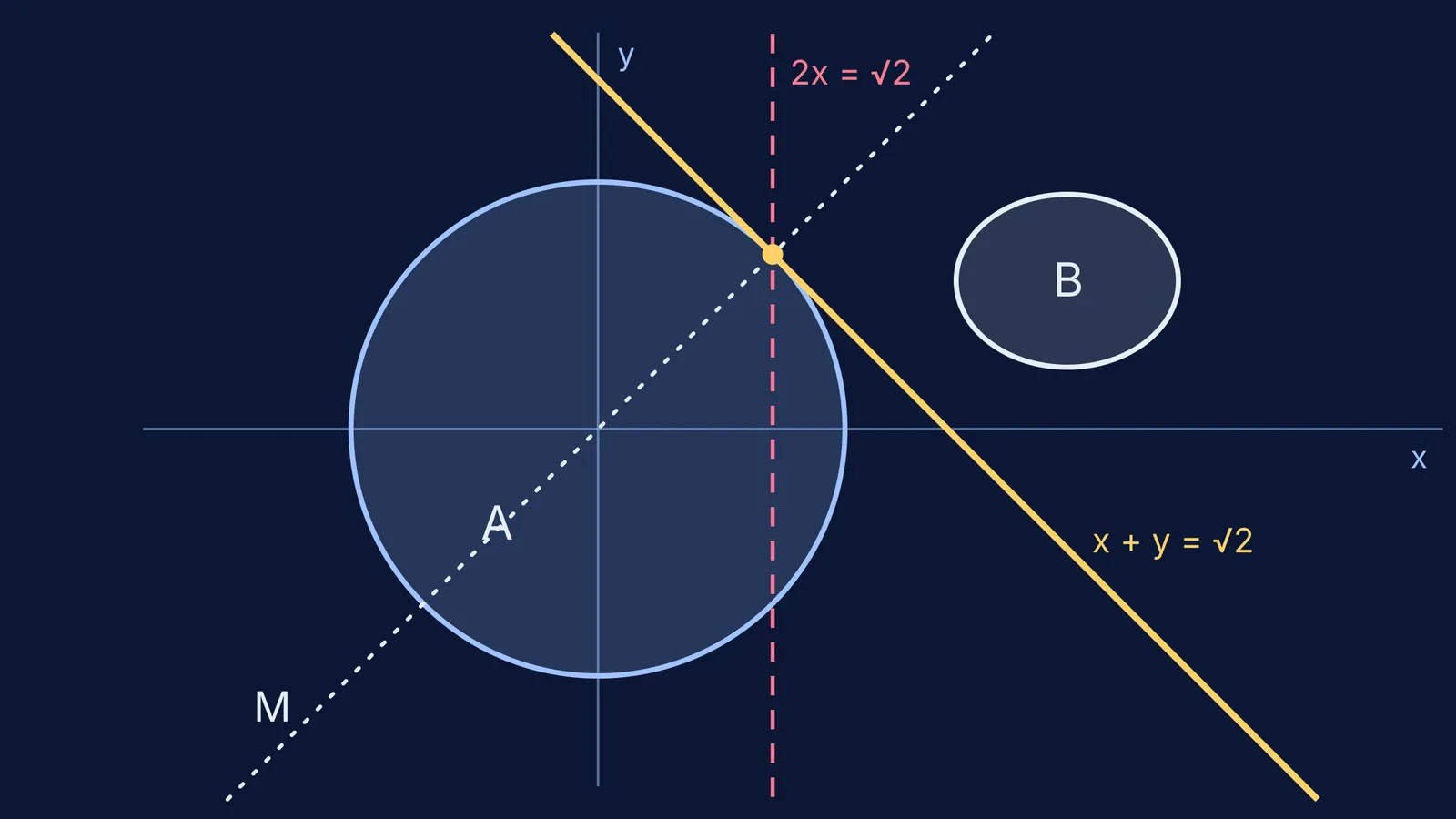
Take X = R² with the usual length ‖(x, y)‖ = √(x² + y²), and let M be the line of points (t, t) through the origin. On M define f(t, t) = 2t.
Find the norm of f. A point (t, t) has length √2·|t|, and |f(t, t)| = 2|t|, so ‖f‖ = 2/√2 = √2.
List every extension. Any linear F on R² is F(x, y) = ax + by; agreeing with f on M means a + b = 2.
Find each extension's norm. By the Cauchy–Schwarz inequality, the norm of ax + by is √(a² + b²).
Minimise. Subject to a + b = 2, √(a² + b²) is smallest at a = b = 1, where it equals √2. So F(x, y) = x + y keeps the norm.
Compare a careless choice. F(x, y) = 2x also agrees with f on M, but its norm is 2. Extending is easy; extending without increasing the norm is the real content.
What is the geometric version of Hahn–Banach?
In geometric form it is called the Hahn–Banach separation theorem, or hyperplane separation theorem (separation theorem, Wikipedia). In a real normed space, if A and B are non-empty, disjoint convex sets and A is open, a closed hyperplane separates them: there is a continuous linear F and a number c with F(a) < c ≤ F(b) for every a in A and every b in B. In R² a hyperplane is a line.
The worked example draws this. On the open unit disc, x + y is always less than √2, and the line x + y = √2 touches the disc's edge only at (1/√2, 1/√2), so it separates the disc from any convex set lying where x + y ≥ √2. The careless extension's level line 2x = √2 passes through the same point but cuts through the disc: that is what a larger norm looks like. More on plane convex sets: Helly's theorem for convex sets.
Why does Hahn–Banach need Zorn's lemma?
The proof starts with a one-step move: if F is defined on a subspace and you add one new direction, you can choose F's value there so the bound still holds. In finite dimensions, finitely many steps finish the job.
An infinite-dimensional space may need infinitely many new directions with no natural order. Zorn's lemma handles this: a non-empty partially ordered set in which every chain has an upper bound has a maximal element (statement of Zorn's lemma). Apply it to all partial extensions, ordered by "extends": a maximal one must be defined everywhere, or the one-step move would extend it further. Max Zorn published the lemma in 1935 (Zorn's paper); Kazimierz Kuratowski had proved it in 1922.
Zorn's lemma is equivalent to the axiom of choice, but Hahn–Banach needs less: the strictly weaker ultrafilter lemma is enough (Hahn–Banach proof notes).
How should you study the Hahn–Banach theorem?
Redo the R² example with M as the x-axis and f(t, 0) = 3t. Check that F(x, y) = 3x is the only norm-preserving extension for the Euclidean length.
Draw the unit disc and each extension's line F = √2 (the norm of f): it only touches the disc for a norm-preserving extension, and cuts it otherwise.
Write the one-step extension argument in your own words before reading the Zorn's lemma part.
If a definition here (sublinear function, dual norm, convex set) feels shaky, the Fermi Concept Library covers every concept in physics, chemistry, biology, mathematics and computing, so you can patch the gap first.