On this page
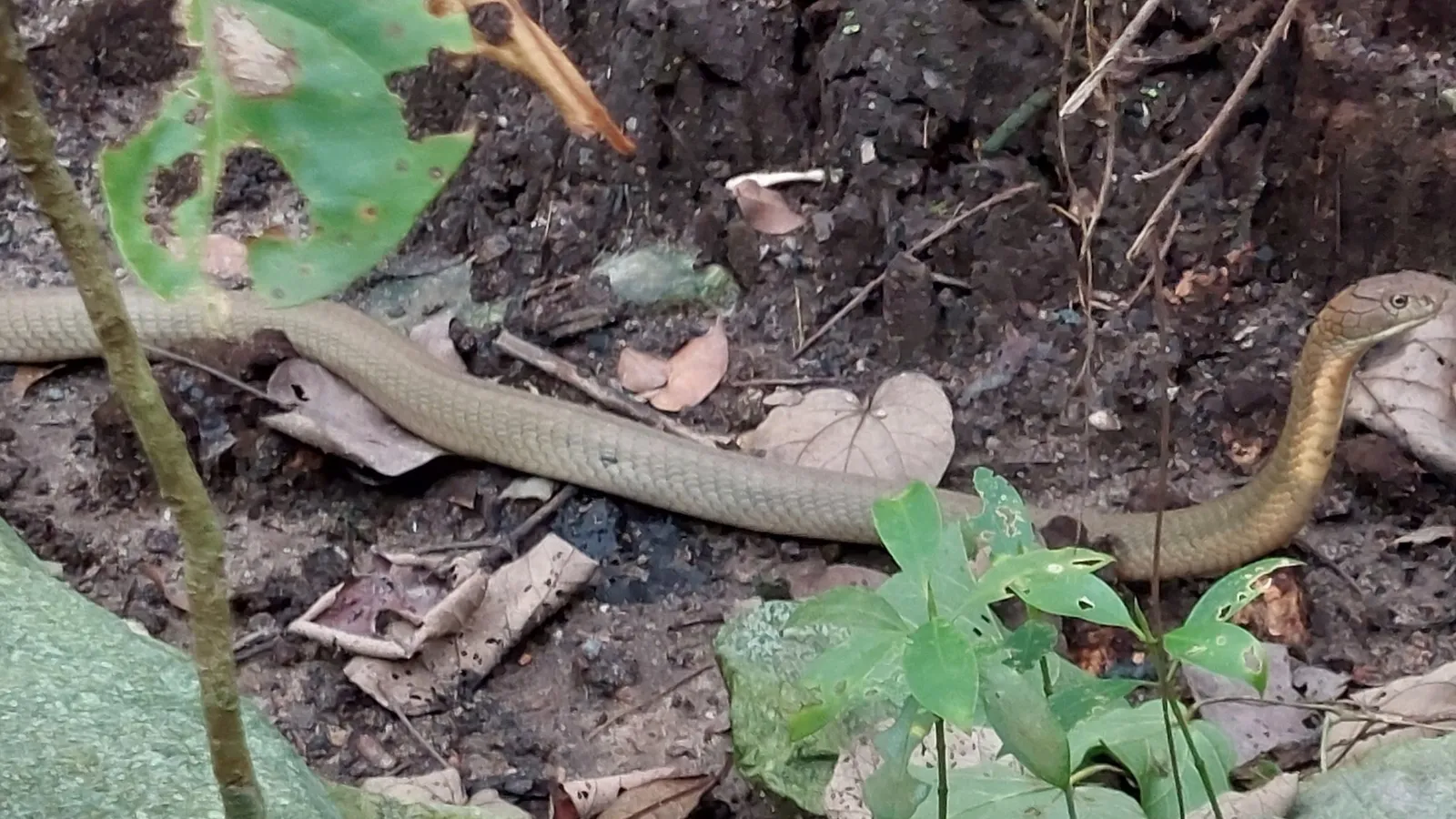
Yes, the king cobra builds a nest, and it is the only snake known to do it. A 2022 paper from Mizoram University describes it as "the only snake species where females actively construct a nest from leaf litter or other plant material" (Biakzuala et al., Herpetological Bulletin, 2022). The reasons behind it teach you more than the fact itself.
How does a king cobra build its nest?
The female gathers leaves into a mound, lays her eggs inside and stays with them. From 2017 to 2021, the Mizoram team recorded 18 new nesting sites (Biakzuala et al., 2022). The paper reports:
Material: most nests were made of bamboo leaves. Nests in Champhai District used pine and oak leaves.
Season: nests have been seen between April and July.
Clutch: reported clutches range from 14 to 53 eggs.
Guarding: females sometimes rest in the nest's upper chamber or coil on top of it. They leave once the young hatch.
Conditions inside: the team moved 13 threatened nests to an enclosure on their campus. Inside those mounds, the temperature stayed between 26 and 30 °C and humidity between 80 and 90% during incubation, from June to August.
A 2025 study from Yunnan, China, reported three cases of nesting and "confirmed multi-individual participation in nest guarding". The authors linked this to an exceptionally large clutch (Wang et al., Integrative Conservation, 2025).
Why does a king cobra guard its eggs?
A clutch sitting on the forest floor for weeks is an easy meal for predators. A large, venomous parent close by changes that. The Mizoram readings suggest the leaf mound also keeps the eggs warm and damp, although they come from relocated nests with no comparison group. The paper doesn't measure how many more eggs survive because of the nest, so treat this as the likely reason, not a proven one.
Pythons show what egg care costs a parent. In a study of 48 captive female ball pythons collected in south Togo, brooding mothers stayed coiled around their eggs for about two months and refused to feed (Aubret et al., Animal Behaviour, 2005). They lost less than 6% of their body mass, and brooding substantially improved hatching success. The same paper notes that pythons are the only cold-blooded animals known to warm their eggs by shivering.
Why does the king cobra eat other snakes?
Its genus name, *Ophiophagus*, means "snake eating", and the species is often considered a snake specialist (Bontrager et al., Ecology and Evolution, 2025). Researchers at Agumbe in Karnataka began radio-tracking king cobras in 2008, the first time radio telemetry was tried on snakes in India (Mongabay India, 2021).
The Agumbe team's report gives some useful numbers (Agumbe Rainforest Research Station, 2009 to 2010 report):
In captivity, adult males eat an average of two to three adult rat snakes a month. The team puts that at roughly 30,000 g of prey a year.
Indian rat snakes and spectacled cobras are confirmed prey in the study area. Both are common near farms and villages, probably because rats are common there.
In the monsoon, when those snakes were harder to find, one tracked male was seen eating 26 pit vipers in 135 days.
The team also saw king cobras eating other king cobras, including a male that killed and swallowed a female.
Long, thin prey suits a hunter that swallows whole (see how snakes swallow prey bigger than their heads). But the diet is not only snakes. A 2020 study in Thailand found that monitor lizards make up a significant part of it there (Jones et al., Ecology, 2020). To see how the venom gets delivered, read how snake fangs and venom types differ.
What does this tell us about parental care in reptiles?
The vast majority of animal groups give their young no care at all, probably because care is costly for the parent (Aubret et al., 2005). Reptiles can lay their eggs and leave because the shelled egg carries its own water and food (see the amniotic egg explained). Care appears where the benefit to the young outweighs the cost to the parent. Even then it can be short: the king cobra's care ends when the eggs hatch.
How can you check any "only animal that" fact?
Ask three questions:
What exactly is unique? For the king cobra, it is building the nest, not guarding the eggs.
What does it cost the parent? The ball python mothers went about two months without food (Aubret et al., 2005).
What does it buy the young? Steady warmth and moisture, protection from predators, and better hatching success in pythons.
Answer all three and an assertion-reason question becomes easy. If oviparous, amniote and ophiophagy blur together, the Fermi Concept Library gives every biology concept its own lesson and its place in the map.
In an exam, write "king cobra" and add the reason: a leaf mound and a guarding mother keep the eggs warm, damp and safe.