

On this page
A hen's egg and a frog's spawn in a monsoon puddle are both eggs, yet biologists put them in different groups. The difference is not just the shell you can see. It is a set of thin membranes that form around the developing embryo and give it its own private pond. Understand those membranes and a whole family of exam classification questions gets much easier.
What is an amniotic egg?
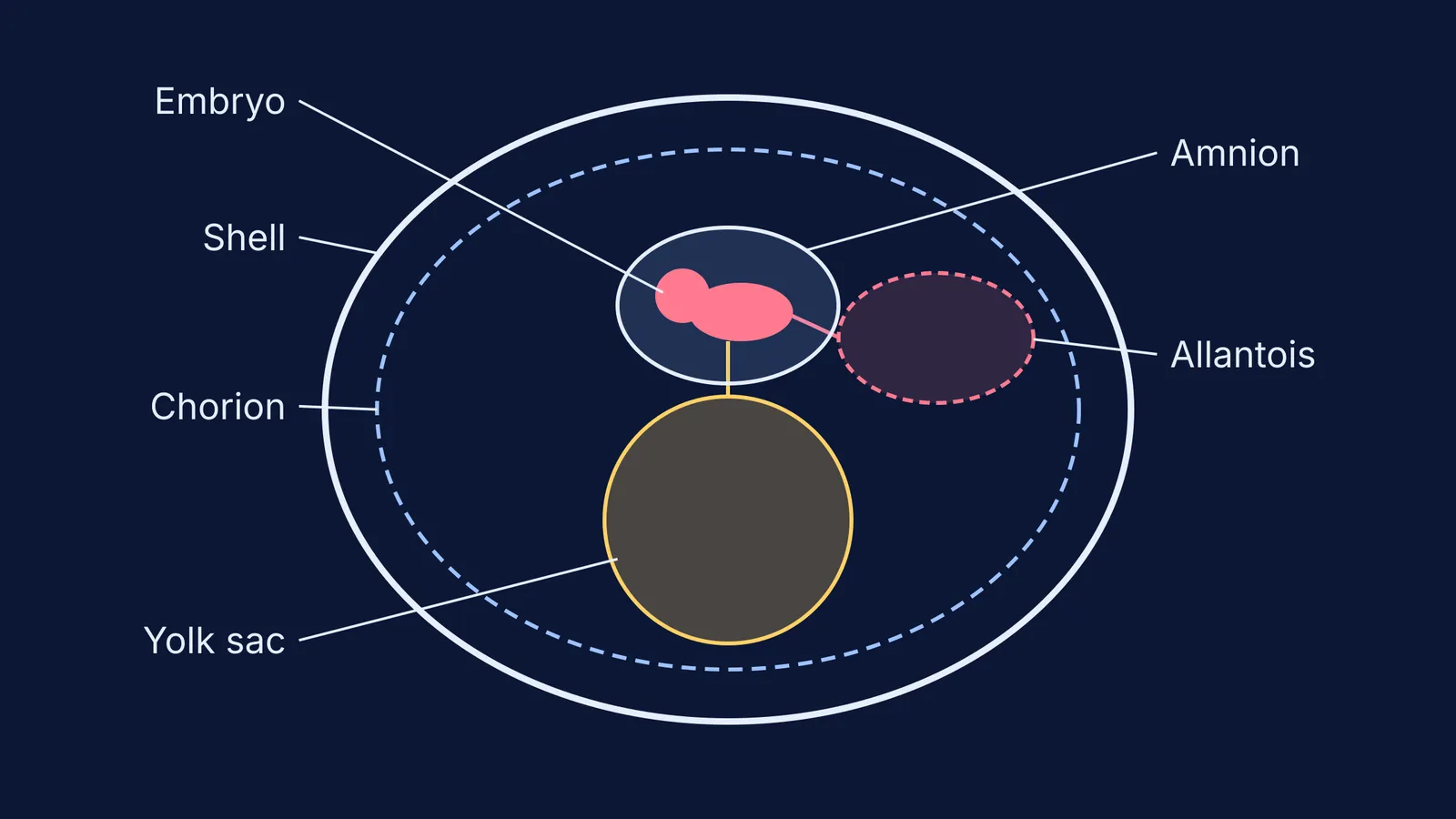
An amniotic egg is an egg in which the embryo develops inside four extraembryonic membranes: the amnion, chorion, allantois and yolk sac (OpenStax Biology 2e, Reptiles). Animals whose embryos develop this way are called amniotes: reptiles, birds (which biologists count as reptiles) and mammals.
The same OpenStax chapter dates the first amniotes to about 340 million years ago, in the Carboniferous period, when they evolved from four-limbed (tetrapod) ancestors.
What do the amnion, chorion, allantois and shell do?
The wording below follows OpenStax Biology 2e:
Amnion: protects the embryo from mechanical shock and keeps it hydrated.
Chorion: lets oxygen and carbon dioxide pass between the embryo and the world outside the egg.
Allantois: stores the embryo's nitrogen-containing wastes and also helps with respiration.
Yolk sac: its blood vessels carry nutrients from the yolk into the embryo's circulation.
Shell: holds water and nutrients in. Bird eggshells are hardened with calcium carbonate, so they are rigid but fragile; most other reptiles, such as turtles, lay leathery eggs that need a moist place.
If you want a labelled walk-through of the membranes on their own, our post on the functions of the amnion, chorion, yolk sac and allantois goes membrane by membrane.
Why could reptiles and birds lay eggs on land?
On dry land an embryo needs water, oxygen and a safe place for waste. The shell and amnion stop the embryo from drying out. The shell lets gases through, and the chorion handles the exchange of oxygen and carbon dioxide. The allantois stores nitrogen-containing waste away from the growing body. OpenStax puts it simply: these membranes led to less dependence on water for development and let amniotes branch out into drier environments (OpenStax Biology 2e).
Scientists still debate how this happened. A 2023 study in Nature Ecology and Evolution by Baoyu Jiang, Michael Benton and colleagues analysed 80 living and extinct species and concluded that the first amniote probably kept its embryos inside the mother's body for an extended time, possibly including giving birth to live young (Jiang et al., 2023). So whether the membranes first evolved for eggs laid on land is still an open question. For your exam, the textbook answer stands: the membranes are what freed reptiles and birds from laying eggs in water.
Why are amphibians and fish not amniotes?
Frogs, toads, salamanders and fish lay eggs, but their eggs have no amnion, chorion or allantois. Their eggs are shell-less, usually wrapped in jelly, and must be laid in water or very damp places. OpenStax notes that amphibians are still restricted to moist environments because of their shell-less eggs (OpenStax Biology 2e).
The test is the membranes, not egg-laying. Humans never lay eggs, but every human embryo grows inside an amnion, and in mammals the placenta is derived from the chorion and allantois. So mammals are amniotes too. The platypus and echidna, mammals that do lay eggs, fit the same rule; see why egg-laying mammals are still mammals.
How do you spot an amniote in an exam question?
Use this three-step check on any animal an exam question names:
Ask: does the embryo grow inside an amnion? If yes, it is an amniote. Reptiles, birds and mammals all pass.
Ignore "lays eggs". Fish and amphibians lay eggs but have no amnion, so they fail.
Ignore "no shell". Humans, bats and whales have no eggshell but still have an amnion, so they pass.
Worked example. Which of these is not an amniote: crocodile, pigeon, salamander, bat?
Crocodile: a reptile with shelled eggs and an amnion. Amniote.
Pigeon: a bird with a calcium carbonate shell and full membranes. Amniote.
Bat: a mammal whose embryo grows in an amnion inside the mother. Amniote.
Salamander: an amphibian whose jelly-coated eggs need water. Not an amniote.
The bat is the usual trap, because students link "amniotic" with "egg"; step 3 removes it. For the wider picture of reptile traits such as dry scales and the crocodile heart, read our guide to the features of reptiles.
If the topic exposes gaps elsewhere, such as chordate classes or the placenta, the Fermi Concept Library gives every biology concept its own lesson and its place in the map. To practise, the Fermi Problem Library has worked problems with a step-by-step solver that explains the reasoning rather than printing an answer.
Next time you crack a hen's egg, remember that a fertilised one, kept warm, would build all four membranes inside that shell.


